Topic: Stalin

132 chapters across the catalog

McInnes and Jones discuss the logistics of a national divorce, suggesting that blue states like California and New York should be isolated to prevent them from "funding" their own destruction. They reference Milton Friedman's "I, Pencil" essay to illustrate the superiority of the free market over state-controlled economies. Jones compares modern Democratic policies to Stalin's Holodomor, where the state decides who eats.
Viktor Bout argues that Western sanctions have actually benefited the Russian economy by forcing it to decouple from Western domination and boost local production. He draws parallels between the current situation and World War II, claiming that Hitler was a project of British intelligence used to destabilize Russia. Bout suggests that the "globalist" plan to bomb Russia into oblivion has existed since the Churchill era and continues today.

Bracken draws a historical parallel between Joseph Stalin's pivot toward the Orthodox Church during WWII and the current situation in Iran. He argues that just as Stalin used Russian nationalism to survive the German invasion, the Iranian regime will downplay forced religion to rally the secular population against a genocidal foreign threat. He warns that bombing Iran is unifying the people behind a national cause rather than triggering a pro-Western uprising.

The discussion explores how Jeffrey Epstein operated as a "gatekeeper" for the scientific and financial elite by dangling billions in potential funding. Harrison Smith compares Epstein's social standing to a celebrity or a dictator like Stalin, where everyone around him pretended to admire his intellect to gain access to his resources. The segment details how Epstein provided the elite with access to sex parties and tax-avoidance secrets to maintain his influence.

A historical digression explores the origins of the Neoconservative movement, tracing it back to followers of Leon Trotsky who fled Stalin's Russia. Jones claims the CIA historically propped up leaders like Fidel Castro and Lenin before they turned against U.S. interests. Currently, Trump is credited with "batting a thousand" by cutting off funding to globalist NGOs and corrupt DOJ institutions.

Dinesh D'Souza and Alex Jones discuss Donald Trump's non-ideological pragmatism in meeting with world leaders like Kim Jong-un. D'Souza expresses concern over a "strange pattern" in Tucker Carlson's recent commentary, citing Carlson's remarks on Sharia law, the "conservative" nature of Maduro, and his platforming of guests who criticize Winston Churchill. D'Souza argues that while free speech is essential, Carlson's recent stances may not represent the core values of the MAGA movement.

Islam is described as incompatible with Western values, with claims that it brings societal "cancer" through inbreeding and sex slavery. The narrative warns that the current phase of societal exploitation will lead to a total collapse followed by brutal communist collectivism. Historical massacres under Mao Zedong, Stalin, and Pol Pot are referenced as the inevitable outcome for those currently supporting socialist policies.

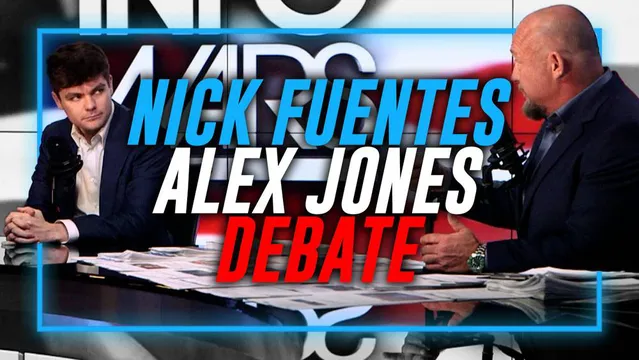
Nick Fuentes provides a historical analysis of Joseph Stalin, calling him an "evil, ruthless person" but also an "archetypal great man of history" for transforming Russia into a nuclear superpower. He contrasts Stalin with Hitler, whom he calls a "loser" set up by British intelligence. Fuentes admits he is attracted to "winners" in history who successfully wielded total power to change their nations.

A historical analysis of leftist revolutions explains how "useful idiots" in universities are used to destabilize societies before being discarded by authoritarians. This is linked to current unrest in U.S. cities, where the National Guard is being deployed to combat crime. Smith argues that the left is "forcing" the Trump administration to be heavy-handed by attacking police and hospital helicopters with lasers.

A documentary-style segment recounts Adolf Hitler's 1941 decision to tear up the non-aggression pact with Stalin and invade the Soviet Union. It describes the brutal conditions faced by German soldiers at Stalingrad and Kursk, where the "lightning war" was extinguished by the Russian winter and Soviet resistance. The narrative frames this as Hitler's "fatal obsession" that led to the Reich's collapse.

A historical documentary segment explores why Iran transitioned from a Western ally to a member of the "Axis of Evil." It traces the rise of the Pahlavi Dynasty in 1925 and the 1941 joint British-Soviet invasion of Iran to secure a supply corridor to Stalin. The documentary explains how Reza Shah was forced to abdicate in favor of his son, Mohammad Reza, after showing admiration for the German rise to power.

Jasper expresses skepticism regarding Vladimir Putin's anti-globalist credentials, noting his continued alliance with Xi Jinping and his rehabilitation of Soviet-era symbols. He argues that the threat of nuclear war is being used by the globalists to strengthen the United Nations and push for a world government. NATO's encirclement of Russia is viewed as a deliberate provocation to keep this threat alive.

Drew Pavlou introduces himself as an anti-communist activist who has faced kidnap plots from the Chinese government. He argues that the war is fundamentally about Ukraine's right to exist as an independent nation separate from the Russian Empire. Pavlou cites the Holodomor genocide as a reason Ukrainians reject Russian rule and mentions a peace proposal involving a ceasefire and the return of kidnapped children.

The historical origins of Ukraine and Russia are debated, with the host claiming Lenin gave Ukraine its sovereignty while Pavlou argues for a distinct Ukrainian identity predating the Soviet era. Pavlou maintains that the divergence between the two cultures was cemented by the Mongol invasion and centuries of separate development. The Holodomor remains a central point of contention regarding Ukrainian attitudes toward Moscow.

EXCLUSIVE: Alex Jones & Nick Fuentes Debate / Discuss All The Top Issues & Stories Happening In The World Today
1:45:22 - 1:47:51

EXCLUSIVE: Alex Jones & Nick Fuentes Debate / Discuss All The Top Issues & Stories Happening In The World Today

Russian Territorial Claims and the Minsk Accords

Fuentes argues that Ukraine is historically Russian territory and its existence as a state is an "anomaly" created by Lenin and Stalin. They discuss Vladimir Putin's goals of securing a buffer zone and control over Crimea. They express concern that if Trump cannot force a lasting peace deal, it will make the administration look weak on the global stage.

Myron Gaines mentions he is reading "Mein Kampf" to conduct his own research into World War II history, expressing skepticism toward "official narratives." The host provides a breakdown of the massive casualties on the Eastern Front, noting that 24 million Germans and 26 million Russians died. They discuss the Versailles Treaty as a catalyst for the rise of the Nazi party and the eventual destruction of Poland.

Dr. Michael Savage joins the program to discuss his 1982 novel "Xenon," which he claims predicted a future dominated by a "femme-dominated Stalinist state" and the rise of transgenderism. Savage reflects on his observations of social decay in San Francisco and the emergence of "anti-life demons" in modern politics. He characterizes the current political struggle as a battle against the enemies of freedom and nature.

The 1917 Bolshevik Revolution was reportedly financed by British and American elites to establish a communist command base in Russia. The John Birch Society emerged from U.S. intelligence circles to warn against the intentional handover of China to Mao Zedong in 1949. These historical events are presented as evidence of a long-term strategy by monopoly capitalists to use communism as a social control system.

Vladimir Putin recently referenced a thousand-year conflict between Russia and Anglo-American powers, asserting that Russia will not be defeated. Historical analysis suggests that globalist interests, including the Rothschilds, originally installed Lenin and Stalin before being double-crossed by Stalin at the end of World War II. Current NATO movements are viewed by the Kremlin as a continuation of this long-term encirclement strategy intended to force a coup or national breakup.