Topic: Crimea

87 chapters across the catalog

Donald Trump has established a Christmas deadline for a peace deal in the Ukraine war, prompting accusations of betrayal from European Union leaders. NATO and EU officials have reportedly labeled the United States an enemy due to this shift in foreign policy. While critics claim Trump is siding with Russia, supporters argue he is pursuing a pragmatic "realpolitik" strategy to split the Russia-China alliance and end the four-year conflict.
Donald Trump delivered a speech at the United Nations criticizing carbon taxes and replacement migration before shifting his stance on the Ukraine conflict. Trump expressed public support for President Volodymyr Zelenskyy, suggesting Ukraine could retake all lost territory from Russia. This shift is viewed as a dangerous escalation that encourages NATO expansion and risks total war with Russia.

NATO is characterized as the primary aggressor in the Ukraine conflict, having spent 30 years surrounding Russia and overthrowing non-aligned governments. The Russian annexation of Crimea is compared to how the United States would react if Cuba attempted to seize Guantanamo Bay. Critics argue that Western think tanks and defense groups have intentionally provoked Russia into a war that could have been avoided through different diplomatic strategies.

The competing wish lists for the Alaska summit reveal deep divides between the EU, Ukraine, and Russia. Ukraine and NATO demand a return to 1991 borders and $500 billion in reparations, while Russia insists on sovereignty over Crimea and the Donbass alongside a permanent ban on Ukrainian NATO membership. A bridge proposal involves a 38-month frozen contact line and a gradual sunset of economic sanctions.

Donald Trump is reportedly bypasssing Volodymyr Zelensky to negotiate directly with Vladimir Putin regarding the partition of Ukraine. The proposed deal would allow Russia to maintain a security corridor in the east and control of Crimea while preventing Ukraine from joining NATO. Internal reports suggest the U.S. has been secretly running the Ukrainian military's intelligence and telemetry, giving Trump significant leverage to force a ceasefire.

A prediction is made that Volodymyr Zelensky will be deposed in a U.S.-led coup or putsch if he continues to block the peace deal accepted by Russia. The proposed deal involves Russia securing a buffer zone, Crimea, and oil pipelines, while the U.S. gains control over Ukrainian minerals through a new Marshall Plan. Russia seeks a formal agreement to end NATO expansion and lift economic sanctions in exchange for a troop withdrawal to the border.

Russian forces have reportedly captured the Donetsk stronghold of Chazov Yar after a 17-month siege, with Ukrainian casualties estimated at a three-to-one ratio. President Zelensky is accused of reversing anti-corruption laws only when threatened with a loss of funding. Proposed peace terms involve removing Zelensky, holding new elections, and ensuring Ukraine never joins NATO while allowing Russia to retain Crimea.

Australian activist Drew Pavlou joins the program to debate the Ukraine conflict and the risk of nuclear escalation. The host argues that NATO's eastward expansion and strikes on Russian nuclear strategic assets are provocations intended to start a global war. Pavlou is challenged on his support for the Ukrainian government, which the host characterizes as a dictatorship that has banned opposition and the Orthodox Church.

Ukraine utilized underwater drones to strike the Kursk Bridge in Crimea, an act intended to derail potential peace negotiations. NATO and the EU have allegedly planned for a long-term conflict to break up Russia into five parts, a strategy dating back 15 years. General Kellogg recently characterized the current situation as a global conflict, while Donald Trump and Elon Musk have previously advocated for pulling out of NATO.

Russia is currently advancing in the Sumy region to create a buffer zone, using tactics of encirclement rather than direct urban combat to avoid civilian casualties. Victor Bout suggests that Russia intends to reclaim historical lands where the population is 80% Russian-speaking. He notes that while Ukraine wants to set up a "new Stalingrad," Russia's goal is to secure its borders and ensure the rights of the Russian-speaking population.

The host labels Volodymyr Zelensky an "illegitimate president" and a "dictator" for canceling elections in Ukraine. It is argued that Russia will not stop its military campaign until Zelensky is removed from power and a new election is held. The segment suggests that Ukrainian oligarchs are profiting from the war while living under NATO protection, and that a diplomatic solution requires Zelensky's resignation.

NATO is accused of engineering a decades-long strategy to encircle Russia and eventually break the nation into five separate pieces. Current battle lines show Russian forces advancing toward Kharkiv while Belarus masses troops on the northern border. Concerns are raised that the deployment of NATO peacekeepers without a formal deal will trigger Article 5, leading to a direct and catastrophic confrontation between the West and Russia.

Donald Trump, speaking before boarding Air Force One, called for an immediate end to the war in Ukraine, citing satellite images of "horrible body parts" on the battlefield. He estimated that 3,000 to 4,000 people are dying weekly and suggested that President Zelenskyy is now more open to a peace deal. Trump reiterated that the conflict, including the loss of Crimea, was a failure of the Obama and Biden administrations.

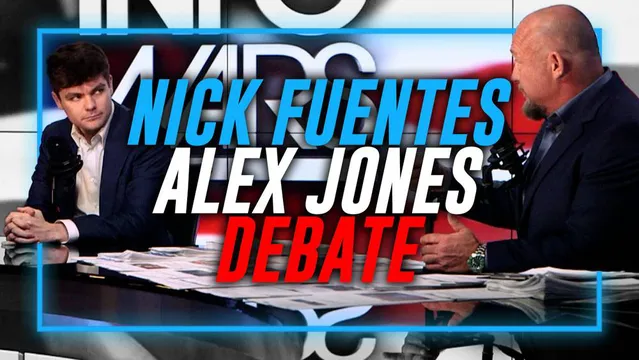
EXCLUSIVE: Alex Jones & Nick Fuentes Debate / Discuss All The Top Issues & Stories Happening In The World Today
1:45:22 - 1:47:51

EXCLUSIVE: Alex Jones & Nick Fuentes Debate / Discuss All The Top Issues & Stories Happening In The World Today

Russian Territorial Claims and the Minsk Accords

Fuentes argues that Ukraine is historically Russian territory and its existence as a state is an "anomaly" created by Lenin and Stalin. They discuss Vladimir Putin's goals of securing a buffer zone and control over Crimea. They express concern that if Trump cannot force a lasting peace deal, it will make the administration look weak on the global stage.

The conflict in Ukraine is described as a NATO proxy war that Russia has effectively won. Late diplomat Henry Kissinger is cited for his warnings that the war would bankrupt Europe and that Russia would never relinquish Crimea. Concerns are raised that continued escalation, including the use of Western long-range missiles, could trigger a Russian nuclear response if they perceive a mass aerospace attack as a nuclear first strike.

Donald Trump issues a statement criticizing President Zelensky for inflammatory remarks regarding Crimea, noting that the territory was lost during the Obama administration. Jones argues that the West started the Ukraine war to bankrupt Russia and break it into pieces. He also revisits controversial past comments by George Soros regarding his activities during World War II to illustrate the "Nazi" roots of globalist figures.

Volodymyr Zelenskyy is accused of blocking Donald Trump's ceasefire efforts by insisting on a return to 2014 borders, including Crimea. Ukraine recently conducted a massive drone strike on the Ingalls airbase, 435 miles inside Russia, targeting Tu-160 nuclear-capable bombers. This escalation occurred despite reports of a potential ceasefire agreement between Trump and Putin regarding critical infrastructure.

Vladimir Putin and Donald Trump held a 90-minute phone call to discuss a framework for peace in Ukraine. Putin is reportedly demanding a total suspension of Western weapons deliveries as a prerequisite for a truce. There are also indications that the U.S. may consider recognizing Crimea as Russian territory to entice a settlement and end the conflict.

Vladimir Putin publicly rejected a proposed 30-day ceasefire in Ukraine, appearing at a military command center in battle fatigues. Russia demands a long-term framework including the recognition of Crimea and the four Donbass regions as Russian territory. Putin insists that Ukraine must be demilitarized, denazified, and permanently barred from joining NATO to ensure regional stability.

Jones discusses the potential for a massive false flag operation involving nuclear reactors in Ukraine to blame Russia. He notes a shift in rhetoric from neoconservatives like Lindsey Graham, who has reportedly called Zelensky a dictator and suggested he should leave office. The discussion covers the history of NATO expansion, the Nord Stream pipeline sabotage, and Zelensky's alleged demands for nuclear weapons.