

Matt Bracken explains the "Third Rome" concept, positioning Moscow as the protector of Christian culture. The discussion covers the history of Ukraine, arguing that its borders were arbitrarily drawn by Soviet leaders like Lenin and Khrushchev.
56 chapters across the catalog
Matt Bracken explains the "Third Rome" concept, positioning Moscow as the protector of Christian culture. The discussion covers the history of Ukraine, arguing that its borders were arbitrarily drawn by Soviet leaders like Lenin and Khrushchev.
Bout and Bracken analyze the Bolshevik Revolution as an early "globalist project" funded by New York bankers. They compare historical figures like Armand Hammer to modern figures like George Soros, alleging a long-term plan to destroy traditional Russian culture.
Communism as a Feudal System of Slavery
Communism is redefined as a modern form of feudalism designed to enslave populations through "planned austerity." Historical parallels are drawn between the Russian Revolution and current "Great Reset" policies. The speaker argues that communist leaders throughout history have used the promise of liberation to lead people into "slave gulags."
The Psychopathy of Vladimir Lenin and the French Revolution
A graphic anecdote describes Vladimir Lenin allegedly murdering hundreds of rabbits on an island as a display of "demon possession." This behavior is linked to the Jacobins of the French Revolution and a broader "death cult" ideology. The speaker warns that these types of leaders seek to break the human spirit through isolation and violence.
Historical Analysis of Joseph Stalin and "Great Men"
Nick Fuentes provides a historical analysis of Joseph Stalin, calling him an "evil, ruthless person" but also an "archetypal great man of history" for transforming Russia into a nuclear superpower. He contrasts Stalin with Hitler, whom he calls a "loser" set up by British intelligence. Fuentes admits he is attracted to "winners" in history who successfully wielded total power to change their nations.
Ukrainian History, Lenin vs. Stalin and National Identity
The historical origins of Ukraine and Russia are debated, with the host claiming Lenin gave Ukraine its sovereignty while Pavlou argues for a distinct Ukrainian identity predating the Soviet era. Pavlou maintains that the divergence between the two cultures was cemented by the Mongol invasion and centuries of separate development. The Holodomor remains a central point of contention regarding Ukrainian attitudes toward Moscow.
Biblical Curses and Historical Bolshevik Analysis
A debate continues regarding the biblical implications of supporting Israel versus criticizing its political actions. Jones provides a historical critique of the Bolshevik Revolution, claiming it was funded by British intelligence and led by Jewish commissars who targeted Christians. He concludes that he does not support any extremist ideologies, whether from the Ayatollah, Netanyahu, or George Soros.
Russian Territorial Claims and the Minsk Accords
Fuentes argues that Ukraine is historically Russian territory and its existence as a state is an "anomaly" created by Lenin and Stalin. They discuss Vladimir Putin's goals of securing a buffer zone and control over Crimea. They express concern that if Trump cannot force a lasting peace deal, it will make the administration look weak on the global stage.
Historical Globalist Funding, OECD and CIA Origins
The globalist power structure is traced back to the Rothschild and Rockefeller funding of Mao Zedong in 1949 and Lenin in 1917. The OECD was established at the end of World War II as a central control hub for the Marshall Plan, eventually setting up the EU Commission and NATO. This international banking consortium reportedly uses narcotics and human trafficking revenue to fund clandestine CIA operations and penetrate national cabinets.
Bolshevik Revolution, John Birch Society and Maoism
The 1917 Bolshevik Revolution was reportedly financed by British and American elites to establish a communist command base in Russia. The John Birch Society emerged from U.S. intelligence circles to warn against the intentional handover of China to Mao Zedong in 1949. These historical events are presented as evidence of a long-term strategy by monopoly capitalists to use communism as a social control system.
Historical Conflict and Anglo-American Encirclement of Russia
Vladimir Putin recently referenced a thousand-year conflict between Russia and Anglo-American powers, asserting that Russia will not be defeated. Historical analysis suggests that globalist interests, including the Rothschilds, originally installed Lenin and Stalin before being double-crossed by Stalin at the end of World War II. Current NATO movements are viewed by the Kremlin as a continuation of this long-term encirclement strategy intended to force a coup or national breakup.
Marxist Infiltration, Weathermen Court Cases
The Mayor of Los Angeles is accused of being a Marxist-Leninist agent of the Cuban government. Jones references historical federal court cases involving The Weathermen to argue that communists have spent decades infiltrating education and medicine to bankrupt America. He warns that Antifa "hordes" are being activated to burn down cities as a precursor to a full communist takeover.
Dismantling the US Economy and Communist Parallels
Dr. Elliott compares current US economic policies to Leninist strategies of controlling the populace through the money supply. He asserts that the US has reached a point of "critical mass" regarding debt, where the system is on the verge of collapse. The discussion frames the current administration's actions as a deliberate move toward a globalist, non-sovereign financial future.
Factionalism and the "Death of Stalin" in the DNC
Posobiec describes the internal power struggles within the Democratic Party as a "Bolshevik vs. Menshevik" conflict. He claims Jill Biden is clinging to power for the "trappings of office" while younger, more ruthless revolutionaries wait to take over. He warns that in these power vacuums, the most brutal factions usually prevail.
Lenin, Stalin, and the History of Ukraine
Jack Posobiec provides a historical overview of Ukraine's relationship with Russia, from the Kievan Rus to the Soviet era. He explains Lenin's "trick" of offering national freedom to groups only to force them into the USSR. He also mentions Victoria Nuland's family history in Odessa as a factor in her current foreign policy stance.
Kievan Rus, Lenin, Soviet Imperium
The history of the Kievan Rus is cited to show the deep cultural ties between Russia and Ukraine, framing the current conflict as a civil war. Lenin is accused of using "national freedom" as a trick to bring disparate groups under the Soviet Imperium. The discussion also links modern US politicians like Jamie Raskin to a lineage of Bolshevik collaborators.
Ukrainian History, Bolshevik Funding, and Civil War
The conflict in Ukraine is characterized as a civil war where "Russians are fighting Russians" due to historical manipulation by the Austro-Hungarian Empire and the Bolsheviks. Victor Bout claims the Bolshevik Revolution was funded by New York and British intelligence to weaken Russia. He credits Stalin with reversing Lenin's socially destructive policies to preserve the Russian state during the 20th century.
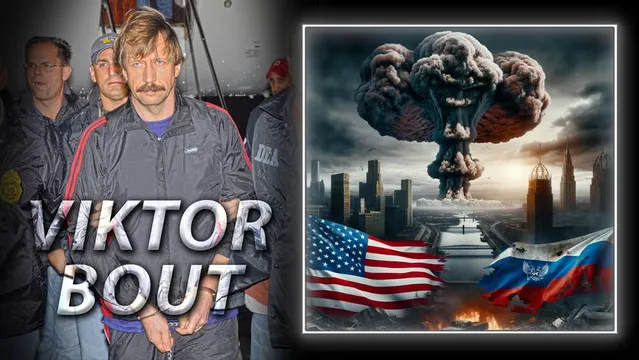
Leon Trotsky, New York Bankers, Joseph Stalin's Pivot
The Bolshevik Revolution is described as a coup funded by globalists, with leaders like Trotsky arriving on ships from New York. Joseph Stalin is credited with pivoting back to traditional values, such as the nuclear family and national history, once he realized the globalist plot to destroy Russia. This shift reportedly turned Stalin from a Western ally into a villain in the eyes of the New World Order.
Psychological Readiness for Imminent Global Escalation
Alex Jones quotes Vladimir Lenin regarding weeks where decades of history happen, applying it to the current rapid escalation of globalist control. He asserts that COVID-19 lockdowns were merely "training wheels" for permanent future restrictions tied to climate change and a cashless society. Jones describes a physical and spiritual "energy of resistance" he feels, urging his audience to prepare for a major societal impact.
Communism History, British Intelligence, Xi Jinping
A debate ensues regarding the origins of communism, with claims that British intelligence and Wall Street funded the Bolshevik Revolution to remove the Czars. Hinkle and the host discuss the break between Xi Jinping and globalist figures like George Soros. They examine the historical role of the Council on Foreign Relations in supporting Communist China before recent geopolitical shifts.