Topic: Ukraine

1720 chapters across the catalog

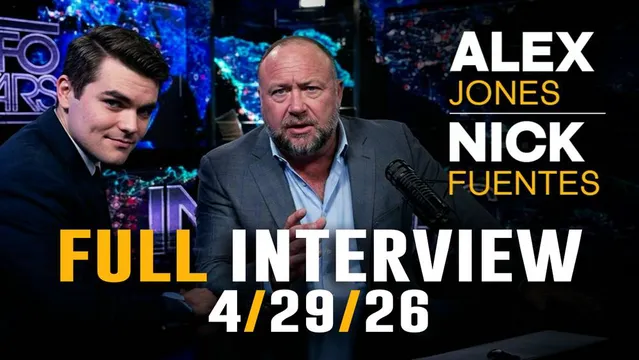
FULL NEW ALEX JONES INTERVIEW WITH NICK FUENTES — 4/29/26
1:02:02 - 1:07:01

FULL NEW ALEX JONES INTERVIEW WITH NICK FUENTES — 4/29/26

Israel Influence on Trump, Military Matrix

Military planners and Israeli-infiltrated entities within the Pentagon have reportedly created a "matrix" around Donald Trump, convincing him that a war with Iran would be easy. This is compared to the faulty intelligence that led Vladimir Putin to believe the invasion of Ukraine would result in a quick collapse of the government. The U.S. is now viewed as having walked into a "NATO-style trap" in the Middle East, leading to a war of attrition.

Reports from Ukraine indicate widespread resistance to forced conscription, with videos showing citizens and women fighting back against recruitment officers. Critics describe the nation as a "globalist project" where fertile land has been sold to corporations like BlackRock and Cargill. Volodymyr Zelensky is characterized as a figurehead installed by oligarchs and Western intelligence to facilitate a proxy war against Russia.

Viktor Bout, a Russian official and former U.S. prisoner, joins the program to discuss the interconnected nature of global crises. Bout argues that the "globalist cabal" uses confusion and armed conflict to advance a "Great Reset" and establish global control. He suggests that the current societal unrest is part of a "Fourth Turning," a period of great awakening and resistance against the New World Order.

Viktor Bout describes the "boosification" of Ukraine, where citizens are forcibly grabbed from the streets to serve as "cannon meat" for the military. He notes that Ukraine's population has plummeted from 54 million in 1991 to an estimated 22 million today, representing a total demographic collapse. Bout claims the Zelensky regime is an illegal entity that prioritizes the interests of its foreign masters over the survival of the Ukrainian people.

Viktor Bout outlines a scenario for ending the Ukraine conflict, suggesting that Donald Trump could immediately stop the war by ordering Elon Musk to cut Starlink services to Ukraine. Additionally, Trump could instruct the Pentagon to cease sharing intelligence used for deep strikes into Russian territory. Bout claims that without U.S. support, the Ukrainian effort would collapse, as European nations have already run out of cash to fund the proxy war.

U.S. intelligence reports indicate that China may have shipped shoulder-fired missiles to Iran for use against American and Israeli forces. The host argues that the United States set a dangerous precedent by waging a proxy war against Russia in Ukraine. He warns that American infrastructure, such as the Golden Gate Bridge, could become targets for retaliation due to the government's actions overseas.

Viktor Bout speculates that the Russian military is at maximum alert as the conflict threatens to expand. He suggests that if the UK provides nuclear capabilities to Ukraine, Russia will be forced to strike British bases and logistics hubs in Poland and Romania. The host and Bout agree that the Iran conflict has effectively taken peace in Ukraine off the table, as Zelensky seeks to insert himself back into the center of global attention.

Jones and Sears discuss the "paradox" of modern geopolitics, where opposing the war in Ukraine leads to accusations of being a Russian agent, and opposing the Iran war leads to accusations of anti-Semitism. Jones describes a feeling of "Jew fatigue," where Middle Eastern conflicts dominate American life. They argue that overplaying the "war card" will eventually lead to the death of the American empire.

Trump's threat to stop weapons for Ukraine unless Europe joins a Middle Eastern coalition is analyzed as a form of geopolitical leverage. The host expresses concern over the Pentagon and European nations promoting a military draft, which he believes would cause a revolution. He specifically calls out Ben Shapiro and other "pro-war" figures, noting they are now within the expanded enlistment age.

Iran is reportedly preparing symmetrical responses to attacks on its civilian infrastructure, potentially targeting Israeli hospitals and universities. Meanwhile, tensions are rising in the Baltic Sea following Ukrainian attacks on Russian oil ports, which Bout claims were orchestrated by the British. These actions are seen as an attempt to force a NATO-Russia conflict that would further destabilize global energy markets.

The risk of nuclear war is described as imminent, with reports that Britain and France are prepared to transfer nuclear warheads to Ukraine. Victor Bout argues that Russia would likely launch a retaliatory strike against London, which he identifies as the headquarters for globalists trying to "eliminate humanity." The narrative suggests that NATO members are being sacrificed as "stooges" in a high-stakes geopolitical game.

Vladimir Putin is described as maintaining "restrained" and "focused" military command despite NATO-backed attacks deep inside Russian territory. Russia has reportedly warned that it could provide tactical nuclear assistance to Iran if the U.S. continues to escalate. The narrative highlights that Ukrainian attacks on Russian refineries are impossible without direct U.S. satellite intelligence and weaponry.

A caller suggests that the Iran conflict serves as a "second front" for Russia to relieve pressure from the war in Ukraine. The host agrees, characterizing the situation as a proxy war where Israel and neoconservatives have drawn the U.S. into a trap. Speculation is raised regarding Benjamin Netanyahu's background and whether Israeli policy is inadvertently or intentionally benefiting Russian interests.

A massive explosion at the Valero refinery in Port Arthur, Texas, occurred simultaneously with Ukrainian drone strikes on Russian energy terminals. These events, combined with the closure of the Strait of Hormuz, are viewed by analysts as an orchestrated effort to create global scarcity. The International Energy Agency (IEA) is currently urging governments to implement work-from-home measures and air travel restrictions to mitigate the oil supply shock.