Topic: Donbass

54 chapters across the catalog

In 2022, Russian-speaking residents in four Ukrainian regions voted to annex themselves to the Russian Federation to escape NATO-backed attacks. Viktor Bout emphasizes that 80% of the Ukrainian population thinks and speaks in Russian, sharing a common ethnic identity with Russia. He argues that the current conflict was manufactured by rewriting history to instill hatred in younger generations.

The competing wish lists for the Alaska summit reveal deep divides between the EU, Ukraine, and Russia. Ukraine and NATO demand a return to 1991 borders and $500 billion in reparations, while Russia insists on sovereignty over Crimea and the Donbass alongside a permanent ban on Ukrainian NATO membership. A bridge proposal involves a 38-month frozen contact line and a gradual sunset of economic sanctions.

The military and trade agreement between Russia and China in 2012 set the stage for the current geopolitical alignment, which the Obama administration failed to counter. General Flynn argues that the U.S. intelligence community's underhandedness led to the 2014 conflict in Ukraine following the Sochi Olympics. He stresses that the U.S. must now focus on domestic readiness and the 300,000 Chinese illegals currently within the country.

Vladimir Putin publicly rejected a proposed 30-day ceasefire in Ukraine, appearing at a military command center in battle fatigues. Russia demands a long-term framework including the recognition of Crimea and the four Donbass regions as Russian territory. Putin insists that Ukraine must be demilitarized, denazified, and permanently barred from joining NATO to ensure regional stability.

Jones describes the globalist system as "holding the world hostage" through the Ukraine war to maintain money laundering operations. He criticizes the proposal to send European troops into Ukraine as "peacekeepers," arguing this would trigger a direct conflict with Russia. The segment touches on the history of the Donbass region and Trump's previous provision of Javelin missiles to Ukraine.

Viktor Bout outlines Russia's non-negotiable conditions for peace, which include the total demilitarization and denazification of Ukraine. Russia demands that Ukraine remain a neutral state and never be used as a launchpad for NATO attacks. Bout references the failure of the Minsk agreements and the 2014 overthrow of the Ukrainian government as the root causes of the current military intervention.

The conflict in Ukraine is described as a tribal war exacerbated by NATO interference and the suppression of the Orthodox Church by the Zelensky government. Martin Armstrong claims that a peace agreement was nearly reached early in the war but was blocked by Western leaders like Boris Johnson. He suggests that the only way to end the conflict is to cut off all U.S. funding, as the Ukrainian economy is currently entirely dependent on foreign aid.

FULL CENSORED SHOW 8/6/24 — Deep State Planning New Trump Assassination As Top Democrat Confesses Plan To Launch Civil War
1:41:02 - 1:46:44

FULL CENSORED SHOW 8/6/24 — Deep State Planning New Trump Assassination As Top Democrat Confesses Plan To Launch Civil War

Ukraine Frontline Report, Zaporozhye Nuclear Plant and US Missiles

Jackson Hinkle reports on his visit to the Donbass region, claiming he saw a US missile lodged near nuclear waste storage at the Zaporozhye Nuclear Power Plant. He accuses the Ukrainian military of using US-supplied weapons to "rain terror" on civilians in liberated territories. Hinkle argues that the Ukrainian military has effectively collapsed and that the West is prolonging a "mess" that could lead to a nuclear catastrophe.

Former Army intel officer and whistleblower Scott Bennett joins the program, stating that the deep state "drew first blood" by attacking Trump. Bennett, who recently traveled to the Donbass and Belgorod, argues that the American people have reached a breaking point. He claims the tide has turned in favor of the "patriot" movement and that the establishment's vitriol is backfiring.

Gerald Celente encourages listeners to support InfoWars and subscribe to the Trends Journal to stay informed. He points out the hypocrisy of the West placing sanctions on Iran while ignoring Israel's actions in Damascus and Gaza. Celente also mentions the long-standing conflict in the Donbass region as a primary driver of the current war in Ukraine.

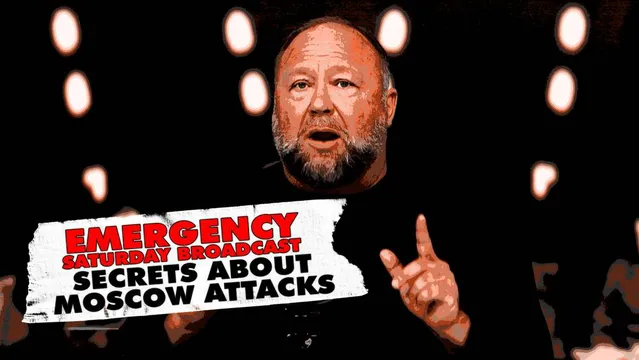
Saturday Emergency Broadcast: Alex Jones & Vladimir Soloviev Reveal Secrets of The Moscow Terror Attacks
29:02 - 35:06

Saturday Emergency Broadcast: Alex Jones & Vladimir Soloviev Reveal Secrets of The Moscow Terror Attacks

Globalist Destabilization, Operation Gladio 2.0, and Russian Unity

Alex Jones and guest Aussie Cossack discuss the potential for "Operation Gladio 2.0," involving staged terror attacks to justify military escalation. Aussie Cossack argues the Moscow attack is an "own goal" that will unite the Russian population behind Putin. They criticize Fareed Zakaria’s recent calls to hit Russia internally and discuss the presence of Ukrainian military veterans among the captured suspects.

Saturday Emergency Broadcast: Alex Jones & Vladimir Soloviev Reveal Secrets of The Moscow Terror Attacks
44:20 - 46:04

Saturday Emergency Broadcast: Alex Jones & Vladimir Soloviev Reveal Secrets of The Moscow Terror Attacks

NATO Encroachment, Jared Kushner, and Scott Bennett Introduction

Syrian Girl concludes her segment by arguing that NATO is the aggressor encroaching on Russian borders. She mentions Jared Kushner’s interest in Gaza real estate as evidence of globalist motives. Alex Jones then introduces Scott Bennett, a former Army intel officer who recently returned from the front lines in Donbass and Russia.

Saturday Emergency Broadcast: Alex Jones & Vladimir Soloviev Reveal Secrets of The Moscow Terror Attacks
46:04 - 50:55

Saturday Emergency Broadcast: Alex Jones & Vladimir Soloviev Reveal Secrets of The Moscow Terror Attacks

Scott Bennett, Russian Culture, and Foreign Mercenaries in Donbass

Scott Bennett shares anecdotes from his time in Russia, including meeting pranksters who targeted Mike Pompeo. He describes a "brightness" growing in Russia and the Donbass, where foreign mercenaries from Japan, Korea, and Serbia are joining the Russian side. Bennett characterizes the Western leadership as schizophrenic and disconnected from the reality of the conflict.

A report details Volodymyr Zelensky's admission that Vladimir Putin urged a ceasefire in the Donbass region in 2019. Celente argues that Zelensky lied his way into office as a peace candidate, similar to Barack Obama. He criticizes the rejection of diplomacy in favor of freezing or escalating the conflict.

Scott Bennett recounts his time in the Donbass region with Russian Spetsnaz troops. He claims that Russian soldiers and patriots are supporters of Donald Trump and view him as a victim of the same globalist forces they are fighting. Bennett asserts that Russia's "long game" is peace and fellowship with American conservatives, harkening back to the friendship between the two nations in 1776.

The conflict in Ukraine is framed as a vicious proxy war orchestrated by George Soros and the Biden administration to manipulate Russia into an invasion. Historical context is provided regarding Slavic culture's origins in Ukraine and how figures like Lenin and Hitler previously divided the region. Claims are made that NATO has been at war with Russia for nine years and that Russia's primary goal is preventing Ukraine from joining NATO while protecting the Donbass.

The discussion covers alleged atrocities committed by the Azov Battalion and other Ukrainian units in the Donbass region since 2014. Thornton cites reports of cluster bombs being dropped on civilians and maternity units in Donetsk. He mentions the "Alley of Angels" memorial for children killed in the conflict and accuses the West of ignoring ethnic cleansing of Russians in eastern Ukraine.

Thornton argues that the Ukrainian government's goal is the ethnic cleansing of Russians from the Donbass to secure resources for corporations like BlackRock and Vanguard. He contrasts the high approval ratings of Vladimir Putin with the unpopularity of Western leaders like Joe Biden and Justin Trudeau. The segment concludes that Russia will not leave Ukraine until its security objectives are met.

Celente references John F. Kennedy's 1963 peace speech and the historical context of Operation Barbarossa to argue that Ukraine cannot defeat Russia. He claims the Trends Journal accurately predicted the war's outcome and the rise of neo-Nazism in Ukraine. The segment concludes with a critique of "dynasty" politicians like Justin Trudeau and George W. Bush, whom Celente describes as "warmongering clowns."