Topic: Trade Act

13 chapters across the catalog

The host alleges that Howard Lutnick deliberately miswrote the tariff executive order to ensure it would be overturned by the Supreme Court, allowing his family to profit from insurance bets. Justice Kavanaugh's dissent is cited as a roadmap for Trump to reissue the orders using more durable legal authorities like the Trade Act of 1974. Trump confirmed during his press conference that he will immediately institute a 10% across-the-board provision using these alternative statutes.

Audio clips from the Supreme Court feature Justice Ketanji Brown Jackson questioning government lawyers about the historical use of the phrase "regulate importation" to confer tariff authority. The lawyer cites the 1971 Nixon tariff and the Yoshida case as legal precedents. The host mocks Justice Jackson's line of questioning, referencing her previous refusal to define the word "woman" during her confirmation hearing.

If the Supreme Court rules against the current tariff structure, Dr. Kirk Elliott outlines "Plan B" options, such as invoking Section 122 of the 1974 Trade Act or Section 338 of the 1930 Tariff Act. These laws allow for temporary tariffs to address trade imbalances and discrimination against U.S. trade. The discussion emphasizes that the administration has multiple legal avenues to continue its protectionist policies.

During an event for the 60th anniversary of Medicaid, Nancy Pelosi dismissed allegations of insider trading as "ridiculous" and shifted focus to the attack on her husband. Conversely, Donald Trump and various Republican lawmakers continue to push for a total ban on congressional stock trading. The proposed "Pelosi Act" aims to make such financial activities prosecutable.

The host outlines a "Great Reset" plan to collapse industrial society and implement "Feudalism 2.0" through artificial shortages. Globalists are accused of using the COVID-19 pandemic to double their wealth while destroying the middle class and small farms. The ultimate goal is described as a post-industrial world where the population is managed as "domesticated animals" under total bureaucratic control.

Attorney Norm Pattis explains that the appellate court provided some protection for the press by rejecting the misapplication of the Unfair Trade Practices Act. However, he criticizes the court for upholding the discovery default, which he views as a miscarriage of justice. Pattis describes the trial environment as more of a "wake" than a legal proceeding, citing improper conduct by plaintiff lawyers.

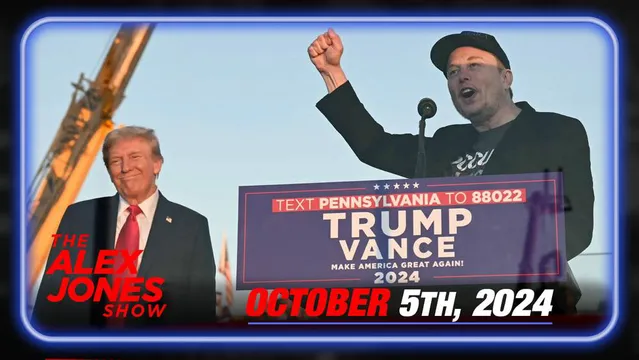
President Donald Trump Returns to Butler, Pennsylvania For Historic Rally 3 Months After Assassination Attempt
3:19:40 - 3:23:55

President Donald Trump Returns to Butler, Pennsylvania For Historic Rally 3 Months After Assassination Attempt

Manufacturing Renaissance, Reciprocal Trade Act

Donald Trump details his plan for a "manufacturing renaissance," including a 15% corporate tax rate for companies that make their products in America. He promises to use tariffs to protect domestic industries and proposes the Reciprocal Trade Act to match the taxes charged by foreign nations. Trump also expresses opposition to the sale of U.S. Steel to a Japanese company, vowing to keep the iconic firm under American ownership.

FULL SHOW: Israeli Stand Down Confirmed As Western Funding Of Islamic Take Over Revealed, Must Watch!
0:05 - 2:12

FULL SHOW: Israeli Stand Down Confirmed As Western Funding Of Islamic Take Over Revealed, Must Watch!

Canadian Parliament Nazi Controversy, Prescott Bush Financial History

The Canadian government faces scrutiny following the honoring of a Ukrainian Nazi unit soldier in Parliament, prompting calls for a historical reckoning regarding war criminals admitted after World War II. Investigations into the De Schene Commission highlight secret reports of Nazi collaborators, while historical records link Senator Prescott Bush to companies that profited from Nazi Germany's financial backers. These business dealings continued until assets were seized in 1942 under the Trading with the Enemy Act, eventually leading to civil actions by former slave laborers.

Chase Geyser discovered archived InfoWars broadcasts from March and July 2001 in which the 9/11 attacks were predicted. The footage features claims that elements of the FBI would use remote-controlled jets to strike the World Trade Center to usher in the Patriot Act. Jones emphasizes that these historical clips validate his long-term accuracy regarding transhumanism and the destruction of the nuclear family.

Emergency Thursday Broadcast: Billion Dollar Show Trial Verdict Signals Death of Free Speech – Thursday FULL SHOW 10/13/22
1:55:46 - 2:01:10

Emergency Thursday Broadcast: Billion Dollar Show Trial Verdict Signals Death of Free Speech – Thursday FULL SHOW 10/13/22

First Amendment Under Attack, Unfair Trade Practices Act

Norm Pattis expresses concern over the use of the Unfair Trade Practices Act to target speech, arguing it sets a dangerous precedent for anyone who sells products alongside their commentary. He describes a "vice" where Jones was ordered not to testify about certain beliefs, which would have forced him into either contempt or perjury. Pattis calls the trial a "PC hysteria run amok."

John Bowne reports on alleged insider trading and corruption among senior members of Congress, specifically naming Dianne Feinstein, Chuck Schumer, and Nancy Pelosi. The report highlights Feinstein’s husband’s stock trades and the revelation that her driver of 20 years was a Chinese spy. The segment questions the mental fitness of aging lawmakers and calls for term limits to prevent "dementia" from ruling the country.

Russia Withdraws Troops From Ukrainian Border as NATO Continues to Declare Full-Scale War Is Imminent - FULL SHOW 2/15/22
1:21:38 - 1:26:40

Russia Withdraws Troops From Ukrainian Border as NATO Continues to Declare Full-Scale War Is Imminent - FULL SHOW 2/15/22

Norm Pattis on Remington Settlement, Proximate Cause

Attorney Norm Pattis explains that the Remington settlement eviscerates the legal notion of "proximate cause" by holding a manufacturer liable for the criminal acts of a third party. He notes that the case relied on the Connecticut Unfair Trade Practice Act regarding "unscrupulous advertising." Pattis argues that the plaintiffs are attempting to legislate through litigation to bypass the Second Amendment.