Topic: Ports

32 chapters across the catalog

A caller points out that Israel signed a 25-year concession for China to operate the Haifa Bay Port in 2021, suggesting a complex alliance that may not favor U.S. interests. The host agrees that the current conflict empowers China while destroying the American economy. The conversation also touches on the "anti-Semitism" label being used to silence criticism of Israeli foreign policy and protect the "Israeli coup."
A massive explosion at the Valero refinery in Port Arthur, Texas, occurred simultaneously with Ukrainian drone strikes on Russian energy terminals. These events, combined with the closure of the Strait of Hormuz, are viewed by analysts as an orchestrated effort to create global scarcity. The International Energy Agency (IEA) is currently urging governments to implement work-from-home measures and air travel restrictions to mitigate the oil supply shock.

President Marcos of the Philippines declared a one-year national energy emergency to enforce conservation as oil futures surged following social media posts by Donald Trump. Meanwhile, Nebraska is battling the largest wildfires in its history, consuming 800,000 acres of farmland. Concerns are rising over federal incompetence in managing domestic disasters while billions of dollars are diverted to foreign conflicts in Iran and Ukraine.

Patrick Byrne is introduced as a former intelligence asset who has been declassified. The conversation returns to William Rodriguez's 9/11 testimony, noting that he was the only person with a master key to the World Trade Center. Byrne and the host discuss how Rodriguez was silenced by the Port Authority and subsequently traveled the world to tell his story.

Donald Trump has reportedly declared a "full-scale war" on drug cartels, with the U.S. military preparing to seize ports and airfields in Venezuela. Alex Jones explains that the strategy involves baiting the Venezuelan military into shooting back, providing a pretext for a total takeover. Jones predicts the imminent fall of Nicolas Maduro's regime, citing the country's economic collapse and starvation.

George Papadopoulos outlined a "New Great Game" involving a struggle for control over emerging trade and energy corridors in Asia. China is utilizing the Gwadar port in Pakistan to hedge against India's economic rise and its strategic partnership with the United States. The conflict is viewed as a battle between China's Belt and Road Initiative and the U.S.-backed IMEC corridor involving India and Israel.

Mainstream media outlets report a GDP dip and trade deficits, while financial publications like The Wall Street Journal highlight blowout tech earnings and robust manufacturing. Shipping volume at the Port of Los Angeles is down 35% as businesses adjust to new tariffs targeting Chinese exports.

War correspondent Michael Yon reports from Panama City, stating that he believes the U.S. is preparing for a military move to retake control of the canal. Yon highlights the strategic importance of the "China Bridge" and the influence of Hutchison Ports, which is tied to Hong Kong interests. He warns that internal violence in Panama, potentially stoked by labor unions, could serve as a "causus belli" for U.S. intervention.

Callers discuss the recent East Coast port shutdowns and speculate on the use of Nikola Tesla's advanced technology to interact with the "spiritual world." One caller suggests the government is developing high-speed drones and robots specifically to compete with demonic entities that supposedly move faster than the human eye can perceive.

The deep state's objective is a controlled military commitment that avoids total annihilation while maintaining the flow of war-related capital. Defense Secretary Lloyd Austin's dismissal of Russian warnings is criticized as a product of normalcy bias and conventional thinking. Meanwhile, China continues to secure 80% of global ports and critical rare earth minerals, benefiting from the West's preoccupation with Russia.

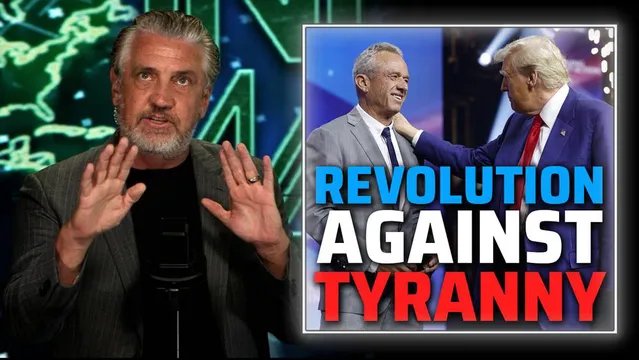
Robert F. Kennedy Jr.'s endorsement speech in Phoenix is hailed by General Flynn as one of the greatest political statements in history. The speech addressed the takeover of the U.S. government by corporate and globalist interests, a theme Alex Jones has covered for decades. The decision to join Trump was finalized at Hyannis Port after extensive deliberation among Kennedy's advisors and family.

During a pivotal meeting at Hyannis Port, Robert F. Kennedy Jr. decided that continuing as an independent would be a futile act of martyrdom. Donald Trump offered Kennedy the opportunity to help build a cabinet and lead a national health initiative, a proposal that was leaked in a private video. This realignment is framed as a providential moment where former rivals unite against a common "dark" establishment.

Recent port strikes are viewed as another test run for cutting off the U.S. food supply. Dr. Wolf highlights Jamie Raskin's scheduled panel on "chaos and confusion" following the election as evidence of a pre-planned refusal to certify results. The discussion warns of potential false flag events, such as a dirty bomb or an attack on Trump's plane, being used to justify a military roundup of dissidents.

A temporary agreement was reached to end the U.S. port strike, including a 61.5% wage increase over six years, but the core issue of automation remains unresolved. Longshoremen are fighting against the replacement of human workers with robots, a trend that could eliminate 50% of jobs in the next five years. The segment predicts that the strike will resume in January 2025 if the ports do not provide guarantees against further automation.

A caller links the current port strike to the long-term globalist plan of offshoring American manufacturing to create dependency. The discussion frames the strike as an opportunity for Donald Trump to advocate for a return to US-based manufacturing and to expose the "oligopoly" of middlemen controlling trade with China.

A caller predicts that the 2024 election may be canceled through the imposition of martial law or a foreign attack. The combination of the port strike, hurricane damage, and open borders is framed as a "huge snarl" designed to create a national emergency that prevents a standard election.

A massive strike involving 45,000 dockworkers has commenced from Maine to Texas, halting approximately half of all ocean shipping in the United States. The labor dispute centers on wages and automation, with workers demanding significant raises to combat inflation after a decade of stagnant pay. Experts warn the work stoppage could cost the U.S. economy $5 billion daily and lead to widespread shortages of consumer goods.

The ongoing port strike is analyzed as a "perfect storm" of economic pressure that could exacerbate inflation and cripple the U.S. supply chain. The discussion explores the tension between human labor and the globalist push for AI-driven automation within the shipping industry. The strike is framed as a necessary stand for workers against the ESG-driven replacement of human employees by robotic systems.