Topic: Gdp

80 chapters across the catalog

Mike Adams, the Health Ranger, analyzes the economic impact of a 20% reduction in global energy supply. He predicts a minimum 10% reduction in global GDP, which would be three to four times more severe than the COVID-19 economic contraction. Adams argues that the collapse of the petrodollar and continued Federal Reserve money printing will lead to mass poverty and social unrest.

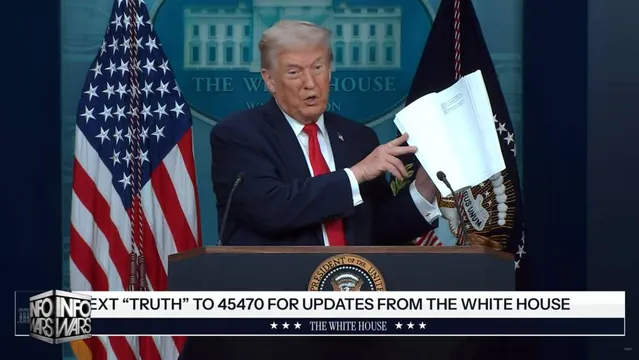
President Trump is presenting a comprehensive list of "365 wins in 365 days," highlighting the end of Biden-era stagflation and the return of high economic growth. The administration claims that fourth-quarter GDP is on track to exceed 5%, driven by a surge in domestic manufacturing and business investment. Trump also criticized the Federal Reserve for raising interest rates in response to economic success, calling it an attempt to "kill success."

Donald Trump discusses the reversal of "Biden stagflation" and claims the United States is currently experiencing a massive economic boom. He cites a fourth-quarter GDP growth track of over 5% and criticizes the Federal Reserve for raising interest rates during periods of success. Trump highlights the construction of the world's largest factories within American borders.

Donald Trump announces the apprehension of terrorists responsible for the Abbey Gate bombing in Afghanistan. He claims to have forced NATO members to increase their defense spending to 5% of GDP. While asserting he has done more for NATO than anyone else, Trump questions whether European allies would come to the aid of the United States in a conflict.

A summary of current economic indicators shows inflation at 2.7%, record high stock markets, and 4.2% unemployment. Trillions of dollars in foreign investment are reportedly entering the United States, alongside new trade deals with the EU and Japan. These facts are used to counter Democratic claims of a national calamity or economic failure.

The US housing market is reportedly rolling over, with a significant correction expected to impact 20% of the GDP. Edward Dowd characterizes the Federal Reserve's decision to hold interest rates high based on "fake" payroll numbers as the biggest policy error in history. While inflation rates are slowing, the cost of insurance, taxes, and food remains a burden on consumers, leading toward a full-blown recession that the Trump administration must navigate.

The European Union is described as being on the verge of an economic collapse similar to the fall of communism. Germany's GDP is shrinking, and countries like Spain are reportedly implementing capital controls to prevent money from leaving the region. Analysts suggest the EU's "business model" of a 20-year war with Russia is a delusional strategy that will lead to its dissolution by 2030.

Economist Dr. Kirk Elliott reports that the U.S. GDP grew by 3% in the second quarter of 2025, exceeding expectations. Trump's trade strategy has secured a $550 billion direct investment from Japan and a deal for the EU to purchase $750 billion in American energy. These wins are attributed to the strategic use of reciprocal tariffs to level the global playing field.

Billionaire investor Chamath Palihapitiya warned that the military-industrial complex frequently invents escalations to trigger wars that benefit defense contractors. Palihapitiya noted that oil prices reaching $112 or higher would be calamitous for global GDP and inflation. Data from 2024 shows that 20 million barrels of oil per day flow through the Strait of Hormuz, making it the world's most critical energy chokepoint.

Elon Musk has endorsed a constitutional amendment that would make members of Congress ineligible for re-election if the national deficit exceeds 3% of GDP. The US is described as being in the final stages of "debt slavery," with $12 trillion added to the debt in just four years. Historical data is presented showing the massive loss of purchasing power since the creation of the Federal Reserve.

Economic AI models predict a significant milestone in 2030, where the US dollar faces a high probability of losing its reserve currency status. Factors such as the BRICS nations' de-dollarization and a potential Chinese invasion of Taiwan could accelerate this timeline toward financial Armageddon. Vladimir Putin and Volodymyr Zelensky are currently involved in diplomatic maneuvers in Turkey, with Donald Trump responding to the lack of a formal meeting.

NATO officials are calling for defense spending to exceed the current 2% GDP target, citing increased global threats. The discussion touches on the destruction of the Nord Stream pipeline and the lack of European opposition as evidence of globalist control. Furthermore, the Biden administration is characterized as a "government by committee" due to the president's documented cognitive decline.

Economic data indicates the United States may avoid a recession as manufacturing futures show positive growth under the current administration. Claims are made that the previous administration provided fraudulent economic numbers, while the current trade war strategy is yielding international victories.

Mainstream media outlets report a GDP dip and trade deficits, while financial publications like The Wall Street Journal highlight blowout tech earnings and robust manufacturing. Shipping volume at the Port of Los Angeles is down 35% as businesses adjust to new tariffs targeting Chinese exports.

Economist Edward Dowd joins the show to discuss the "popping" of the AI bubble and a looming housing bubble. Dowd predicts a recession with a potential 50% drawdown in the stock market, comparing the current economic climate to Ronald Reagan's first term. He argues that the previous administration used fraudulent numbers and excessive deficit spending to temporarily float the GDP, which is now reversing as Trump takes office.

Dmitry Peskov, the Kremlin spokesperson, and financial advisors have indicated that Russia is not seeking sanctions relief, as their GDP growth has outperformed Europe's despite the restrictions. Howard Lutnick is mentioned in the context of the US trade strategy, which aims to lower the dollar's value to flood the country with jobs. The host agrees with Trump's assessment that the US holds "all the cards" in the current economic negotiation and can achieve independence from globalist systems.