Topic: Nicolas Maduro

103 chapters across the catalog

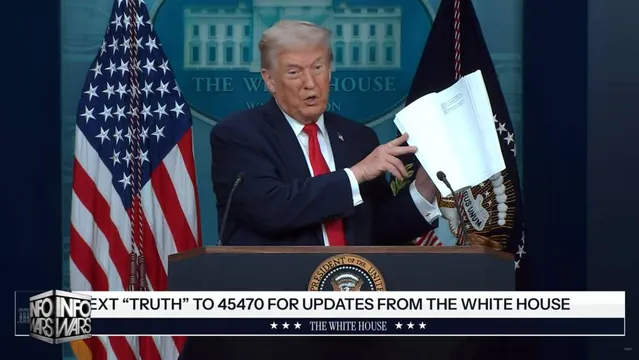
Donald Trump claims Venezuela emptied its prisons into the United States, though he notes a recent improvement in relations with the country. He reiterates claims that the 2020 presidential election was rigged and that new evidence continues to emerge. Trump emphasizes that his administration is working to deport 10,000 criminals who entered through open borders.
FULL VIDEO: President Trump Presents 365 Wins In 365 Days To The American People At Historic Press Conference!
37:34 - 40:19

FULL VIDEO: President Trump Presents 365 Wins In 365 Days To The American People At Historic Press Conference!

Birthright Citizenship, Fentanyl, Nicolas Maduro Capture

Donald Trump discusses an executive order to end birthright citizenship for children of illegal migrants, arguing the 14th Amendment was intended for children of slaves. He designates fentanyl as a weapon of mass destruction following 300,000 annual deaths. Trump also takes credit for the capture of Venezuelan dictator Nicolas Maduro, labeling him a "tremendous drug dealer."

FULL VIDEO: President Trump Presents 365 Wins In 365 Days To The American People At Historic Press Conference!
1:20:21 - 1:22:43

FULL VIDEO: President Trump Presents 365 Wins In 365 Days To The American People At Historic Press Conference!

Gavin Newsom Relationship, Maduro Custody, 2020 Election

Donald Trump reflects on his "exceptional" past relationship with Gavin Newsom before they "went astray" over California's management. He declines to speak personally with Nicolas Maduro in prison regarding 2020 election tampering claims. Trump also asserts that if the Supreme Court rules against his tariffs, he has "other alternatives" to secure Greenland.

Footage is discussed showing a Minneapolis resident physically pushing protesters out of the road to pick up his daughter. Mike Lindell claims these protests are highly organized and funded by George Soros, noting that similar "Free Maduro" signs appeared nationwide within hours of his arrest. The Mayor of Minneapolis and Governor Walz are accused of encouraging these disruptive tactics.

A first-hand account from a Venezuelan security guard describes a high-tech U.S. raid to extract Nicolas Maduro. The guard claims American forces used sonic weapons that caused soldiers to vomit blood, as well as AI-assisted guns and drones. The host celebrates the technological superiority of the U.S. military while questioning why similar force isn't used against domestic political targets like Tim Walz.

Enrique Tarrio and Alex Jones discuss Donald Trump's use of the Monroe Doctrine to counter Chinese and Russian influence in the Western Hemisphere. Tarrio, a Cuban-American, supports the "strangling" of the Venezuelan oil supply to topple the Maduro regime, which he views as a puppet of Cuba. The conversation details the dire living conditions in communist Cuba and the strategic necessity of removing hostile regimes from America's backyard.

Venezuela is facing economic collapse following a U.S. oil blockade, leading to reports of gunfire and explosions near the presidential palace in Caracas. Alex Jones prepares to debate Jackson Hinkle, a supporter of Maduro, regarding the potential for a long-term quagmire in the region. Additionally, claims have surfaced from Patrick Byrne suggesting the Trump administration will release proof of Hollywood stars being on the Venezuelan communist payroll for decades.

Jackson Hinkle argues that the Venezuelan people largely support Nicolas Maduro because he protects national resources from foreign exploitation by the Rothschilds and multinational banks. He claims that the opposition, led by Maria Corina Machado, is funded by the NED and Zionist interests to facilitate a hostile takeover of Venezuelan oil. Jones counters by citing reports of militia violence and election fraud, though Hinkle maintains that Venezuela's voting system is more secure than that of the United States.

Hinkle recounts a conversation with Nicolas Maduro, who expressed a desire to work with Donald Trump but claimed his efforts were blocked by John Bolton and Mike Pompeo. He warns that a U.S. occupation of Venezuela would face a 2-million-strong armed militia and skilled guerrilla forces, making it a deadlier conflict than Vietnam. Jones acknowledges the danger of the situation, noting that the militias have vowed to resist any foreign-installed government regardless of central military actions.

Donald Trump's military intervention in Venezuela is analyzed as a return to the Monroe Doctrine and classic Americana gunboat diplomacy. The operation resulted in the capture of Nicolas Maduro and is described as a strategic move to secure oil and gold resources before China could exert full control. Jones expresses concern that the success of this mission might embolden the military to strike Colombia, Mexico, and Cuba.

Trump issues threats to Venezuela's new leader, Delcy Rodriguez, warning her of a fate worse than Maduro's if she does not comply with U.S. demands for free elections. While the initial extraction of Maduro was successful, critics like Tulsi Gabbard and General Flynn warn against escalating strikes into Cuba, Mexico, and Colombia. The administration is reportedly pressuring the Venezuelan communist infrastructure to release political prisoners.

A detailed tactical breakdown of "Operation Southern Spear" describes the surgical extraction of Nicolas Maduro from Caracas at 2:00 AM. The mission involved 150 aircraft, including F-35 stealth fighters that created a sonic shield to mask Delta Force helicopters. Operators reportedly used blowtorches to breach a safe house within the Fort Tuna complex after a CIA mole provided the exact location.

Senator Marco Rubio defends the limited scope of the military operation, explaining that capturing every indicted official simultaneously would have required a full-scale occupation. The primary objective was the "top target," Nicolas Maduro, and his wife Celia Flores, both of whom were indicted drug traffickers. Rubio emphasizes that the mission was a success because it secured the high-value targets without American casualties.

Speculation arises that Maduro may turn state's evidence to expose deep state money laundering and election fraud involving the Democratic Party. Patrick Byrne notes that Maduro was effectively a prisoner of his own Cuban bodyguards, who wanted him to die as a martyr for the "Bolivarian Revolution." The U.S. raid may have functioned as a rescue mission for Maduro, who was unable to flee on his own.

Alex Jones presents a "global exclusive" theory that the U.S. military raid was actually a mission to save Maduro from Cuban and Chinese intelligence forces. This would allow Maduro to testify against the "communist spies" allegedly embedded within the American government. The discussion references Joe McCarthy's historical warnings about infiltration, suggesting Maduro holds the names of 25 active spies.

Alex Jones discusses the January 4, 2026, regime change in Venezuela, characterizing it as a pragmatic move by Donald Trump to secure U.S. sovereignty. He alleges that Smartmatic, a company linked to the Venezuelan government, has manipulated U.S. elections for decades through Dominion and Sequoia voting systems. Jones argues that the operation follows the Monroe Doctrine to remove a communist dictatorship and secure the Western Hemisphere from Chinese and Cuban influence.

Nicolas Maduro is reported to be in U.S. custody in New York, where he is expected to provide evidence regarding globalist money laundering networks and Democrat-linked NGOs. Jones references historical reporting by Lou Dobbs to support claims that Venezuelan-controlled Smartmatic software has influenced elections in 120 nations. The capture is framed as a death blow to the deep state's financial and electoral infrastructure.

A CNN clip features analysis of the military precision required to capture Maduro alive without U.S. casualties, noting that Russia, China, and Iran are privately impressed. Jones claims Maduro intentionally flooded the U.S. with hardened criminals during the Biden administration as a destabilization tactic. He asserts that the successful capture has already triggered a massive shift of global capital back to the United States.

Speculation grows regarding a potential declaration of war or military escalation in Venezuela to serve as a domestic distraction. Nick Fuentes and others warn that this could become a "new Vietnam," orchestrated by the CIA to trap the Trump administration in a quagmire. While the goal of removing Nicolas Maduro is supported in principle, the risks of narco-terrorism and failed nation-building in the jungle terrain are highlighted.

Tucker Carlson confirms that a member of Congress informed him of a planned declaration of war against Venezuela. While the U.S. has deployed its newest aircraft carrier, the Gerald Ford, analysts doubt a full-scale ground invasion is feasible with the current troop levels. The strategy is likely "effects-based," targeting command and control centers to force a regime change without a long-term occupation.