Topic: Chips

113 chapters across the catalog

The United States is described as being at the 250-year "expiration date" typical of historical empires. The current economic crisis is linked to rising oil prices, which serve as the basis for all inflation, affecting everything from fertilizer to semiconductor production in Taiwan. The narrative argues that the country is "committing suicide" through immoral leadership and a lack of sound military strategy.

Stuart Rhodes and Alex Jones discuss the influence of "dark money" in Texas politics, specifically citing Peter Thiel's support for candidates opposing populist incumbents. They endorse Dr. Pete Chambers for Governor and Paul Bondar for Congress, criticizing Governor Greg Abbott for being part of the "establishment setup." The hosts also mention a confusing Trump endorsement for a baseball player running for Chip Roy's seat, suggesting the President's staff may be selling endorsements without his full knowledge.

The discussion focuses on how the "machine" around Donald Trump may be selling endorsements to establishment candidates without the President's knowledge. Bondar cites a recent special election loss in a Republican stronghold as evidence that these endorsements are becoming "watered down." He urges voters to look past endorsements and examine a candidate's financial backers to ensure they are not electing a "pawn of the deep state."

Congressman Chip Roy and Senator Tom Tuberville have launched the "Sharia-Free America Caucus" to combat the spread of Islamic law in the US. Gabriel urges listeners to join "Act for America" and start local chapters to monitor city council decisions and school board policies. She advocates for a "new crusade" of information and democratic engagement to protect the US Constitution.

The Safeguard American Voter Eligibility (SAVE) Act, originally introduced by Representative Chip Roy, passed the House in April 2025 and currently faces a legislative bottleneck in the Senate. Majority Leader John Thune has signaled potential support for an updated version, while House Republicans like Annapolina Luna threaten to stall government spending bills unless the voter ID requirements are attached. The legislation aims to mandate documentary proof of U.S. citizenship for federal voter registration to prevent non-citizens from participating in elections.

The Safeguard American Voter Eligibility (SAVE) Act, introduced by Representative Chip Roy, aims to require proof of citizenship for federal voter registration. Senate Majority Leader John Thune is identified as the "choke point" for the bill's passage. The segment argues that non-citizens are being added to voter rolls through automatic systems and social security number loopholes.

Economist Dr. Kirk Elliott reports that silver has reached $95 an ounce, outperforming gold by a factor of four in early 2026. Unlike previous speculative bubbles, the current price surge is driven by fundamental supply shortages and massive industrial demand for AI chips, electric vehicles, and solar technology. Analyst Eric Sprott has projected that silver could reach $300 an ounce as global mining supply fails to meet the needs of emerging technologies.

A bill aimed at banning gender-reassignment surgeries for minors has successfully passed through the Senate following a strategic amendment withdrawal by Representative Chip Roy. The legislation targets federal funding for states that continue these procedures, which are being framed as violations of the established medical code. Despite lobbying efforts from Big Pharma and major medical centers, proponents view the bill's progress as a significant populist victory.

Congresswoman Marjorie Taylor Greene discusses her legislation, the Protect Children’s Innocence Act, which seeks to make "gender-affirming care" for minors a federal felony. She accuses fellow Republican Chip Roy of attempting to gut the bill with an amendment that would protect "sanctuary states" like California. Greene argues that the bill is essential to stopping the chemical and surgical castration of children nationwide.

Reports from individuals with brain chips in Austin, Texas, suggest that the devices can cause "psychotic nightmares" and involuntary internet surfing during sleep. While brain chips are acknowledged as beneficial for quadriplegics or those with seizures—citing a personal anecdote about a relative's recovery—there are concerns about hacking and the loss of human autonomy.

Donald Trump claims that the United States has secured $18 trillion in investment commitments within ten months, contrasting it with one trillion during the Biden administration. While Trump highlights new factory construction and foreign investment from companies like Toyota, critics argue that average Americans are still struggling with high inflation and car prices. The current economic state is described as the "best house in a bad neighborhood," with warnings that voters are growing impatient for immediate relief.

Donald Trump defended his policy of allowing foreign experts into the U.S. to open complex manufacturing plants, such as the battery factory in Georgia. He argues that American workers must be taught these detailed skills by those who have done it before to ensure the success of multi-billion dollar investments. Trump acknowledges he may take "heat" from his conservative base but insists this is necessary for the MAGA agenda.

Kyle Serafin argues that the FBI's claim of a "missing" digital footprint for a 20-year-old in the modern era defies logic. He points out that Bongino previously expressed skepticism about this lack of data before joining the administration. Serafin suggests that the FBI is using Bongino and Patel to maintain an official narrative that protects the agency from scrutiny.

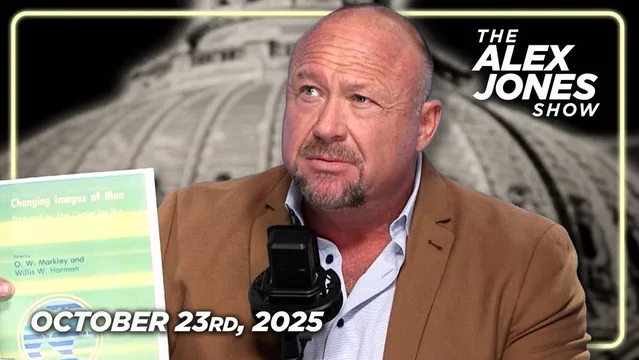
The "Changing Images of Man" text was published by Robert Maxwell's publishing house, linking it to high-level intelligence networks. The document discusses "panspermia"—the idea that life was planted on Earth by off-world entities—and the potential for brain chips to create a real-world "Brave New World" scenario. These technologies are presented as tools for the "priests of power" to control human conduct and evolution.

New developments in the Ukraine conflict and the Charlie Kirk trial are introduced, with Tucker Carlson reportedly expressing concern over a potential cover-up. Congressman Chip Roy of Texas joins the discussion to label the government shutdown as "economic terrorism" designed to crash the economy. The segment emphasizes that the current shutdown is the third longest in history and represents a constitutional crisis.

Congressman Chip Roy criticizes the Democratic Party for weaponizing the government against citizens and pushing radical social agendas in schools. He asserts that while the left holds a "No Kings" rally, the only true king is Jesus Christ, a sentiment he claims Charlie Kirk was killed for expressing. Roy outlines Republican priorities, including securing the border, passing the Laken Riley Act, and defunding the World Health Organization.

The discussion continues regarding 9/11, focusing on the deaths of first responders due to toxic dust and the presence of molten metal that office fires could not produce. Material science evidence, such as fused concrete and steel artifacts found in the NYPD 9/11 Memorial Museum, suggests temperatures reached 3,400 degrees Fahrenheit. The segment also mentions the discovery of human bone chips ejected hundreds of feet laterally, which implies the use of high explosives.

The global supply chain for rare earth minerals remains heavily dependent on China, complicating efforts to move battery and tech production to the United States. Concurrently, advancements in Neuralink technology are being discussed for their potential to restore eyesight and mobility to the blind and paralyzed. Concerns are raised regarding the integration of AI with human consciousness and the potential for "backdoors" in future brain-chip interfaces.