Topic: Atf

76 chapters across the catalog

Donald Trump is reportedly surrounded by sycophants and Israeli operatives who are influencing his policy decisions, including his stance on the Charlie Kirk murder investigation. Despite ATF findings regarding ballistics, Trump has called for the prosecution of anyone questioning the official narrative of the event. Critics argue this environment at Mar-a-lago is leading to a "runaway train" scenario that threatens the populist movement.

The Loudermilk report revealed that law enforcement cell phones were excluded from the initial search for the J6 pipe bomber, despite the likelihood that suspects used FirstNet devices. Kyle Serafin theorizes that the January 6 events involved an "inner government conspiracy" including members of Congress and the Capitol Police. In this theory, the FBI and CIA acted as a "mop-up crew" to contain the fallout and protect those involved.

The ATF has reportedly issued an inconclusive finding regarding the bullet used in the Charlie Kirk assassination, contradicting early claims about the caliber. Donald Trump has publicly urged Erica Kirk to "sue the ass off" anyone questioning the official narrative of the murder. This "stream of consciousness" from the president is seen as an attempt to suppress legitimate investigative questions before they reach a court of law.

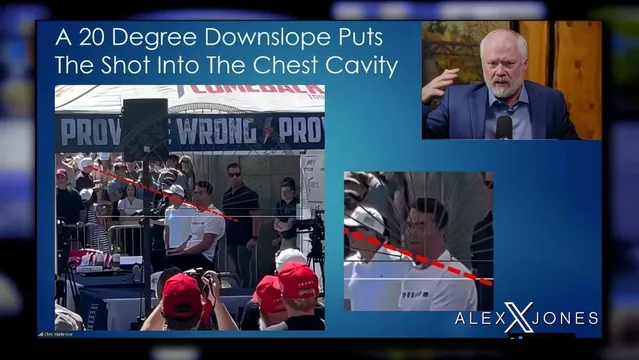
The ATF has reportedly determined that the bullet used in the September 10th shooting of Charlie Kirk was not a 30-06 round, contradicting earlier reports. Alex Jones argues that a 30-06 round would have exited the neck at that range, suggesting a cover-up involving the FBI and Cash Patel. Jones discusses his personal experience with high-powered rifles, including the 300 Win Mag, to highlight the ballistic inconsistencies.

Former Green Berets Nate Karnacki and Gary Melton join the show to discuss the ATF's "inconclusive" ballistic report on the Charlie Kirk shooting. They argue that the lack of a conclusive match between the recovered fragment and the 30-06 rifle is a major red flag. They discuss the legal implications of "exculpatory evidence" that could exonerate the primary suspect, Tyler Robinson.

The speaker reflects on a personal commitment to truth-telling over the last decade, contrasting it with the perceived lies surrounding the Charlie Kirk case. New ballistics evidence suggests Kirk was not shot with a .30-06, as the bullet did not exit the throat despite the caliber's high power. Tyler Robinson is characterized as a "patsy" in a larger MK Ultra-style operation designed to set him up at the scene.

Retired Green Beret Nate Kornacki discusses the ATF forensic expert's testimony that the bullet found in Charlie Kirk does not match the 30-06 rifle found by the FBI. Kornacki points out that sheriff department bomb dogs failed to find the weapon initially, only for the FBI to "magically" discover it minutes later. The lack of a ballistics match is seen as a major blow to the prosecution's case against Tyler Robinson.

The conversation turns to the 1993 Waco siege, noting that Kyle Serafin's father was a prominent reporter who interviewed David Koresh during the standoff. They discuss the failures of the ATF and FBI at Waco and Ruby Ridge, using these events as historical examples of government overreach and lack of accountability. Todd Blanche's recent press conferences are critiqued for "muddying the waters" by focusing on crazy tips to distract from legitimate evidence in the Epstein files.

Dr. Chambers outlines his "Day One" plan as governor, which includes a call for prayer and fasting followed by the massive expansion of the Texas State Guard. He proposes that any citizen who joins the guard should be exempt from property taxes. The goal is to create a defensive force capable of resisting federal overreach, such as potential ATF gun seizures.

Kyle Serafin details the retaliation he faced from the FBI after blowing the whistle on the targeting of Catholics. He describes a "sting" operation involving a "solvent trap" (a precursor to a firearm suppressor) that the ATF used to search his home. Serafin explains that he had the item shipped to the FBI office for research purposes, yet was still targeted for felony prosecution.

A discussion on personal safety highlights the necessity of being a "hard target" by carrying firearms to deter those making death threats. Kyle Rittenhouse presents "Abolish the ATF" merchandise, signaling a policy stance against the Bureau of Alcohol, Tobacco, Firearms and Explosives. The segment emphasizes that both Rittenhouse and his wife carry weapons for self-defense against political extremists.

The 1993 Waco siege and the Branch Davidians are cited as examples of federal overreach and PR-driven law enforcement violence. The narrative suggests that the Davidians had a right to defend themselves after being attacked by the ATF. Current ICE operations are contrasted as being lawful and constitutional, while warnings are issued about potential future "Waco-style" false flag events staged to blame Trump supporters.

The discussion continues regarding 9/11, focusing on the deaths of first responders due to toxic dust and the presence of molten metal that office fires could not produce. Material science evidence, such as fused concrete and steel artifacts found in the NYPD 9/11 Memorial Museum, suggests temperatures reached 3,400 degrees Fahrenheit. The segment also mentions the discovery of human bone chips ejected hundreds of feet laterally, which implies the use of high explosives.

Attorney General Pam Bondi is criticized for her comments on targeting "hate speech," which critics argue is a slippery slope toward First Amendment violations. The ATF has reportedly issued a subpoena to Stephen Crowder's team to identify a source who leaked information about the Kirk assassination, a move that allegedly required Bondi's approval.