Topic: Budget

87 chapters across the catalog

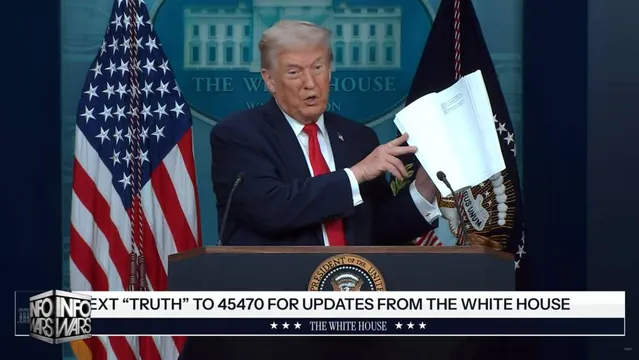
Donald Trump stated that the federal government cannot afford to fund daycare, suggesting that individual states should raise taxes to cover these costs. He argued that the federal government must prioritize military protection over social programs like Medicaid and Medicare. These comments signal a potential shift toward a wartime economy where federal social spending is significantly reduced.
New York City is facing a $5.4 billion budget shortfall, leading to proposals to raise property taxes and raid retiree health benefit funds. Hunter Gaylor criticizes the leadership of figures like Zohreh Mamdani, characterizing their policies as "cartelish behavior" that drives residents to Florida. The segment argues that New York's decline is a direct result of voters electing "communist" officials who prioritize free initiatives over fiscal stability.

Donald Trump details tax policy changes, including the elimination of taxes on tips, Social Security, and overtime. He introduces a tax deduction for interest on car loans, specifically for vehicles built within the United States to encourage domestic manufacturing. Trump also claims to have slashed the federal budget deficit by 27% in a single year.

Donald Trump is targeting defense contractors by threatening to revoke contracts if corporate profits exceed 20%. While pressuring companies like Raytheon, he simultaneously proposes increasing the defense budget to $1.5 trillion to ensure global dominance. Additionally, the administration is moving against predatory real estate conglomerates that buy entire housing tracts in "hot zones" like Austin, Texas.

An investigation is underway regarding the suspicious deaths of two students at Brown University and a high-level MIT scientist involved in black-budget free energy research. The suspect, an individual from Portugal with long-standing ties to the engineering department, is being scrutinized for potential connections to advanced technology and bio-weapons sectors. Claims are made that intelligence agencies and corporations frequently target scientists in these specialized fields.

MUST-WATCH ALEX JONES & NICK FUENTES INTERVIEW / DEBATE — 12/17/25
16:49 - 21:53

MUST-WATCH ALEX JONES & NICK FUENTES INTERVIEW / DEBATE — 12/17/25

Legislative Stagnation and the Threat of a Venezuela Conflict

Critics point to a lack of tangible policy victories, noting that only five bills have passed in the first year of the current term. Instead of focusing on a domestic agenda involving the border wall and election fraud, the administration is accused of being distracted by social media feuds. Reports suggest Trump may announce a war with Venezuela as a "short-term, easy intervention" to boost polling before the midterms, a move described as a potential trap set by the CIA.

The struggle for control of the Pentagon is linked to its massive budget, which can be used to hide "black budget" funding for the deep state. Senators Mitch McConnell and Tom Tillis are identified as potential obstacles to Pete Hegseth's leadership. Raiklin suggests that establishment Republicans are working to undermine Hegseth to protect the "J6 insurrection narrative."

The existence of a "secret space program" is discussed, with references to missing money from NASA, the DoD, and HUD. Daniel Lis mentions whistleblower Gary McKinnon's discovery of an "off-world officers list" as evidence of a program operating outside public knowledge. This secret infrastructure is allegedly tied to the continuity of government plans established during the Eisenhower administration.

Reports indicate that TSA agents and air traffic controllers have missed multiple paychecks, leading to staffing shortages and potential airspace shutdowns. Transportation Secretary Pete Buttigieg is blamed for the crisis, which has resulted in massive flight delays and safety concerns. The situation is described as a "cascade" of failures within the federal aviation system.

Vice President JD Vance uses a "bubble gum on a dam" analogy to describe the administration's efforts to fund essential services during the Democrat-led shutdown. Vance argues that the administration has exhausted its ability to move money around for SNAP benefits and other programs. He calls on Democrats to pass a "clean CR" (Continuing Resolution) to reopen the government rather than forcing the country to operate on a shoestring budget.

Donald Trump discusses the necessity of federal layoffs during the government shutdown, noting that many affected employees are Democrats who favor government control. Trump argues that the country cannot afford healthcare for illegal immigrants and suggests the shutdown could be used to eliminate unnecessary programs. Representative Hakeem Jeffries and other Democrats are criticized for lacking an exit strategy for the budget stalemate.

Kyle Serafin discusses the FBI's history of "setting up" vulnerable or mentally ill individuals to inflate terrorism statistics and secure larger budgets. He references the movie *Police State* and a specific case in Knoxville involving a J6 defendant. Serafin argues that the Bureau often allows dangerous individuals to "cook" longer to build more significant cases, sometimes resulting in preventable violence.

Owen Shroyer offers a critique of modern American communists, arguing that their desire for "free stuff" is mathematically impossible without addressing the $37 trillion national debt. He suggests a hypothetical compromise where the left and right agree to cut all foreign aid to Israel and Ukraine, redirecting those hundreds of billions of dollars into domestic infrastructure or healthcare. He concludes that trying to implement communism in the current debt-ridden system will lead to total collapse.

Congress is criticized for using "hostage negotiations" by bundling essential policies like border security and tax cuts into massive, complex bills. Principled conservatives express frustration that they must vote for bloated legislation to avoid tax increases or open borders. There is a call for a shift toward single-item reconciliation bills to prevent the government from holding citizens' interests over their heads like an anvil.

Elon Musk has renewed his attacks on the Trump-backed "mega bill," claiming it will destroy millions of jobs and fail to address the $35 trillion national debt. While Trump argues that other countries rig their currencies and the U.S. should do the same, Musk remains concerned about the long-term economic impact. The tension highlights a rift between the administration's political goals and Musk's focus on cost-cutting through DOGE.

Elon Musk reportedly feels "disenfranchised" after his DOGE team identified trillions in potential savings that the administration has largely ignored. Instead of instituting deep cuts, Washington D.C. has opted for a much smaller $10 billion reduction, leading to claims that Musk was "used" during the campaign. The failure to follow through on DOGE's findings is described as a missed opportunity to fix the national debt.

Senator John Fetterman faced backlash for complaining that budget negotiations were interfering with his family's trip to the beach. Critics pointed out that many Americans cannot afford such vacations and that Fetterman's primary job is to show up and vote. The incident is cited as an example of how out of touch some politicians are with the economic reality of the average citizen.

Before her assassination, Minnesota House Speaker Melissa Hortman cast a controversial vote to cut state funding for undocumented immigrants' healthcare. This decision was part of a budget compromise to secure Republican votes, which reportedly angered members of her own DFL caucus. Speculation has arisen that this specific vote may have been the catalyst for the politically motivated attack by the suspect, Vance Luther Bolter.

Representative Chip Roy announced his opposition to the "Big Beautiful Bill" (BBB), citing concerns over a 10-year moratorium that prevents states from regulating artificial intelligence. Roy argued that the bill destroys federalism and fails to implement significant spending cuts, noting that the projected $1.6 trillion in reductions are merely decreases in future increases. He warned that the bill would add $400 billion to the existing deficit in its first year.

A new rescission package totaling $98.4 billion is set for introduction in Congress, though it represents only a fraction of the cuts identified by Elon Musk. Tensions have risen following reports that Jared Isaacman, a close associate of Musk, had his NASA appointment blocked by Sergio Gore due to Isaacman's history of donations to Democrats. This move is cited as a primary reason for Musk's current frustration with the Trump administration's personnel decisions.