Topic: Federal Budget

19 chapters across the catalog

Donald Trump stated that the federal government cannot afford to fund daycare, suggesting that individual states should raise taxes to cover these costs. He argued that the federal government must prioritize military protection over social programs like Medicaid and Medicare. These comments signal a potential shift toward a wartime economy where federal social spending is significantly reduced.
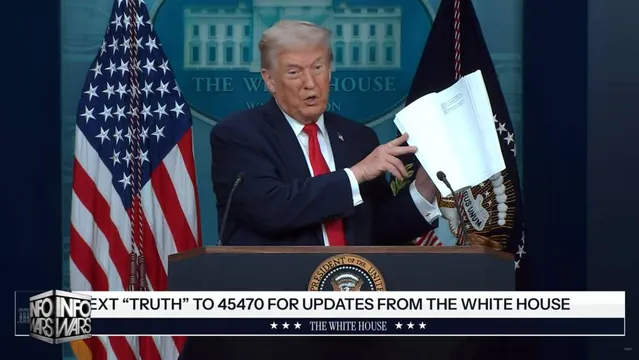

Donald Trump details tax policy changes, including the elimination of taxes on tips, Social Security, and overtime. He introduces a tax deduction for interest on car loans, specifically for vehicles built within the United States to encourage domestic manufacturing. Trump also claims to have slashed the federal budget deficit by 27% in a single year.

Donald Trump discusses the necessity of federal layoffs during the government shutdown, noting that many affected employees are Democrats who favor government control. Trump argues that the country cannot afford healthcare for illegal immigrants and suggests the shutdown could be used to eliminate unnecessary programs. Representative Hakeem Jeffries and other Democrats are criticized for lacking an exit strategy for the budget stalemate.

Congress is criticized for using "hostage negotiations" by bundling essential policies like border security and tax cuts into massive, complex bills. Principled conservatives express frustration that they must vote for bloated legislation to avoid tax increases or open borders. There is a call for a shift toward single-item reconciliation bills to prevent the government from holding citizens' interests over their heads like an anvil.

Representative Chip Roy announced his opposition to the "Big Beautiful Bill" (BBB), citing concerns over a 10-year moratorium that prevents states from regulating artificial intelligence. Roy argued that the bill destroys federalism and fails to implement significant spending cuts, noting that the projected $1.6 trillion in reductions are merely decreases in future increases. He warned that the bill would add $400 billion to the existing deficit in its first year.

Representative Thomas Massie is noted for his stance on a continuing resolution that includes significant budget cuts. Jones claims that Trump is successfully stabilizing the economy and reducing inflation despite the Federal Reserve's attempts to tank the market by increasing interest rates. He predicts that the public will begin receiving "checks in the mail" within six months as a result of recovered fraudulent funds.

The Trump administration is targeting a balanced budget within the next two years by utilizing the Department of Government Efficiency (DOGE) to cut trillions in waste. Elon Musk sent "pulse check" emails to federal employees to verify their existence and productivity, noting that many have failed to respond. The initiative aims to eliminate "ghost employees" and individuals holding multiple jobs while on the government payroll.

The DOGE team must cut $2 trillion from the federal budget just to reach a "break-even" point, as the US currently spends $1.8 trillion more than it brings in. Dr. Kirk Elliott reiterates his prediction that silver will hit $50 to $75 an ounce due to supply and demand imbalances. The administration's plan for a sovereign wealth fund is highlighted as a way to make the nation's assets work for the American people.

Catherine Austin Fitz, former Assistant Secretary of Housing, discusses the "red button" problem, where the US economy's reliance on "dirty money" laundering prevents systemic reform. She argues that the current political establishment is terrified of RFK Jr.'s health initiatives because they would expose how federal agencies have profited from the poisoning of American children. Fitz characterizes the current state of governance as "administrative terrorism" and "murder by pen."

Dave Smith Responds To Leftist Meltdown Insanity: We Must Target The Brainwashers— Not The Brainwashed
25:06 - 27:38

Dave Smith Responds To Leftist Meltdown Insanity: We Must Target The Brainwashers— Not The Brainwashed

Draining the Swamp through Government Spending Cuts

Draining the "swamp" is defined as making drastic cuts to the six trillion dollars in annual government spending that enriches politically connected individuals in D.C. suburbs. The segment highlights the disparity between the wealth of the capital's suburbs and the rest of the country. An advertisement for a "Save Alex Jones" fundraiser t-shirt follows, emphasizing the fight for free speech.

Senator Lindsey Graham faces criticism for pivoting from Hurricane Helene disaster relief in South Carolina to advocating for military aid to Israel. The segment contrasts the immediate needs of American citizens in storm-ravaged areas with the billions of dollars allocated by Congress for foreign conflicts and the migrant crisis. Arguments are presented that the federal government has prioritized foreign interests and border processing over domestic emergency funding.

Analysis of the 2024 federal budget revealed that 83% of all U.S. revenue is consumed by mandatory spending on entitlements and interest on the $34 trillion national debt. Dr. Kirk Elliott pointed out that once interest payments reach $1 trillion annually, there is virtually no revenue left for infrastructure, defense, or education. This fiscal trajectory was compared to the fall of the Roman Empire, which collapsed under the weight of similar entitlement burdens.

The discussion covers how rising silver prices will impact the cost of electronics and defense manufacturing, as silver is a critical strategic metal. Dr. Elliott points out that U.S. interest payments on federal debt are on track to reach $1 trillion this year, surpassing the budgets for Medicare and the Defense Department.

BREAKING: Globalists Resigning In Mass Ahead Of HUGE Events - MUST WATCH
21:55 - 25:53

BREAKING: Globalists Resigning In Mass Ahead Of HUGE Events - MUST WATCH

Inflationary Pressures, Federal Debt Interest Payments

Rising silver prices are expected to drive up retail costs for electronics and increase the federal defense budget, as strategic metals are essential for missile and torpedo production. The U.S. national debt has reached a point where interest-only payments are on pace to hit $1 trillion annually, surpassing the budgets for Medicare and the Department of Defense. Major food producers like Tyson Foods are reportedly warning the government about the potential for civil unrest as consumers struggle to afford basic staples.

The House of Representatives passed a $460 billion bipartisan spending bill, which Shroyer characterizes as a "swamp" initiative that does not benefit the American people. The segment also addresses the geopolitical tensions in the Gaza Strip and Ukraine. Shroyer predicts Biden will struggle to balance support for Israel with the concerns of pro-Palestinian voters during his speech.

The fall of the Roman Republic is compared to the current state of the United States, specifically regarding the "weight of entitlements." Dr. Kirk Elliott explains how the politician Clodius used free grain to buy votes in 56 BC, leading to a system where one-third of Romans were on government assistance. Today, nearly 80% of U.S. federal revenue goes toward entitlements and interest on the national debt, signaling an "already exploded" time bomb.

Peter St. Onge explains how the Federal Reserve hides the true cost of war and government spending through inflation. He notes that while the public may not feel the immediate impact of $100 billion sent to Ukraine, it manifests as rising prices for basic goods like eggs. The discussion covers the historical precedent of Paul Volcker and the likelihood that the current administration will choose currency devaluation over fixing the underlying debt.

Ottawa County, Michigan, is highlighted as a location where a new conservative county commission is attempting to return to constitutional governance. Patrick Colbeck explains how the state and federal governments use the "power of the purse" to force local compliance, threatening to strip funding if counties reject tools like Albert sensors. He encourages citizens to support local officials who take risks to protect election integrity and local sovereignty.

Emergency Broadcast! The Engineered Global Collapse Has Begun - FULL SHOW 10/3/21
1:33:31 - 1:36:09

Emergency Broadcast! The Engineered Global Collapse Has Begun - FULL SHOW 10/3/21

John Yarmuth and the Myth of Unlimited Federal Money

A video clip of Representative John Yarmuth is played, where he dismisses Senator Joe Manchin's concerns about the federal budget by claiming the government is not bounded by household income limits. Harrison Smith counters that the government has no money of its own and only operates by squeezing taxpayers or creating debt for future generations. He characterizes this mindset as a dangerous delusion that ignores the reality of economic consequences.