Topic: Trade Tariffs

75 chapters across the catalog

Howard Lutnick and his associates are reportedly profiting from the overturning of tariffs by purchasing billions in insurance against Supreme Court decisions. The narrative suggests Donald Trump is being set up by sophisticated financial actors and naive advisors who ignore military realities. Trump’s recent withdrawal from the UN and WTO is framed as a positive move currently jeopardized by the failing Iranian intervention.

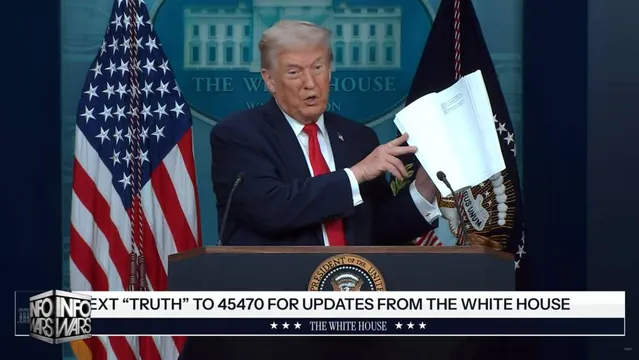
The host alleges that Howard Lutnick deliberately miswrote the tariff executive order to ensure it would be overturned by the Supreme Court, allowing his family to profit from insurance bets. Justice Kavanaugh's dissent is cited as a roadmap for Trump to reissue the orders using more durable legal authorities like the Trade Act of 1974. Trump confirmed during his press conference that he will immediately institute a 10% across-the-board provision using these alternative statutes.

Donald Trump criticizes the inclusion of men in women's sports and references ongoing Supreme Court deliberations on the matter. He credits his tariff policies for a 62% reduction in the trade deficit and for saving a Ford plant in Michigan. Trump argues that tariffs provide national security and significant federal income without causing inflation.

Donald Trump faces potential legal setbacks as Supreme Court justices express skepticism regarding the constitutionality of his trade tariffs. Despite Howard Lutnick's insistence that the administration will prevail, legal analysts suggest a majority opinion may rule against the president's power to levy these fees. The discussion frames tariffs as the heart of an economic recovery plan intended to reclaim sovereignty from the World Trade Organization.

Audio clips from the Supreme Court feature Justice Ketanji Brown Jackson questioning government lawyers about the historical use of the phrase "regulate importation" to confer tariff authority. The lawyer cites the 1971 Nixon tariff and the Yoshida case as legal precedents. The host mocks Justice Jackson's line of questioning, referencing her previous refusal to define the word "woman" during her confirmation hearing.

If the Supreme Court rules against the current tariff structure, Dr. Kirk Elliott outlines "Plan B" options, such as invoking Section 122 of the 1974 Trade Act or Section 338 of the 1930 Tariff Act. These laws allow for temporary tariffs to address trade imbalances and discrimination against U.S. trade. The discussion emphasizes that the administration has multiple legal avenues to continue its protectionist policies.

A federal court recently struck down Donald Trump's reciprocal tariffs as illegal, a decision that has been appealed to the Supreme Court. These tariffs are designed to force other countries to pay for American infrastructure and reduce the domestic tax burden on citizens earning under $200,000. Proponents argue that tariffs have been an unmitigated success in curbing China's military and economic expansion.

Economist Dr. Kirk Elliott reports that the U.S. GDP grew by 3% in the second quarter of 2025, exceeding expectations. Trump's trade strategy has secured a $550 billion direct investment from Japan and a deal for the EU to purchase $750 billion in American energy. These wins are attributed to the strategic use of reciprocal tariffs to level the global playing field.

Donald Trump has finalized a landmark trade deal with the European Union that sets a 15% across-the-board tariff and opens the EU market to American industrial standards. The agreement includes $750 billion in energy purchases and $600 billion in direct investment into the United States. Similar deals are reportedly being negotiated or finalized with Japan, Indonesia, and India to supercharge the American economy.

The U.S. government has reportedly collected $121 billion in tariff revenue since the start of the fiscal year, contradicting corporate media claims that the policy would cause high inflation. While a trade deal with Vietnam is officially finalized, many other nations are reportedly operating under new agreements with the Trump administration. The segment argues that the Federal Reserve is ignoring these positive growth indicators to intentionally depress the economy.

President Trump celebrates a court decision lifting a stay on his tariff authority, arguing it restores powers intended by the founders. He claims that without the ability to use tariffs quickly and nimbly, the US would be vulnerable to other nations. Trump also praises Elon Musk's Starlink for saving lives in North Carolina following a disaster.

President Trump rejects the "taco trade" label from Wall Street, asserting that his tariff threats against China and the European Union have successfully forced foreign leaders to the negotiating table. He claims his administration has secured trillions in investment commitments that were absent during the Biden presidency. The host contrasts Trump's active negotiation style with Joe Biden's perceived lack of engagement and frequent vacations.

President Trump discusses plans to cut federal funding from Harvard University and redirect those billions toward trade schools in states like Indiana and Iowa. He criticizes Harvard for its high percentage of foreign students and alleged anti-Semitism, suggesting the money is better spent training Americans for the "AI boom." Trump credits his tariff policies for creating a massive investment surge in U.S.-based AI plants.

Donald Trump's trade strategy involves targeting the EU for what he describes as predatory regulatory systems that exclude American products. The segment claims the EU has formed a public alliance with Xi Jinping and Communist China to defeat Trump's populist movement. Issues regarding European energy taxes and the banning of GMO foods are also addressed.