Topic: Strategy

147 chapters across the catalog

Historical analysis suggests that bombing campaigns often increase civilian support for a war effort rather than forcing a surrender, as seen in Britain during World War II. The current conflict with Iran is compared to the Vietnam War, where massive aerial bombardment failed to defeat a resilient population. The Persian military is described as a formidable force that has historically resisted outside intervention, regardless of the ideology of its leadership.
The Strait of Hormuz is identified as a primary military trap where Iran has stationed a third of its military forces in fortified underground bases. Former counterterrorism head Joe Kent resigned in protest after warning that a ground invasion would likely fail, despite political advisors pushing for the move. Critics argue that the mission to seize Iranian uranium is a "suicide mission" that ignores the Pentagon's 92% probability of failure.

Military assessments suggest that the current conflict with Iran is a deliberate move toward regime change that will eventually require a massive ground troop presence. Predictions indicate that the United States will first use Marines and Special Operations to seize islands near oil facilities, leading to a full military commitment. The strategy is criticized as a high-risk gamble that could lead to a global depression and a national draft.

The deployment of 7,000 US troops to the Strait of Hormuz is characterized as a "pawn sacrifice" intended to draw out Iranian military positions at the cost of American lives. This chess-based analogy suggests the operation is a strategic trap or a false flag designed to provoke a full-scale war. The segment warns that the public will be manipulated into supporting escalation once these troops are inevitably attacked.

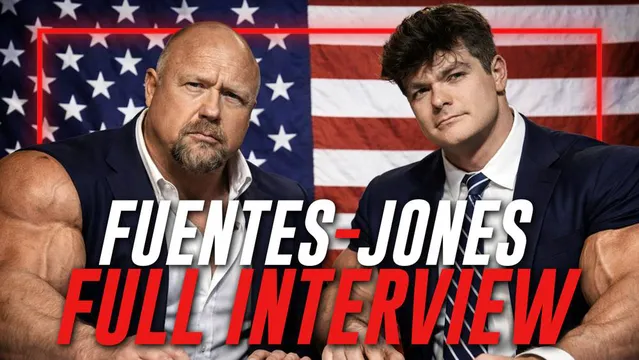
FULL FUENTES-JONES INTERVIEW 3/3/26: Trump Admin Pushes Ground Invasion Of Iran To Ensure Regime Change
17:25 - 19:34

FULL FUENTES-JONES INTERVIEW 3/3/26: Trump Admin Pushes Ground Invasion Of Iran To Ensure Regime Change

Israeli Grand Strategy and the Fragmentation of the Middle East

Analyst Nick Fuentes discusses the "Israeli grand strategy" of breaking up neighboring countries into smaller, manageable territories, citing Iraq and Syria as previous examples. There is ongoing discussion about using Kurdish forces as a ground element to facilitate the breakup of Iran. This multi-domain operation is viewed as a way to ensure no single regional power can challenge Israeli interests.

The speaker expresses optimism about the progress of the "information war," claiming that the globalist order is in retreat. He uses a metaphor of a boat pilot or a native guide for Lewis and Clark to describe his role in navigating current events. The segment emphasizes the need for a return to meritocracy and steadfastness in the face of institutional pressure.

An analysis of the Trump administration's 2026 National Defense Strategy suggests a pivot away from overseas regime change and "democracy promotion" toward defending the American homeland. The unrest in Minneapolis is characterized as a "color revolution" tactic being applied domestically by far-left agitators. The new strategy emphasizes industrial revival and the Monroe Doctrine over globalist interventionism.

There is a 40% chance that the U.S. operation in Venezuela will accelerate a Chinese invasion of Taiwan using similar extraction tactics. Speculation arises regarding a secret deal between Trump, Putin, and Xi Jinping to divide the world into three power zones, effectively ending the UN's rules-based order. This shift is evidenced by Trump's recent pressure on President Zelensky to settle the conflict in Ukraine.

Jones draws a historical parallel between the Venezuelan raid and the German invasion of France, where much of the opposition was allegedly bought off before the fighting began. He argues that the Venezuelan military's "stand-down" on Saturday morning was likely the result of similar pre-arranged deals. The primary resistance came from Maduro's "Praetorian Guard" of Cuban intelligence officers who refused to let him leave.

Donald Trump is described as upending the international "rules-based order" to empower the U.S. dollar and stabilize the planet. Defense Secretary Pete Hegseth contrasts this operation with the Iraq War, claiming the goal is stabilization rather than balkanization. Jones details how Trump used deceptive flight patterns and halted orders five times since Christmas to maintain the element of surprise and identify leakers within the Pentagon and Congress.

The current Republican leadership is criticized for using outdated 1990s-era PR tactics that fail to address the urgency felt by the American public. Donald Trump's current policies are characterized as moderate compared to the radicalized platform of modern Democrats, who have moved far to the left of 1990s figures like Bill Clinton and Chuck Schumer. This shift has created a political environment where compromise with the opposition is viewed as impossible.

President Trump’s new national security strategy explicitly opposes further NATO expansion and identifies mass immigration as a primary threat to the United States. European leaders and NATO officials have reportedly labeled Trump an enemy due to this shift in foreign policy. The strategy prioritizes American sovereignty and border integrity over traditional Atlanticist military alliances.