Topic: Oil Reserves

37 chapters across the catalog

The closure of the Strait of Hormuz by Iran has sent shockwaves through the global economy, causing oil prices to rise by $14 in a single day. Donald Trump’s administration is reportedly targeting Iranian water and electricity supplies, a move critics call illegal and likely to supercharge inflation. Analysts warn that the lack of an exit ramp in the Iran conflict could lead to a national default and the implementation of a "Great Reset" by globalists.
The conflict in the Middle East threatens the Trump administration's economic recovery plan by driving oil prices toward $100 per barrel. High energy costs serve as a baseline for inflation, disproportionately affecting lower-income populations and potentially derailing interest rate strategies. The segment suggests globalist forces are using the war to sabotage domestic economic gains, similar to the impact of COVID-19.

The modern borders of the Middle East were reportedly drawn by MI6 to ensure perpetual conflict by grouping warring tribes together. Tripoli explains how the British Empire manipulated the Saudi royal family into long-term fixed deposits, which fueled the global fractional reserve banking system. This history is used to illustrate how international banking cabals have historically seized control of global resources and land.

Robert Barnes warns that the CIA may be leading President Trump into a "Vietnam-style" quagmire in Venezuela. While Trump seeks to secure oil reserves and remove Chinese influence, Barnes argues that the CIA is providing false intelligence about the ease of extracting Venezuelan oil and the stability of the opposition. The concern is that a failed intervention would be used by the deep state to sabotage Trump's presidency.

Glenn Beck provides a breakdown of the Venezuelan crisis, explaining that the U.S. blockade is designed to cripple China's energy supply rather than secure oil for American consumption. Since China relies on Venezuela and Iran for the majority of its non-U.S. regulated oil, these maneuvers prevent Chinese AI dominance and the success of the BRICS currency. Beck and Jones agree that this "America First" policy is a pragmatic defense of the hemisphere against adversaries.

The United States is exerting dominance in the Western Hemisphere to secure 18 trillion barrels of heavy Venezuelan oil for domestic refineries. Analysts argue that maintaining hegemon status is essential to preventing an extended Great Depression worse than the 1930s. The narrative suggests that if the U.S. does not control these resources, the dollar will collapse, allowing the World Bank and IMF to implement a feudalistic social credit system.

The United States is reasserting the Monroe Doctrine in the Western Hemisphere, with a focus on removing the communist dictatorship in Venezuela. Venezuela is accused of manipulating U.S. elections and flooding the country with fentanyl. While generally opposing regime change, proponents argue that surgical strikes to depose Nicolas Maduro would allow for democratic elections and secure the world's largest oil reserves.

Federal Reserve Chairman Jerome Powell's decision to keep interest rates steady is viewed as a move that could devastate the Trump economy. If war with Iran drives oil to $300 a barrel, the resulting stagflation would force the Fed to raise rates, potentially triggering a depression. This economic scenario is framed as a "no-win" situation designed by globalists to sabotage Trump's recovery plan.

A military conflict with Iran is projected to drive oil prices to $130 per barrel and double the Consumer Price Index inflation to 5%. This scenario creates stagflation, where rising energy costs force the Federal Reserve to raise interest rates despite a sluggish economy. Such a policy shift would likely trigger a recession and undermine Donald Trump's economic recovery plans.

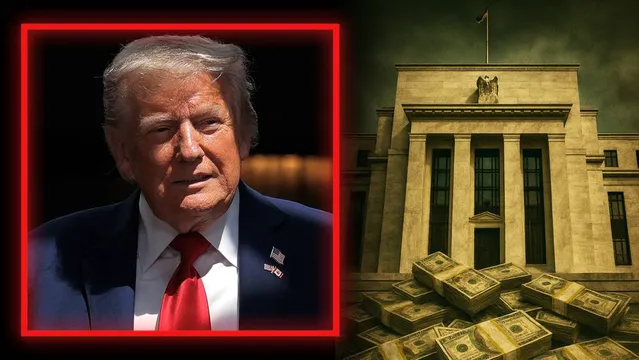
Donald Trump declares war on the international banking cartel, threatening to repeal the Federal Reserve Act if Jerome Powell refuses to lower interest rates. The administration plans to cap credit card interest rates at 10% and make America the global capital of AI and crypto. Trump reiterates the use of the military to repel what he describes as an "invasion" at the southern border.

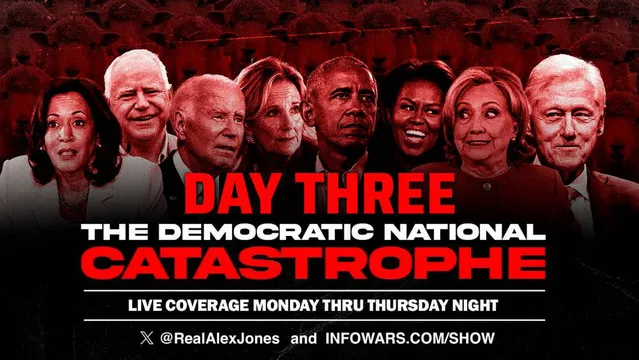
Day Three LIVE Coverage Of The DNC! Globalist Criminals Bill Clinton & Nancy Pelosi Next In Line To Support Harris
6:29 - 8:58

Day Three LIVE Coverage Of The DNC! Globalist Criminals Bill Clinton & Nancy Pelosi Next In Line To Support Harris

Iraq War Destabilization, Iran Influence, China Trade Dominance

Donald Trump critiques the bipartisan decision to enter the Iraq War, arguing it destabilized the Middle East and allowed Iran to gain control over Iraqi oil. He highlights China's strategic dominance in the global market for rare earth minerals and trade. Trump laments the loss of American lives and trillions of dollars in military spending without securing economic benefits like oil.

A discussion on the economic points raised in the Musk-Trump interview focuses on energy as the precursor to all wealth. Trump's argument that increasing domestic energy production will naturally lower inflation is highlighted. The hosts also clarify Trump's comments about Venezuela, explaining that he was highlighting how criminal migration has lowered Venezuela's crime rate at the expense of American security.

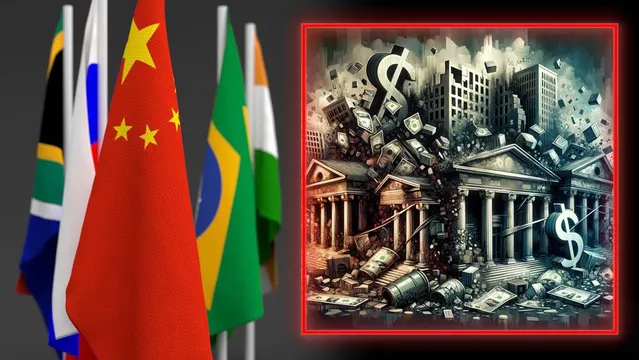
Economic disruption is predicted to lead to social unrest and potential martial law scenarios ahead of the 2024 US election. As the US depletes its strategic oil reserves, it becomes increasingly dependent on OPEC and BRICS nations for energy. The global power shift from West to East is expected to culminate in the BRICS nations controlling global trade benchmarks through gold and oil.

Globalists Panic, Admit Persecution of Trump Political & Fraudulent — 5/13/24
3:28:38 - 3:33:16

Globalists Panic, Admit Persecution of Trump Political & Fraudulent — 5/13/24

World War III Escalation, Nuclear Power Plant Threats, Bank Delinquencies

The potential for World War III to escalate is discussed, with warnings that a conflict between Israel and Iran could push oil prices above $130 a barrel. Celente cites a Federal Reserve report showing that office property loan delinquencies have jumped from 1% to 8% in a single year. He predicts that the banking crisis will eventually crash the equity markets and send gold to $3,000 an ounce.

The Biden administration is reportedly ramping up domestic oil production as a political tactic ahead of the 2024 election, despite previous moves to cancel the Keystone Pipeline and drain the Strategic Petroleum Reserve. The segment also revisits a 1989 UN prediction that global warming would wipe out entire nations by the year 2000. This is presented as evidence of a long-standing "climate scam" used to justify globalist control and the sale of Chinese-made green energy technology.

Russia has implemented a strategic ban on diesel exports, placing further pressure on global oil markets and driving up U.S. gas prices. While the Biden administration touts "Bidenomics," fuel costs are approaching $7 per gallon in states like California and New York. The U.S. Strategic Petroleum Reserve has been depleted to historic lows, leaving the country vulnerable to further energy price spikes.

The segment criticizes the Biden administration's request for oil producers to increase output after allegedly depleting the Strategic Petroleum Reserve. The speaker uses a metaphor of a person being hacked with a hatchet to describe the state of the US energy industry. The topic concludes with a final pitch for InfoWars products like X3 and Vitamin Mineral Fusion before a transition to the next hour.

Gerald Celente analyzes the global economy, predicting that the Federal Reserve's interest rate hikes will eventually lead to a significant downturn. He forecasts that when the Fed eventually lowers rates, the dollar will weaken and gold prices will surge. Celente identifies potential military conflict between Israel and Iran as a "wildcard" that could send oil prices over $130 a barrel and crash equity markets.