Topic: Narcos

23 chapters across the catalog

The Trump administration has designated Mexican drug cartels as foreign terrorist organizations, involving the Department of War in extraction and interdiction efforts. Victor Avila explains that while Mexican President Claudia Sheinbaum is cooperating more than her predecessors, the cartels still maintain a stronghold on the country's power structures. The US is pursuing a strategy of "bilateral or unilateral" action to dismantle these narco-terrorist groups.

Venezuela is characterized as a long-term CIA playground where the agency allegedly manages drug trafficking and election fraud through Smartmatic software. The discussion references the television show Narcos as an accurate depiction of how the CIA and cartels operate in Latin America. Claims are made that the deep state uses Venezuela as a command base to manipulate elections in over 100 countries.

Senator Marco Rubio defends the limited scope of the military operation, explaining that capturing every indicted official simultaneously would have required a full-scale occupation. The primary objective was the "top target," Nicolas Maduro, and his wife Celia Flores, both of whom were indicted drug traffickers. Rubio emphasizes that the mission was a success because it secured the high-value targets without American casualties.

Christopher, an American-Ecuadorian, reports on the regional impact of the Venezuelan crisis, noting that Ecuadorian citizens are generally supportive of Maduro's removal. He discusses the influx of Venezuelan migrants into Ecuador and the concerns regarding how closing Venezuelan drug routes might shift narco-trafficking into Colombia and Peru. He emphasizes the privilege of American citizenship compared to the conditions in socialist Latin American states.

Roger Stone and Alex Jones discuss the escalating pressure on Venezuela, framing it as a necessary move to stop Marxist narco-trafficking and Chinese influence in the Western Hemisphere. Stone alleges that Venezuelan-affiliated election companies were involved in interfering with the 2020 and 2024 U.S. elections. They argue that the blockade is not about regime change but about securing the Republic against a "mafia-run state" that funds regional instability.

Stephen Miller describes Mexican cartels as "narco-terrorists" who use rape and skinning as weapons, arguing for the use of hard American power to stop them. Donald Trump's criticisms of the Somali community in Minnesota are highlighted, focusing on high welfare rates and the alleged corruption of Representative Ilhan Omar.

Patrick Byrne reads portions of Hugo Carvajal's letter, which details how the Venezuelan government coordinated with FARC, ELN, and Hezbollah to flood U.S. cities with narcotics. The letter states that the "Cartel of the Suns" was a deliberate policy to destroy the United States through weaponized drug trafficking.

Donald Trump and Pete Hegseth address the media regarding military strikes against narco-terrorist vessels at sea. Hegseth explains the deliberative process involving JSOC and SOCOM to ensure targets are tied to terrorist organizations. They defend the decision to sink a specific boat to eliminate the threat of fentanyl poisoning, dismissing war crime allegations as "fog of war" misunderstandings by the press.

Secretary Pete Hegseth reports that military recruiting and retention have reached historic levels following the removal of DEI and political correctness policies. The Department of War is focusing on "lethality" and "readiness," including the development of next-generation F-47 capabilities and the Golden Dome. Hegseth emphasizes that maritime drug smuggling is down 91% due to a shift from a "rinse-and-repeat" arrest policy to one of active deterrence and striking narco-boats.

A retired Marine caller argues that Senator Mark Kelly has clearly violated the Uniform Code of Military Justice (UCMJ) and could be recalled to active duty for a court-martial. Meanwhile, Karoline Leavitt confirms that President Trump and Secretary Hegseth have authorized lethal strikes against narco-terrorist groups in accordance with the laws of war. Jones asserts that these strikes are necessary to cut off the "Deep State's piggy bank" of drug money.

Donald Trump ordered a military strike on a vessel operated by a narco-terrorist organization in international waters to prevent fentanyl from entering the United States. Senator Marco Rubio confirmed the strike and stated that under the Trump administration, such interdictions will continue as a matter of policy. The administration maintains the legal authority to use force against groups trafficking deadly drugs and potential terrorists.

The Trump administration's strike on a Venezuelan vessel carrying fentanyl is defended as a necessary act of "defensive war." Senators Marco Rubio and JD Vance are cited as supporters of using military force to stop the "poison" flooding the country. The segment argues that the million and a half Americans killed by fentanyl justify the use of violence against the cartels and the governments that support them.

Mexican Senator Lili Tellez appears in an interview to describe Mexico as a "narco-state" under President Claudia Sheinbaum. Tellez alleges an alliance between the ruling Morena party and criminal cartels, claiming that the government is resisting U.S. assistance to protect these interests. She expresses fear for her life following threats of criminal prosecution from the Mexican presidency.

Catherine Austin Fitz, former Assistant Secretary of Housing, discusses the "red button" problem, where the US economy's reliance on "dirty money" laundering prevents systemic reform. She argues that the current political establishment is terrified of RFK Jr.'s health initiatives because they would expose how federal agencies have profited from the poisoning of American children. Fitz characterizes the current state of governance as "administrative terrorism" and "murder by pen."

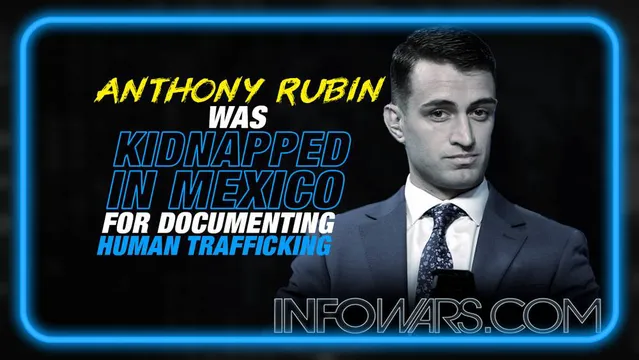
In Pasto, Colombia, Rubin discovered a hotel exclusively serving Chinese nationals, with logbooks showing weeks of consistent occupancy by military-age men. He describes the Darien Gap as a lawless zone where migrants face robbery, rape, and death, with an estimated 80% of women being assaulted. The segment highlights how NGOs funnel people into these dangerous routes controlled by narco-terrorists.

Rubin describes his experience riding "The Beast" freight train through Mexico, where he witnessed thousands of migrants being loaded by cartel members. He describes the guards as looking like "ninjas" from the League of Shadows, armed with swords, body armor, and AR-15s. These cartel members manage the transit of migrants and extort them at various checkpoints along the rail line.

The narrative that border migration is a humanitarian effort is challenged by citing high rates of sexual assault reported by Amnesty International. Rubin argues that the UN and U.S. State Department are funneling vulnerable people directly into the hands of brutal narco-terrorists. The ultimate goal is described as the creation of managed anarchy to justify the imposition of a totalitarian state.

A caller reports on an investigation involving the illegal sale of over 1,000 planes through an airport in Onalaska, Texas, to an international fugitive named Frederick Machado. Machado is allegedly a narco-trafficker with ties to Colombia and Argentina. The caller suggests this operation is part of a larger pipeline of illicit activity facilitated by the current administration's border policies.