Topic: Stanford

66 chapters across the catalog

The 1981 book Millennium and the writings of Willis Harman are analyzed regarding the future of technocracy. Dyer explains the concept of "essential" versus "non-essential" workers and the implementation of a universal basic income tied to social credit. The segment describes a future based on "eco-austerity" and collective thinking, where individual lifespans and resources are managed by computers.

A "soft coup" is reportedly being executed through a network of over a hundred organizations, including Stanford University, to dismantle American sovereignty. This industry of open-source intelligence analysts is accused of targeting populist movements under the guise of hunting for disinformation. The segment argues that this $33 billion-a-year machine employs 215,000 people to enforce technocratic priorities and social justice mandates across the globe.

Australia has passed the Social Media Minimum Age Act, banning accounts for those under 16 and requiring biometric or ID-based verification. Critics, including Elon Musk, argue this is a backdoor for mass surveillance and total internet control. Simultaneously, the EU's Digital Services Act and the UK's Online Safety Act are imposing heavy fines on platforms that fail to censor "misinformation" as defined by government agencies.

A 20-year police officer from New Mexico expresses frustration over the lack of high-profile prosecutions, such as "lock her up," from Trump's first term. Jones introduces Patrick Byrne, the founder of Overstock.com and a PhD from Stanford, who has spent decades fighting the "oligarchy" of Wall Street and the Deep State. Byrne is presented as an expert on Venezuela and election integrity.

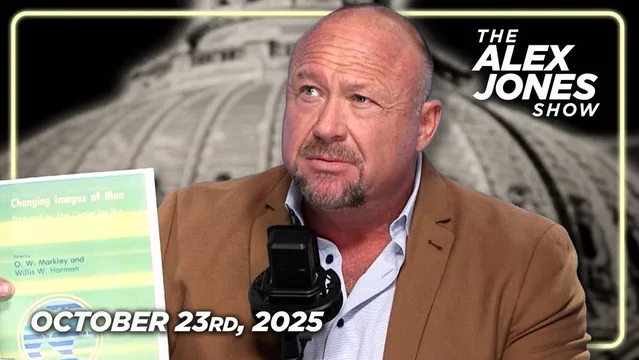
Jay Dyer analyzes "Changing Images of Man," a 1982 Stanford Research Institute textbook that outlines elite plans for a global technocratic paradigm. The text describes how a controlled religious narrative is necessary to corral the population into a new world order. Dyer argues that these control structures are not new but are sophisticated updates of ancient imperial strategies.

Dyer predicts the disintegration of the West will lead to the formation of like-minded enclaves, such as Orthodox Christian homesteads. He warns against "honey trap" operations like Charlottesville or J6, which he claims are easily manipulated by federal operatives. The segment references the Stanford textbook "Changing Images of Man" as a guide for the elite's social engineering projects.

The current economic destabilization is framed as a premeditated plan by globalists to force depopulation and crash the industrial world, citing the 1992 Rio de Janeiro Treaty. A distinction is made between "crimes of passion" and the "premeditated" actions of elites like Bill Gates. There is a proposal to rename the podcast "Premeditated" to emphasize the intentional nature of the perceived attack on civilization.

Guest Jay Dyer joins the show to discuss "Changing Images of Man," a high-level globalist textbook from the early 1980s produced by SRI International. The book allegedly outlines a plan for a cash-free society, social credit scores, and carbon taxes decades before their implementation. Dyer argues that understanding this "enemy battle plan" is essential for the public to defeat the technocratic agenda.

Jay Dyer returns to analyze "Changing Images of Man," a rare $2,000 textbook used in PhD-level political science programs. The document, published by SRI International, allegedly details how to use psychological warfare and social engineering to transition the West into a post-industrial, technocratic society. Dyer emphasizes that the plan involves retooling human archetypes and images to make the public accept a collective, de-industrialized future.

Dyer analyzes the 1982 Stanford Research Institute text *Changing Images of Man*, which outlines plans for a one-world religion based on perennialism and ecology. He explains that the text advocates for devaluing the masculine archetype and promoting a "Gnostic" mystical body of mankind aligned with nature (Gaia). The book suggests that the biblical concept of man being made in the image of God must be replaced by a pantheistic view where man is merely an aspect of nature.

Dr. Malhotra identifies Sean Conley as a key physician involved in Trump's care and discusses the broader issue of "misinformed doctors" within a corrupted healthcare system. He compares the pharmaceutical industry's business model to Bayer's acquisition of Glyphosate. Malhotra argues that medical research is often influenced by trillion-dollar financial interests, leading to the over-prescription of pills.

RFK Jr. defends the pick of Dr. Casey Means for Surgeon General, praising her for walking away from traditional medicine to focus on nutrition and root causes of illness. He dismisses criticisms regarding her lack of an active medical license, noting she was at the top of her class at Stanford. Shroyer supports the "MAHA" (Make America Healthy Again) movement's goal of challenging the medical industrial complex.

Professor Darren Beatty's role as acting undersecretary for public diplomacy involves investigating the "censorship dragnet" that included figures like Nina Jankowicz and organizations like the Stanford Internet Observatory. The segment alleges that these entities worked with Bill Gates and the CIA to suppress information regarding COVID-19 and other topics.

Alex Jones shares a story about his daughter Charlotte's experience at a liberal university, which he describes as a "brainwashing facility." He references Elon Musk's public comments about his son being "killed" by "woke" ideology at an elite school. Jones compares university environments to the Stanford Milgram experiments and CIA mind control operations.

The segment revisits the history of weather modification, citing Operation Popeye in Vietnam and the work of Dr. Ben Livingston. Livingston reportedly claimed that the military could control hurricanes by 1968, a finding certified by the Stanford Research Institute. Jones notes that Livingston was allegedly threatened after appearing on his show to discuss these declassified projects.

The 1980 Cash-Landrum UFO incident in Texas is presented as a case of a malfunctioning man-made craft rather than an alien encounter. Dr. Steven Greer explained that the craft was a captured vehicle fitted with a human nuclear power plant that leaked radiation, injuring civilians. He criticized current "controlled" whistleblowers and academics for mislabeling human-caused injuries as extraterrestrial to maintain the alien-threat narrative.

The assassination of the UnitedHealth CEO by Luigi Mangione is discussed in the context of Mangione's alleged participation in psilocybin clinical trials at Stanford. Geyser suggests that these psychedelic experiments may have inadvertently caused Mangione to "go nuts," similar to the Unabomber. The segment also criticizes leftist figures like Rob Filippowski for allegedly celebrating the attempted bombing of Trump Tower on social media.

The disruption of the American "human capital pipeline" is traced back to the 1970s. Smith cites a post by Louis Conde explaining how the U.S. previously identified exceptional students from small towns and funneled them into elite institutions. He argues that modern DEI (Diversity, Equity, and Inclusion) programs have inverted this system, freezing out talented white men for political reasons.

Smith highlights a viral story of a high school student with a 5.09 GPA and 35 ACT score who was rejected from every elite university, including Harvard, Stanford, and MIT. He argues this proves a systemic bias against high-achieving white males. The segment transitions into a promotion for "Vitamin Mineral Fusion" as a way to combat the physical "mediocrity" imposed by modern diets.