Topic: Peace Deal

43 chapters across the catalog

Volodymyr Zelensky and NATO are reportedly rejecting peace deals in favor of a treaty that would effectively bring Ukraine into the alliance. Claims suggest EU ministers view Donald Trump as a security threat and are actively attempting to sabotage future peace negotiations to provoke a direct war with Russia. This geopolitical shift is framed as a move toward total war by Western powers.

Volodymyr Zelensky's visit to the White House is analyzed, with the host noting Zelensky's refusal to make any territorial or NATO-related concessions for peace. Donald Trump's statements regarding the war are reviewed, including his claim that he could solve the conflict quickly. The segment argues that the West, led by figures like Victoria Nuland, has used Ukraine as a proxy for a long-standing agenda against Russia.

CNN's Abby Phillip noted that Barack Obama failed to credit Donald Trump for brokering a peace deal between Israel and Hamas. Despite the deal, tensions remain high as hostages have not been returned and Benjamin Netanyahu continues to warn of ballistic missile threats from Iran. Trump is credited with preventing conflicts between India and Pakistan, though the Russia-Ukraine war remains unresolved due to deep state interference.

Reports indicate Vladimir Putin may agree to NATO-style protections for Ukraine provided the country does not officially join the alliance. Russia has reportedly offered to return half of the territory seized during the conflict, though some analysts suggest Russia has already effectively won. Donald Trump is expected to present these terms to Zelensky as a final offer to avoid total nuclear escalation.

The possibility of a trilateral meeting between Trump, Zelensky, and Putin remains the primary focus for ending the conflict in Ukraine. Trump indicates that if a deal is not reached through these talks, the fighting will likely continue without further U.S. intelligence or financial support. The administration's goal is to transition Ukraine into a security zone protected by European partners rather than full NATO membership.

Analysis suggests that Russia has effectively won the war in Ukraine, leading to a negotiated capitulation facilitated by the Trump administration. The withdrawal of U.S. intelligence and funding has forced European leaders and Zelensky to accept terms that include neutrality and territorial concessions. This pragmatic approach is viewed as the only way to prevent further loss of life and the risk of global nuclear conflict.

Donald Trump is reportedly seeking a definitive peace deal in the Middle East to secure his legacy and potentially earn a Nobel Peace Prize. Despite a desire to focus on domestic campaign promises like mass deportations and tax cuts, ongoing regional conflicts continue to demand presidential attention. The administration faces pressure from various interests attempting to influence the direction of foreign policy in the region.

In a breaking development, Donald Trump announced that Iran has requested a meeting at the White House and he is considering the offer. Trump stated he would be meeting with the National Security Council in the Situation Room to make a final decision. While the Pentagon has already positioned assets for a strike, Trump expressed a desire to avoid "death and destruction" if a deal can be reached.

The "Greater Israel" project is identified as the primary driver of instability in the Middle East. As Trump considers a meeting with Iranian officials, possibly involving JD Vance or General Flynn, callers suggest he should set strict preconditions. The segment ends with a hope that "outside the box" thinking will prevail over the traditional war-hawk advisors in the administration.

Alex Jones concludes the broadcast by urging for a peaceful resolution and a return to constitutional war powers. He transitions the show to Owen Shroyer and "The War Room" for continued coverage. A final promotional segment for the Alex Jones Store highlights the importance of supporting the network to stop the march toward nuclear war.

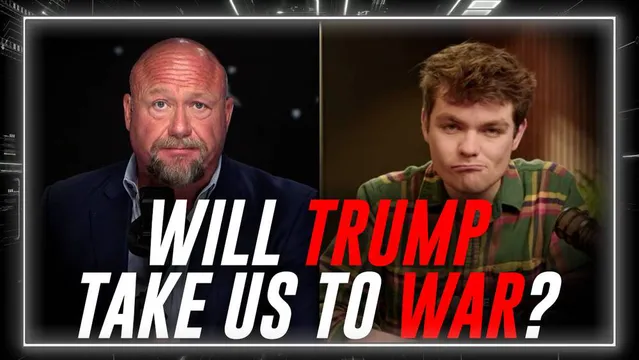
FULL MUST-WATCH INTERVIEW: Nick Fuentes & Alex Jones Debate / Wargame Trump's Plan To Officially Go To War With Iran
1:38:05 - 1:43:11

FULL MUST-WATCH INTERVIEW: Nick Fuentes & Alex Jones Debate / Wargame Trump's Plan To Officially Go To War With Iran

Thomas Massie Resolution and Final Call for Peace

The broadcast concludes with a discussion of Representative Thomas Massie's resolution to enforce the War Powers Act and prevent unauthorized conflict. The hosts express doubt that the resolution will pass the Republican-controlled Senate due to the influence of pro-Israel lobbies. Alex Jones makes a final plea for a peaceful resolution and urges listeners to pray for a deal that avoids nuclear war before handing the show over to Owen Shroyer.

Donald Trump describes a two-hour phone call with Vladimir Putin where he used an analogy of "two young children fighting in a park" to describe the Russia-Ukraine conflict. Trump suggests that sometimes parties must "fight for a little while" before they can be pulled apart. He expresses doubt about an immediate peace deal, noting the "great hatred" between the warring parties.

The host notes a global desire for regime change in Israel, targeting Benjamin Netanyahu, while Netanyahu simultaneously seeks regime change in Iran. The segment highlights the unprecedented amount of on-the-ground footage from Gaza and Palestine, which challenges traditional pro-Israel narratives. Trump’s administration is framed as the only force capable of cutting off bad-faith negotiators to force a peace deal.

The host discusses the potential for peace in the Middle East through a new generation of leaders in Gulf states like Saudi Arabia, UAE, and Qatar. He contrasts these "young leaders" with the older leadership in Iran and Israel, whom he claims are driven by "blood in their eyes and hatred in their hearts." Trump is framed as a figure trying to usher in a future of cooperation by bypassing the "old baggage" of regional conflicts.

A global financial and spiritual realignment is described as taking place while the U.S. navigates potential peace deals with Iran and Ukraine. The surrender of the Houthi rebels is viewed as a sign that Iran may be ready to negotiate. Concerns remain regarding domestic unrest and the potential for "false flag" events to disrupt these diplomatic developments.

Donald Trump officially announces the surrender of Houthi rebels in Yemen, citing their agreement to cease attacks on Red Sea shipping. Senator Marco Rubio comments on the development, framing it as a successful freedom of navigation mission. Trump hints at a even larger "de-escalation peace deal" involving Iran or Ukraine to be announced later in the week.