Topic: Uae

33 chapters across the catalog

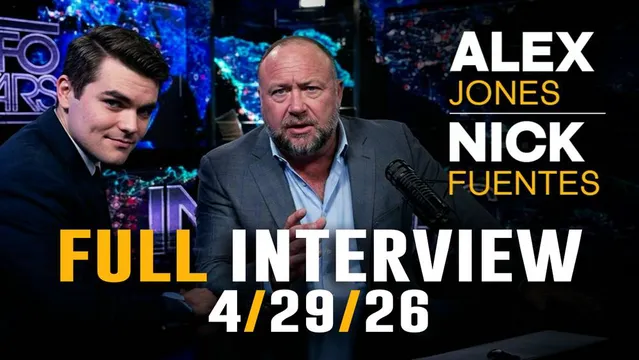
FULL NEW ALEX JONES INTERVIEW WITH NICK FUENTES — 4/29/26
44:15 - 46:32

FULL NEW ALEX JONES INTERVIEW WITH NICK FUENTES — 4/29/26

Global Fertilizer Crisis, Petrodollar Decline

The closure of the Strait of Hormuz has blocked 30% of global fertilizer shipments, guaranteeing a famine for millions next year. Geopolitical shifts, such as the UAE leaving OPEC, are cited as major blows to the Western alliance and the long-term stability of the petrodollar. These economic pressures are viewed as a derailment of the American recovery and a win for globalist banking entities like BlackRock.

The United Arab Emirates has reportedly left OPEC due to the ongoing war, delivering a major blow to Western economic interests. Simultaneously, pollster Mark Mitchell reports that Donald Trump's approval ratings have reached an all-time low as constituents express frustration over inflation and foreign conflicts. Figures like JD Vance have expressed concern regarding the administration's current policy trajectory and its impact on the upcoming midterm elections.

The United Arab Emirates announced its exit from OPEC and OPEC+, a move that weakens Saudi Arabia's control over global oil prices. This decision is interpreted as a strategic attempt by the UAE to avoid being targeted by Iran, given the presence of U.S. military bases in the region. Analysts suggest that Iran's parallel command structure makes it difficult to destabilize through leadership decapitation alone.

The destruction of the Nord Stream pipeline is described as an act of "economic cannibalism" by Europe against its own interests. Viktor Bout discusses Iran's ability to use the closure of the Strait of Hormuz as an "economic nuclear bomb" against the West. He suggests that Benjamin Netanyahu misled Donald Trump into believing a war with Iran would be a quick victory, failing to account for the resulting global energy and fertilizer crises.

The UAE's departure from OPEC is viewed as a reaction to being framed by Israel and the U.S. during military operations against Iran. Viktor Bout explains that Iran's retaliation against the UAE was more severe than its actions against Israel because the UAE provided logistical support for the strikes. This shift indicates a breakdown in the traditional oil cartels and a realignment of regional powers seeking to avoid Iranian aggression.

Reports suggest that Mirage fighters from the United Arab Emirates are participating in the bombing of Iranian oil fields. Caroline Leavitt's claims that the Strait of Hormuz is open are disputed by live transponder data showing the corridor is closed. Jones frames the escalation as a BlackRock-led "Great Reset" agenda designed to derail the global economy, similar to the COVID-19 pandemic.

Multiple nations, including France, Norway, and the UK, have officially rejected or remained silent regarding Donald Trump's request for warships in the Persian Gulf. Qatar has declared force majeure on gas production, warning of a global economic collapse. The segment notes that despite the escalation, ten major countries have refused to provide military support, leaving the US and Israel isolated.

The discussion contrasts the modernization efforts in the UAE and Saudi Arabia with the rise of Islamic radicalism in Western cities like London, Paris, and Minneapolis. Claims are made regarding the refusal of European countries to extradite terrorists back to the Middle East. Personal anecdotes describe viewing videos of radical imams in the United States making extremist statements about social laws and control.

Alex Jones addresses Tucker Carlson's recent comments regarding Islam and his visit with Qatari leadership. While Jones expresses respect for Carlson, he disagrees with the notion that Islam is not a threat to the West, citing the Quran's calls for jihad and the push for Sharia law in Western cities. Jones contrasts the "slick" diplomacy of Qatar with the reformation efforts he perceives in the United Arab Emirates.

Reports of Islamic stabbings and attacks in Washington State, Australia, and Europe are framed as a coordinated effort to destabilize the West. Joseph D. McBride notes that while countries like the UAE have banned the Muslim Brotherhood, Western governments continue to "import" radical elements. The segment suggests that the political left sees these fundamentalist groups as "muscle" for their own revolutionary goals, leading to a suppression of criticism against Islam.

Saudi Arabia and the UAE are noted for their efforts to purge Muslim Brotherhood influences and modernize their societies. The discussion explores whether these reforms represent a genuine shift away from orthodox Islam or a strategic maneuver. Globalist entities are accused of using mass migration as a tool to destabilize Western Christianity and install police states.

A 2017 clip of a UAE minister warning Europe about the dangers of political correctness and radicalization is revisited. The UAE is praised for its "geopolitical understanding" of how the political left allies with radical Islamists. The speaker claims that Middle Eastern nations are more aware of these threats than Western politicians who funded the "Arab Spring."