Topic: Qatar

112 chapters across the catalog

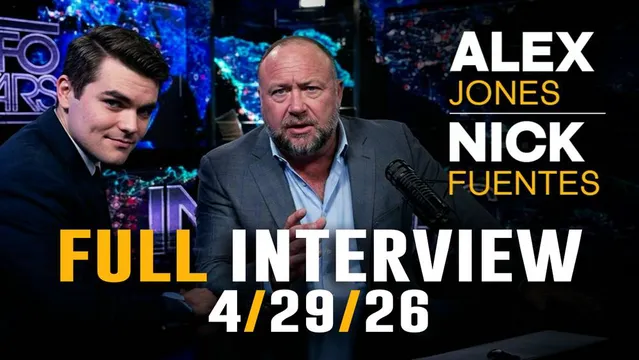
FULL NEW ALEX JONES INTERVIEW WITH NICK FUENTES — 4/29/26
39:49 - 44:06

FULL NEW ALEX JONES INTERVIEW WITH NICK FUENTES — 4/29/26

Midnight Hammer Operation, Iranian Regime Stability

The "Midnight Hammer" operation against Iran failed to achieve its goal of immediate regime change, leading to a consolidated Iranian government. The U.S. is currently pursuing a dual track of secret diplomacy through Pakistan and Qatar while maintaining a military bluff in the Middle East. Experts suggest that unless the nuclear issue and the Strait of Hormuz toll are resolved, a return to full-scale arms is likely.
The war with Iran threatens a global food crisis as Qatar, which controls 50% of internationally traded urea, faces shipping restrictions. Prices for nitrogen fertilizer and diesel have surged by 50% and 60%, respectively. Reports indicate the Pentagon and figures like Marco Rubio warned the administration against the conflict, comparing the risk to the Deepwater Horizon disaster.

A personal anecdote describes a 2017 meeting where a major Republican law firm allegedly offered $50 million annually to join a "superclass" of globalist influencers. The offer, purportedly linked to the CIA and Kissinger-style groups, was rejected despite threats of legal destruction. The host denies current allegations of receiving Qatari or Russian funding, citing a history of refusing state-sponsored propaganda roles.

Savage theorizes that Benjamin Netanyahu keeps the war going to avoid personal legal investigations and stay in power. He criticizes Tucker Carlson for allegedly becoming a "spokesman for Islam" after purchasing a home in Qatar. The segment concludes with a call for the West to return to traditional values, shut down borders, and adhere to Trump's original "no more foreign wars" platform.

The closure of the Strait of Hormuz has triggered a global supply chain crisis, halting one-third of the seaborne fertilizer trade and causing urea prices to surge. Iranian missile strikes on Israel's industrial zones have threatened Teva Pharmaceuticals, the world's largest generic drug maker, potentially leading to global medicine rationing. Additionally, a shortage of helium from Qatar is impacting the production of semiconductors and the operation of MRI machines worldwide.

The speakers discuss the use of selective news reporting to maintain a believable narrative regarding the conflict in Israel. JP Sears addresses online accusations of being a "Qatar agent" or profiting from "Jew hate" for criticizing the Netanyahu government. The segment revisits claims of a stand-down order given to IDF soldiers on October 7th at 5:20 AM.

Media personalities Dave Rubin and Andrew Tate previously predicted that a conflict with Iran would be brief and involve no ground troops. These predictions are now being scrutinized as the situation evolves into a potential quagmire. Retired Delta Force and Navy SEAL officers have reportedly characterized the plan to seize uranium with limited troops as "totally insane" due to the training and time required for such operations.

The rise of global populism is framed as a "Great Awakening" against the coalition-based parliamentary systems seen in Canada and the UK. Recent congressional hearings have featured testimony regarding the indirect assistance of U.S. foreign aid to dozens of terror organizations. Additionally, leaked Israeli police videos show Netanyahu defending the transfer of millions of dollars from Qatar to Hamas.

Congressional testimony has revealed that the United States sends $40 million a week to the Taliban, with other aid reaching groups like Al-Shabaab and Islamic Jihad. Benjamin Netanyahu reportedly requested that Qatar deliver suitcases of cash to Hamas because traditional banks refused to cooperate with the transfers. These actions were intended to keep Gaza under Hamas control while keeping the West Bank under Fatah.

Mike Adams reports on a "dangerous turning point" in the Middle East conflict following the destruction of two out of 14 natural gas "trains" at Qatar Energy. Citing a Reuters interview with the CEO of Qatar Energy, Adams warns that the repair time for these facilities is three to five years. He predicts a decade-long global famine and the death of billions if the remaining infrastructure is targeted, as Qatar provides 17% of the world's LNG capacity.

Mike Adams explains that Qatar Energy has declared force majeure for several countries, including Italy and Belgium, due to the closure of the Strait of Hormuz. He notes that Iran is allowing passage only to vessels paying in Chinese yuan, signaling the collapse of the petrodollar. Adams emphasizes that the loss of Qatari gas will halt the production of nitrogenous fertilizers, leading to catastrophic food shortages worldwide.

Multiple nations, including France, Norway, and the UK, have officially rejected or remained silent regarding Donald Trump's request for warships in the Persian Gulf. Qatar has declared force majeure on gas production, warning of a global economic collapse. The segment notes that despite the escalation, ten major countries have refused to provide military support, leaving the US and Israel isolated.

Alex Jones defends himself against accusations of being a Qatari agent after reporting that the Trump administration miscalculated Iran's resilience. Internal White House meetings reportedly reveal that while the public goal was dismantling nuclear programs, the actual objective was regime change. Concerns are raised regarding Iranian threats to Middle Eastern desalinization plants, which provide 70% of the region's fresh water.

Jimmy Dore and the host discuss the likelihood of Mossad staging terror attacks to blame on Iran, citing historical precedents of Israeli false flags. Reports suggest Mossad agents have been active in Qatar and Turkey, seeking to destabilize the region and draw the U.S. deeper into conflict. The host reiterates his prediction that "sleeper cell" activity may actually be a Deep State operation.