Topic: Grounding

48 chapters across the catalog

Germany has reportedly announced that men of military age are not allowed to leave the country without special permission. Over a dozen countries have allegedly reinstated the draft, including women for the first time. Meanwhile, in the U.S., a majority of Congress and the public are reportedly opposed to putting "boots on the ground" in Iran, despite administration efforts to promote the war.

Donald Trump's shift toward supporting a ground invasion of Iran is criticized as a betrayal of his "America First" base, with polls showing 84% of Americans oppose sending troops. High-profile figures like Erik Prince and the Chairman of the Joint Chiefs have reportedly warned against the move, leading to the removal of several top generals. The closure of the Strait of Hormuz by Iran is presented as a catastrophic economic event that Trump is failing to resolve.

Sam, an Israeli-American caller from Haifa, shares his perspective as a veteran of both the IDF and the U.S. Army. He supports Trump's goal of overthrowing the Iranian government but opposes the use of American ground troops. The caller suggests that Trump's rhetoric about boots on the ground is a "bluff" or a "Joker card" intended to pressure European allies.

The United States military is reportedly preparing for a ground invasion of Iran following a month of aerial operations. Donald Trump has allegedly threatened to destroy Iranian civilian water supplies and desalination plants, an act described as a serious war crime under international law. Military assessments suggest a low probability of successful regime change despite the escalation.

A caller discusses Joe Kent's interview with Sean Ryan, where Kent suggested that re-implementing the draft might make the public more cautious about entering wars. The conversation touches on George Washington's belief in maintaining the "moral high ground" during conflict. They argue that the U.S. military loses its effectiveness when it abandons moral principles for overwhelming firepower.

Joe Kent warns that committing ground troops to Iranian islands would be a "gift" to the enemy, as U.S. forces would become sitting ducks for drone swarms and ballistic missiles. He fears that once casualties are taken, the U.S. will enter a cycle of "honoring the dead" that makes extraction impossible. Kent urges Donald Trump to avoid the sunk cost fallacy that defined the War on Terror.

Donald Trump has reportedly decided to deploy ground troops into Iran at multiple invasion points as of March 29, 2026. This military escalation is described as a globalist trap designed to derail the American economic recovery and reverse the successes seen in Venezuela. Analysts warn that an invasion of Iran could result in a conflict ten times worse than the wars in Iraq or Afghanistan.

Blackwater founder Eric Prince expressed disbelief that the administration ignored intelligence reports regarding the risks of invading Iran. Prince, described as a military hawk, warned that the transition to ground troops was an inevitable but disastrous escalation. These warnings contrast with the rhetoric of media pundits who previously claimed there would be no "boots on the ground."

The Wall Street Journal reports that President Trump is considering sending an additional 10,000 ground troops from Fort Bragg to the Middle East. This follows an initial deployment to secure the Strait of Hormuz, which experts estimate would actually require 100,000 to 1,000,000 troops to hold effectively. The host argues that Trump has been "set up" by Israeli interests to derail the U.S. economic recovery.

Leaked intelligence reports indicate the United States is preparing to send the 82nd Airborne and special forces to seize Iran's nuclear stockpiles and Karg Island. Karg Island is responsible for 90% of Iran's oil exports, and its seizure would mark a direct American takeover of the Persian Gulf's strategic assets. Organizations assisting conscientious objectors report an unprecedented surge in requests from military personnel seeking to avoid participation in what they deem an illegal offensive war.

Military experts, including Eric Prince and the Chairman of the Joint Chiefs, warned Donald Trump that an Iranian invasion would not result in a quick victory. Comparisons to the success in Venezuela are dismissed due to Iran's superior ground troops and fortified mountain bunkers. The potential deployment of the 82nd Airborne to the Strait of Hormuz is characterized as the beginning of a long-term quagmire.

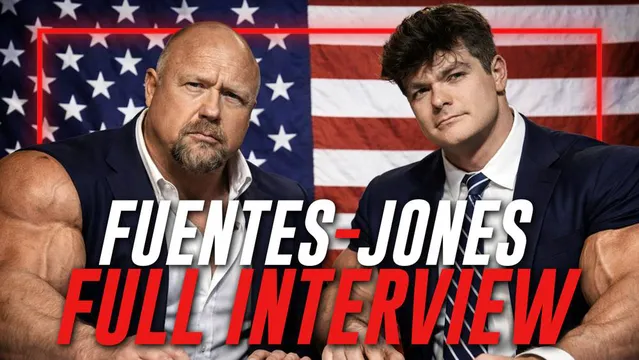
FULL FUENTES-JONES INTERVIEW 3/3/26: Trump Admin Pushes Ground Invasion Of Iran To Ensure Regime Change
3:10 - 5:36

FULL FUENTES-JONES INTERVIEW 3/3/26: Trump Admin Pushes Ground Invasion Of Iran To Ensure Regime Change

Economic Emergency Powers and Unofficial Declarations of War

Donald Trump reportedly signed an executive emergency order to protect shipping in the Strait of Hormuz, which some interpret as an unofficial declaration of war. This move utilizes economic emergency powers to justify a potential military presence on the Iranian side of the strait. Concerns are raised that this "maximum pressure" strategy will inevitably lead to a "boots on the ground" scenario as the U.S. becomes increasingly entangled in the conflict.

Blackwater founder Eric Prince expresses concern over the potential deployment of U.S. ground troops to Iran, a move Donald Trump has not ruled out. Jones argues that the mission has "metastasized" from surgical strikes to a full-scale war of regime change, comparing the escalation to the "two weeks to flatten the curve" COVID-19 mandates. Despite these criticisms, Jones maintains he will not desert Trump because the Democratic alternative poses a higher risk of nuclear war with Russia.

Blackwater founder Eric Prince warns the Commander-in-Chief against contemplating ground troops in Iran, stating he did not believe such an escalation was possible. Jones notes that most top generals, excluding the head of CENTCOM, have advised against the current course of action. The discussion calls for Congress to reinstate War Powers and hold a formal vote to prevent the U.S. from being "slip-walked" into a conflict as damaging as the Vietnam War.

The discussion explores the possibility that Charlie Kirk was targeted by the "Deep State" because of his effective ground game during the 2020 election. A caller suggests that Kirk's ability to mobilize voters in swing states made him a threat to those who prefer "puppet candidates." Geiser compares the Kirk case to the Trump assassination attempt in Butler, noting that while the Kirk case seems more "cut and dry," the political motives for a hit are clear.