Topic: China Trade War

22 chapters across the catalog

China's "debt-trap diplomacy" has made Pakistan beholden to CCP interests, effectively turning the nation into a proxy against India. While China suppresses Islam domestically, it allegedly supports radical Islamic groups internationally to destabilize Western trade routes. This strategy is intended to protect the Belt and Road corridor and facilitate the eventual replacement of the U.S. dollar with a Chinese-led economic system.
Donald Trump highlights U.S. energy abundance, specifically mentioning the reopening of ANWR in Alaska, as a primary advantage in the global economic war against China. The administration's strategy focuses on using tariffs to force manufacturing back to the United States. Reports suggest the Chinese economy is suffering significantly due to the trade imbalance and the loss of U.S. trade.

Dr. Kirk Elliott analyzes the state of the global trade war, asserting that Donald Trump has Xi Jinping "completely surrounded." He argues that while the media claims tariffs will destroy the economy, they are actually forcing manufacturing back to the U.S. Elliott notes that the U.S. dollar is "breaking down" as part of a structural shift that will eventually benefit American exports.

Donald Trump is pursuing aggressive tariff policies to reduce U.S. dependence on Chinese manufacturing and rare earth minerals. Russia has reportedly become more self-sufficient due to ongoing sanctions, a model Trump aims to replicate for the American economy. The administration seeks to challenge the 500% tariffs imposed by China and move toward a protectionist model that prioritizes domestic production.

A discussion on the global trade war and Trump's tariff strategy against China. Jones alleges that liberal judges are hiding gang members and criminals to obstruct federal immigration enforcement. He notes that 70% of the ATF and federal marshals have been reassigned to immigration raids to combat the "Herculean task" of border control.

China has reportedly opened the door for trade talks as Trump's tariffs reach up to 245% on certain goods. Elliott explains that China is in a "lose-lose" situation where Xi Jinping must either capitulate to America or face economic collapse. He notes that Trump's tariffs are strategically designed to address the fentanyl crisis and level the playing field for American manufacturers.

A comparison between the rapid modernization of Shenzhen, China, and the perceived decline of American metropolitan areas serves as a critique of past U.S. trade policies. Shroyer discusses China's recent ban on rare earth mineral exports to the U.S. and their refusal to purchase Boeing jets as escalations in the trade war. The segment supports Donald Trump's use of tariffs to force American manufacturing independence and correct decades of wealth redistribution to foreign nations.

China implemented export controls on key rare earth minerals in response to United States tariffs, an act characterized as a technological and economic act of war. The domestic regulatory environment is criticized for preventing lead smelting and rare earth mining within the United States over the last 40 years. BlackRock CEO Larry Fink is mentioned regarding his past skepticism of bringing industrial jobs back to America.

Legendary economist Martin Armstrong joins the program to discuss the global financial realignment and the accuracy of economic forecasting. Armstrong agrees that the U.S. is in an asymmetrical war with China and discusses the strategic importance of the Panama Canal. He provides a high-level view of how Trump's policies are clashing with the established globalist economic order.

Dr. Kirk Elliot joins the program to analyze President Trump's use of tariffs as a negotiating tool to rebalance global trade. Elliot explains that China's dominance as a top exporter has flip-flopped with the U.S. since 1990 due to unfair trade agreements like NAFTA. He argues that Xi Jinping is trapped between political capitulation and economic collapse as U.S. tariffs reach 145%.

Dr. Elliot discusses China's potential retaliation through the dumping of U.S. Treasuries, which has contributed to the weakening of the U.S. dollar. Jones and Elliot speculate that China's economic desperation may lead to a military move against Taiwan. They discuss the shift in the global economic balance of power and China's failed attempts to establish a world reserve currency.

Jones and Dr. Elliot review comments from Treasury Secretary Scott Bessent regarding the shift from a Wall Street-centric economy to one focused on "Main Street." Bessent claims that Trump successfully goaded China into a weak position. Jones argues that the U.S. must return to domestic production in farms and factories to ensure long-term national security.

The United States has escalated the trade war with China, raising overall tariffs to over 100% while China responded with tariffs exceeding 200%. Kevin O'Leary appeared on CNN to argue that America holds the leverage as the world's largest consumer market and reserve currency holder, but warns the window to act is closing. O'Leary asserts that China has failed to abide by World Trade Organization rules for decades, necessitating a 400% tariff to force a level playing field.

President Trump warned that Iran is in "great danger" if it continues to pursue nuclear weapons, stating that such development is non-negotiable. The escalation with Iran is framed as part of a broader convergence of tensions involving Russia and China. Analysts suggest that China is in a weak position in the current trade war because the U.S. holds a significant trade deficit advantage.

President Trump issued a warning on True Social that China will face 50% tariffs if they do not withdraw their 30% retaliatory measures. China's actions are described as a continuation of long-term tariff abuse and currency manipulation. The administration maintains that the U.S. is in a fight for economic survival and will not succumb to pressure from corporate media or international critics.

The host argues that U.S. labor laws and unions have made the country dangerously dependent on Chinese slave labor, allowing the CCP to subvert the American economy. He highlights the discovery of 30,000 military-age Chinese nationals at the southern border, claiming they were sent by the CCP rather than escaping it. This influx is framed as a potential "sleeper cell" force intended to destabilize the U.S. from within.

The entire Trump family, including Barron and Melania, along with Robert F. Kennedy Jr., have reportedly adopted a perspective similar to the host's regarding globalist threats. An anecdote is shared regarding a confrontation with Joe Rogan eight years ago to warn him against being seduced by the opposition. Meanwhile, China has signaled readiness for both trade and physical war as the U.S. moves semiconductor production from Taiwan.

The United States has initiated a series of trade maneuvers aimed at addressing long-standing imbalances with China, Mexico, and Canada. Claims are made that these nations have exploited American markets for decades, with goods from China making up a disproportionate share of trade. The current administration views these new tariffs as a necessary response to economic "rape" rather than unprovoked aggression.

China has restricted the export of key rare earth minerals to the United States, targeting the American technology and computer industries. The move is described as a strategic "Achilles heel" for the U.S. economy, resulting from decades of globalist policies that allowed China to gain 95% control over these essential minerals.

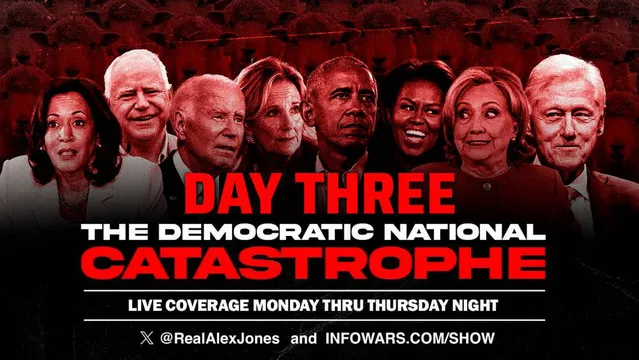
Day Three LIVE Coverage Of The DNC! Globalist Criminals Bill Clinton & Nancy Pelosi Next In Line To Support Harris
6:29 - 8:58

Day Three LIVE Coverage Of The DNC! Globalist Criminals Bill Clinton & Nancy Pelosi Next In Line To Support Harris

Iraq War Destabilization, Iran Influence, China Trade Dominance

Donald Trump critiques the bipartisan decision to enter the Iraq War, arguing it destabilized the Middle East and allowed Iran to gain control over Iraqi oil. He highlights China's strategic dominance in the global market for rare earth minerals and trade. Trump laments the loss of American lives and trillions of dollars in military spending without securing economic benefits like oil.