Topic: Seditious Conspiracy

35 chapters across the catalog

Zachary Rehl discusses his decision to represent himself after his attorneys were hesitant to aggressively pursue the witness recantation. He argues that highlighting the political nature of the prosecution was essential for securing either a dismissal or a pardon. Rehl describes the risk of going pro se and his ultimate success in getting the recanted testimony into the official court record.
The Department of Justice has moved to throw out the convictions of several January 6 defendants, including Zachary Rehl. Rehl explains that vacating the convictions is superior to a pardon because it restores military benefits, disability payments, and retirement for veterans like himself and Joe Biggs. The segment celebrates the potential for full vindication and the recovery of lost back pay.

Rhodes compares the current political struggle to the sacrifices of soldiers in World War II, arguing that "man up" is the only acceptable response to deep state threats. He criticizes J6 defendants who took plea deals for "seditious conspiracy," labeling them traitors for aiding the enemy's narrative. The segment concludes with a call for Trump to purge his inner circle and "drop the hammer" on the deep state.

Jones discusses Title 18, Chapter 115, Section 2387 of the U.S. Code, which criminalizes attempts to interfere with the loyalty or morale of the military. He accuses Senator Mark Kelly and others of engaging in seditious conspiracy by encouraging service members to disobey orders. The discussion also touches on alleged payoffs to lawyers like Todd Blanche and the presence of "globalist operatives" within the upper echelons of federal management.

A report by John Bowne examines the history of seditious conspiracy laws in the United States, noting that no one has ever been executed solely for this charge under federal law. The segment reviews the use of the statute by presidents from John Adams to Joe Biden, who used it against the Oath Keepers and Proud Boys. The report suggests that Trump could use these laws to end the careers of deep state operatives.

Enrique Tarrio, former chairman of the Proud Boys, joins the show to discuss his conviction for seditious conspiracy and the current political climate. He highlights a new feature on X that reveals foreign accounts attempting to influence U.S. discourse. Tarrio argues that the same legal standards used against him should be applied to Democratic senators who are currently encouraging military mutiny.

Tarrio argues that the legal precedent set by the J6 seditious conspiracy convictions must now be applied to Democrats who interfere with the execution of federal laws. He notes that the bar for "force" was set very low in his case, meaning politicians blocking ICE or encouraging mutiny are technically guilty. The segment concludes with a discussion on the importance of local elections in cities like Miami to prevent globalist takeovers.

Roger Stone joins the program to discuss the indictment of John Bolton for retaining and transmitting classified documents. Stone criticizes the "two-tiered justice system," noting that Bolton was allowed to turn himself in while Stone's own home was raided by the FBI. They argue that the President has ultimate authority over documents under the Presidential Records Act, a protection Bolton does not share.

Andrew Weissman, described as the "most corrupt prosecutor in US history," is reportedly under criminal investigation for his role in the Mueller probe and other misconduct. Roger Stone notes that the "seditious conspiracy" involving Obama, Brennan, and Comey is a continuing crime. A major challenge for the Trump administration is finding a fair venue for these trials, as jurisdictions like D.C. and New York are viewed as having "stacked" leftist juries and judges.

Roger Stone predicts a "recalibration of the scales of justice" with imminent indictments for treason and seditious conspiracy against the "cabal," including Biden, Brennan, and Comey. Unlike the first term, Trump reportedly has 50 times more patriots in his administration ready to execute these legal actions. The strategy involves winning the "info war" in the public eye before the grand juries finalize their decisions.

Ed Martin discusses the "Seditious Conspiracy Task Force" and efforts to investigate the origins of the Russia hoax and the January 6th committee. He claims that over 1,500 individuals were improperly placed on terrorism watch lists by the Biden administration before being pardoned by Trump. Martin asserts that grand juries are being prepared to hold "criminal enterprise" actors accountable for weaponizing the government.

Stephen Miller labels the Russia collusion investigation a "coup" and calls for accountability through the Seditious Conspiracy Treason Task Force. Meanwhile, Media Matters for America is reportedly facing collapse due to $15 million in legal fees from a lawsuit filed by Elon Musk. The host claims the organization manipulated algorithms to drive advertisers away from X (formerly Twitter).

The Department of Justice has shifted strategy by utilizing "strike forces" rather than special counsels to investigate intelligence officials involved in the Crossfire Hurricane probe. Targets include John Brennan, James Comey, and James Clapper for their roles in allegedly fabricating the Russia collusion narrative. While Trump has suggested immunity for Barack Obama, the investigation focuses on seditious conspiracy charges against other high-ranking officials from the 2016 era.

Jason Meister appeared on Newsmax to discuss "incontrovertible evidence" that Barack Obama spearheaded a seditious conspiracy in 2016. The report alleges that Obama was briefed on Hillary Clinton's plan to tie Trump to Russia on July 28, 2016, in the Oval Office. This action is described as the most heinous crime in American history, leading to a five-year constitutional crisis.

Rhodes explains the legal maneuvers used to convict him, claiming the jury was told they could "infer an implied conspiracy" based on free speech. He compares his case to Owen Shroyer's, noting the prevalence of false statements in federal filings. Rhodes criticizes the judges for blocking evidence of federal provocateurs like Ray Epps from being shown to the jury.

Ivan Raikland and Alex Jones discuss the importance of Elon Musk's ownership of X (formerly Twitter) as the only platform resisting deep state censorship. They argue that Musk is sitting on a "trove of evidence" regarding seditious acts and that his own safety depends on releasing this information immediately. Jones claims Musk personally told him that the media's portrayal of InfoWars was a lie after reviewing internal logs.

Former Green Beret Ivan Raikland introduces a "Deep State Target List" aimed at exposing individuals involved in what he calls a seditious conspiracy against Donald Trump. Raikland calls on Elon Musk to release the direct messages of key figures like Adam Schiff and Jamie Raskin to prove the existence of a coup. He asserts that the First Amendment is now more powerful due to the presence of figures like Tucker Carlson on X.

EMERGENCY BROADCAST: NATO Attacks Russian Navy Port In Massive WW3 Escalation – WEDNESDAY FULL SHOW 09/13/23
1:39:37 - 1:44:02

EMERGENCY BROADCAST: NATO Attacks Russian Navy Port In Massive WW3 Escalation – WEDNESDAY FULL SHOW 09/13/23

Zach Reel Interview: 15-Year Sentence for January 6th

Zach Reel joins the show from prison to discuss his 15-year sentence for his involvement in the January 6th Capitol events. Reel claims the trial was a "charade" where exculpatory evidence regarding undercover agents was suppressed and legal communications were monitored by the government. He maintains that there was no plan to stop the transfer of power and that his group was there to defend against Antifa.

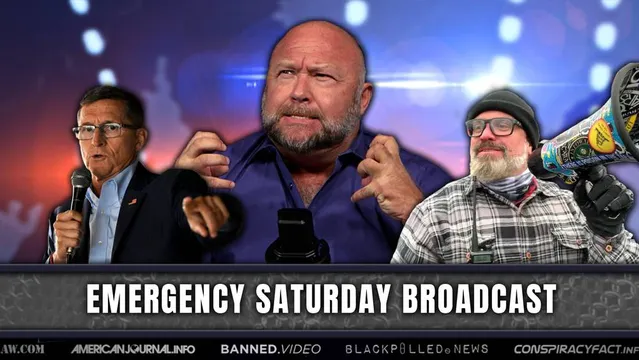
Saturday Emergency Broadcast: Gen. Flynn & Alex Jones Lay Out Globalists' Next Moves And How To Stop Them
1:31:52 - 1:37:44

Saturday Emergency Broadcast: Gen. Flynn & Alex Jones Lay Out Globalists' Next Moves And How To Stop Them

Joe Biggs Return, DC Jury Bias, Seditious Conspiracy Charges

Joe Biggs returns to the line to further discuss the "meeting of the minds" theory used to convict him of seditious conspiracy. He argues that the D.C. jury pool is fundamentally biased against conservatives, making a fair trial impossible. Biggs maintains that his military background was unfairly used by the prosecution to paint him as a leader of an insurrection despite a lack of documented plans.

Oath Keepers founder Stuart Rhodes was sentenced to 18 years in federal prison for seditious conspiracy related to the January 6 Capitol event. The sentencing is criticized as a form of political persecution, with the judge labeling Rhodes a "threat to the Republic."