Topic: Privatization

173 chapters across the catalog

Leon Black, co-founder of Apollo Global Management, is identified as a key figure in the Epstein files with over 8,000 mentions. Black reportedly paid Epstein $160 million for "tax mitigation strategies" that helped him avoid $1.3 billion in taxes. The hosts point out that Apollo manages hundreds of billions in public pension and retirement funds, making Black's character and associations a matter of significant public interest.

Former Speaker of the House Paul Ryan was spotted at Davos, where he reportedly avoided questions regarding his loyalty to conservative ideas and Donald Trump. The event is also criticized for the hypocrisy of its attendees, who arrived in over 500 private jets while promoting climate change regulations for the general public. Military aircraft from various nations, including Lithuania, were also observed at the private Altenrhein Airport.

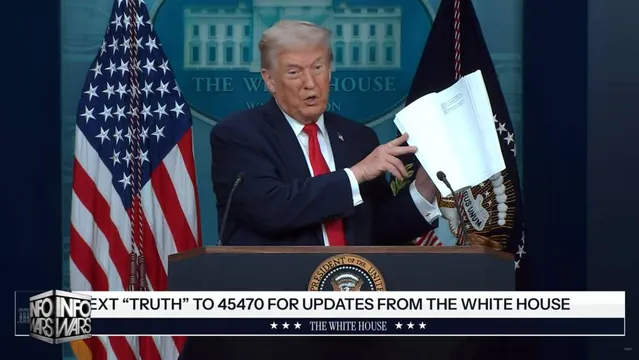
Donald Trump reports the removal of 270,000 bureaucrats from the federal payroll, arguing that government jobs are not "real" jobs. He claims that 100% of new jobs created under his administration have been in the private sector, whereas one in four jobs under Biden were government-based. Trump asserts that former federal workers are finding higher-paying roles in the private industry.

Alex Jones claims that 90% of intelligence agency work has been transferred to private corporations, rendering the official agencies less powerful than commonly believed. He offers a critique of Dan Bongino, suggesting Bongino is acting as a "mouthpiece" for certain factions within the FBI. Jones argues that the true power of these agencies—media manipulation—is failing as the public loses trust in mainstream narratives.

BlackRock, led by Larry Fink, is reportedly acquiring major utility companies and power grids across the United States, including a $6.2 billion takeover in Minnesota. Critics warn that private equity control of essential infrastructure will lead to higher residential bills and a focus on ESG-driven "renewable" projects like wind and solar at the expense of grid resilience.

A report by John Bowne details BlackRock's acquisition of Global Infrastructure Partners and its subsequent move into direct ownership of U.S. utility companies. The segment warns that private equity control of the energy grid will lead to higher residential bills and the prioritization of AI data centers over public resilience, citing a $6.2 billion takeover in Minnesota as a primary example.

Gavin McInnes joins the program to argue for the privatization of the airline industry and airport security. The TSA is criticized for its high failure rate in detecting weapons and for implementing Diversity, Equity, and Inclusion (DEI) policies. Anecdotes of incompetence at JFK and Newark airports are shared to support the call for private-sector solutions.

Kash Patel is accused of hypocrisy for using the FBI's private jet for personal travel after previously attacking Chris Wray for the same behavior. Serafin explains that while the GAO mandated the director fly private for security, the "optics" are disastrous during a government shutdown. Historical examples, such as the removal of William Sessions in the 1990s for jet misuse, are used to illustrate the severity of the issue.

Kyle Serafin criticizes FBI Director Kash Patel for using a government jet to attend a wrestling event and visit his girlfriend during the federal shutdown. Serafin notes the irony that Patel previously criticized Chris Wray for the same behavior. He argues that while maintainers and staff are not being paid, Patel's "jet-setting" creates a terrible optic for the Trump administration.

The Democratic strategy is compared to the Grinch stealing Christmas, with the goal of causing maximum pain to force political concessions. By flooding food banks, the public can trigger a "chain reaction" that renders the government's "leverage" over the hungry obsolete. Citizens are encouraged to post videos of their charitable acts on X and Rumble to inspire a national movement of self-reliance.

A proposal to de-federalize airports and return control to local municipalities or private corporations is discussed as a way to bypass future shutdowns. The Patriot Act is criticized as a move toward "communism" through government control of transportation. A long-time listener recounts the history of the broadcast, including support during the Fukushima disaster and the evolution of the VIP membership program.

Western civilization is described as 100% superior to other cultures, which is why globalists seek to tear it down through demonization. The host warns that an anti-white racial system will lead to the collapse seen in South Africa. Totalitarians are alleged to want the West gone because its success and emphasis on private property rights threaten their control.

The Trump administration reports a reduction of 84,000 federal bureaucrats while private sector jobs have increased by over half a million. Criticism is leveled at the Department of Education and Common Core, alleging they are part of a deliberate plan to lower national intelligence. These domestic policies are framed as a rejection of the Rio De Janeiro Agenda 21 treaty and UNESCO influence.

Activist Tiffany Cianci warns of a new executive order allowing 401k retirement funds to be invested in high-risk private equity. She argues this is a "bailout" for firms like BlackRock that are stuck with devalued assets and high-interest debt. Cianci explains how private equity "strip mines" companies for short-term profit, ultimately driving the transition toward a "renter society" where individuals own nothing.

A new executive order by Donald Trump allows 401k plans to include crypto, private equity, and real estate for the first time. This move is seen as a "paradigm shift" away from the established order of stocks and bonds, providing Americans with greater financial freedom. Economists predict this will lead to a massive influx of capital into the crypto space, specifically Bitcoin and Ethereum.