Topic: Car T

122 chapters across the catalog

The International Energy Agency (IEA) has released a 10-point plan titled "Sheltering From Oil Shocks" in response to Brent crude reaching $120 a barrel. The plan suggests COVID-19 style mandates, including working from home three days a week, reducing speed limits, and imposing car-free Sundays in major cities. Critics view this as a move toward permanent behavioral control and lifestyle rationing.

A 2020 University of Washington study suggests that laws mandating child car seats significantly reduce birth rates, as many vehicles cannot accommodate three seats. The study estimates these laws prevented 8,000 births in 2017 while saving only 57 lives in crashes. Combined with the high cost of childcare and the necessity of dual-income households, these regulations are viewed as indirect economic barriers to expanding families.

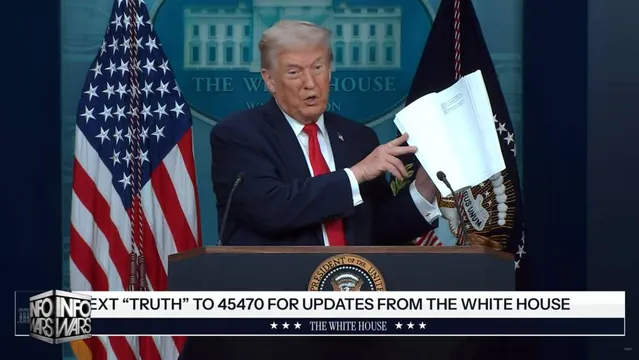
Donald Trump details tax policy changes, including the elimination of taxes on tips, Social Security, and overtime. He introduces a tax deduction for interest on car loans, specifically for vehicles built within the United States to encourage domestic manufacturing. Trump also claims to have slashed the federal budget deficit by 27% in a single year.

Donald Trump is set to sign an executive order banning institutional investors like BlackRock, State Street, and Vanguard from purchasing single-family dwellings. The administration also plans to eliminate taxes on interest for small loans, such as car loans up to $10,000 annually. These moves are framed as efforts to untie "bowling balls" from the legs of the American people.

Bill Pulte confirms Trump's plan to ban institutional investors from the housing market, which has already seen positive reactions in housing stocks. Trump is also moving to break the "big four" meatpacker monopoly by encouraging competition from companies like Walmart. These actions, along with tax relief on car loans, are presented as direct efforts to combat inflation and help the middle class.

Lieutenant General Fanel Sarvanov, a high-ranking Russian officer close to Vladimir Putin, was killed in a car bombing in Moscow. The attack is suspected to be a Ukrainian assassination. Jones notes the continued escalation of the war and criticizes the lack of security for Russian generals who are being targeted in their own apartment complexes.

Alex Jones reports on a major power outage in San Francisco following the winter solstice, noting that a lack of backup power has left electric vehicles stalled on the roads. The broadcast also covers the U.S. Coast Guard's pursuit and seizure of oil tankers off the coast of Venezuela, which the Venezuelan government has condemned as active piracy.

Alex Jones highlights the deteriorating security situation in Canada, citing a case in Welland, Ontario, where a child rapist was released on bail. He criticizes Toronto police for advising citizens to leave their car keys in unlocked boxes on their front porches to avoid home invasions. Jones characterizes these policies as a "psyop" designed to strip citizens of their survival skills and force compliance with a "narco-terrorist" style of governance.

The commentary critiques electric vehicles and solar panels as having high toxic footprints while dismissing the dangers of carbon dioxide. It argues that CO2 is a "life-giving gas" that increases plant yields and that the Earth is currently at historically low levels of oxygen and carbon. The United Nations is accused of ignoring the Sun's 99.9% impact on climate to push regulatory agendas.

A 15-year-old in Charlotte, North Carolina, has been arrested 111 times since August 2023 for offenses including 55 car thefts. Police discovered searches on the teen's phone regarding the charges for killing a police officer. Jeffrey Meigh reports on the lack of accountability in the judicial system, which prioritizes rehabilitation over public safety.

The discussion explores the legal and ethical challenges posed by deepfakes and AI-generated content. Lionel questions how the law will handle AI that commits crimes or engages in extortion using spoofed identities. They predict an extension of libel laws to address the "forgery" of human personas in the digital age.

Elon Musk's prediction that human-driven cars will become obsolete is framed as a "trap" for total slavery. The host discusses Palantir's AI facial recognition drones being used in Gaza and compares the current technology to the 1984 film "Runaway" starring Tom Selleck, which featured spider-like assassination drones.

Eric Schmidt and other tech leaders are cited regarding the massive power requirements of AI, which may need 100 times the current US electrical capacity by 2035. This energy demand is contrasted with environmental regulations imposed on citizens, such as restrictions on cars and air conditioning. The segment also discusses the transition to "robo-taxis," the elimination of private ownership, and the introduction of bug-based proteins like crickets into the food supply.

Waymo makes its debut in New York City, while Tesla expands its autonomous taxi program in Austin, Texas. Schroer expresses personal skepticism and "control freak" anxiety regarding riding in driverless vehicles. Despite these concerns, the segment acknowledges that autonomous ride services are becoming a permanent fixture in major metropolitan areas like Austin and Phoenix.

Footage from Los Angeles shows mobs assaulting individuals and hijacking driverless Waymo vehicles during the ongoing riots. Protesters were seen dancing on top of the autonomous cars and tagging them with graffiti while law enforcement remained outnumbered. The host characterizes these acts as "terrorism" funded by international entities to create a spectacle of instability in the United States.

Donald Trump announced 50% tariffs on European goods, including cars and pharmaceuticals, starting in July to force political and economic alignment. This follows a successful negotiation with China where tariffs were adjusted to 30%. These economic measures are intended to bring manufacturing jobs back to the United States and counter globalist censorship efforts.

Klaus Schwab and the World Economic Forum are accused of planning to eliminate individual car ownership in favor of expensive robo-taxis. The segment argues that high electricity costs will be used to force people out of personal vehicles. While not against the technology of electric cars, the host opposes the forced acceleration of human obsolescence in transit.

In a featured interview clip, Elon Musk predicts that unsupervised full self-driving cars will soon make manually driven cars as rare as horses. The segment contrasts Musk's technological optimism with concerns about government-mandated "kill switches" and tracking in new vehicles. The host warns that these technologies could give tyrants unprecedented power over individual movement.