Topic: Witnesses

28 chapters across the catalog

Ivan Reikland and Stuart Rhodes propose that Donald Trump use the U.S. Marshals to extract Tina Peters from a Colorado prison. They argue she is a critical material witness for federal investigations into the 2020 election and the software used by Jenna Griswold. Reikland suggests that Peters should be placed in the witness protection program at the White House to ensure her safety and facilitate the prosecution of state-level corruption.

Evidence of a second shooter in the Butler assassination attempt is discussed, citing investigations by Doug Hagman and reports from Jack Posobiec. Witnesses and private investigators reportedly faced intimidation from FBI agents during their inquiries. The segment frames these actions as part of a broader effort by the previous administration to hide the truth about the July 13th events.

Alex Jones defends Charlie Kirk's marriage against rumors of it being an "arranged" political union, describing it as a natural meeting of two people with shared values. Dr. Martinson uses video stills to triangulate where witnesses were pointing during the shooting, identifying the Sorensen roof as a more likely source of the gunfire than the official location. He reiterates the need for original video files to confirm these findings.

The legal proceedings for Tyler Robinson at Utah Valley University involve the identification of thousands of potential student witnesses. The prosecution and defense are managing a voluminous amount of digital discovery materials, leading to a 30-to-60-day window before a formal preliminary hearing is set. The defense emphasizes the need to process massive amounts of digital data before proceeding with the trial.

Officer Terrence Yeakey, a hero of the Oklahoma City bombing rescue efforts, was allegedly tortured and murdered by federal agents after discovering bombs inside the Murrah building. Other witnesses, including a K9 unit officer named Browning, were reportedly threatened with death by the FBI if they continued to ask questions. These stories are presented as evidence of a massive, violent cover-up by the Department of Justice and intelligence agencies.

The Drudge Report is accused of carrying water for Democrats by labeling Trump's declassification of RFK Jr. and MLK files as "distractions" from the Epstein case. The decision to send the Deputy Attorney General to meet Maxwell is characterized as potential witness tampering intended to prevent her from testifying before Congress. Critics argue that Trump is making a strategic mistake by protecting unknown entities instead of releasing the full Epstein list.

The role of the 144,000 mentioned in Revelation 7 is defined as Jewish male virgin evangelists rather than members of the Jehovah's Witnesses. These figures, along with two unnamed witnesses, are expected to preach during the tribulation period. The discussion emphasizes that modern global events and the rise of overt Satanism signal the approach of these prophetic milestones.

Chase Geiser joins the show to propose that Jeffrey Epstein may still be alive in the witness protection program. He cites the "perplexing" takes of Kash Patel and Dan Bongino, who recently claimed Epstein committed suicide, as evidence that they may be covering for a national security deal. Jones notes that intelligence agencies frequently stage the deaths of high-level operatives.

Kash Patel and Dan Bongino face scrutiny for their recent claims that Jeffrey Epstein committed suicide, a reversal from their previous skepticism. Analysis of their body language suggests they may not be lying, leading to a theory that Epstein is actually in witness protection and the officials are maintaining a cover story for a larger operation. Additional details cited include Epstein's possession of multiple foreign passports and recent calls by Alan Dershowitz to pardon Ghislaine Maxwell.

A clip from Megyn Kelly's program suggests that the public may "hear from Jeffrey Epstein directly" in the future, fueling theories that he is alive. Host Chase Geiser argues that the CIA and Mossad likely placed Epstein in witness protection to safeguard intelligence operations and maintain leverage over the political class. This theory is used to explain why officials like Kash Patel have adopted the "suicide" narrative despite previous skepticism.

There is growing skepticism regarding recent statements from Dan Bongino and Kash Patel claiming that Jeffrey Epstein actually committed suicide. The host expresses confusion over why this narrative is being pushed now and suggests a theory that Epstein might actually be in witness protection. The segment highlights the "non-denial denial" language used by Patel, which has caused a loss of trust among some supporters.

Dr. Steven Greer emphasized the need for a robust witness protection program for UAP whistleblowers, citing the use of planted "child porn" and other blackmail tactics by intelligence agencies to silence them. He concluded by describing the potential "peace dividend" of disclosure, including medical breakthroughs like limb regeneration and severed spinal cord repair. Greer urged the Trump administration to prioritize this issue to lead the next great industrial revolution.

The House Administration Subcommittee on Oversight has released a report accusing Liz Cheney of tampering with witness Cassidy Hutchinson. The report recommends a criminal investigation by the FBI, alleging Cheney tried to influence testimony to make Donald Trump look worse. Chairman Barry Loudermilk's committee claims Cheney communicated with Hutchinson around her lawyer, violating DC bar ethics and potentially committing a federal crime.

Gerald Celente reflects on the decline of New York City, noting that it is now "dead at 12 o'clock at night" due to crime and the aftermath of lockdowns. He revisits the pardon of Charles Kushner, detailing his 2004 convictions for witness tampering and tax evasion. Celente notes that Charles Kushner recently donated $1 million to a Trump super PAC.

A video clip features a local Lahaina resident named "Fish" who witnessed police blockading Front Street, preventing cars from evacuating as the fire approached. The witness claims the officer stated he was "under orders" to keep the traffic stopped, even though the road ahead was clear. Alex Jones compares the situation to historical instances where populations followed orders to their own detriment, suggesting the blockade was a deliberate attempt to increase the casualty count.

Roger Stone recounted his experiences during the Mueller investigation, where he faced numerous charges that he claims were fabricated "process crimes." He criticized the use of aggressive search warrants based on what he describes as non-existent evidence of treason or money laundering. Stone highlighted that despite reviewing over a million of his emails, investigators found no proof of a conspiracy.

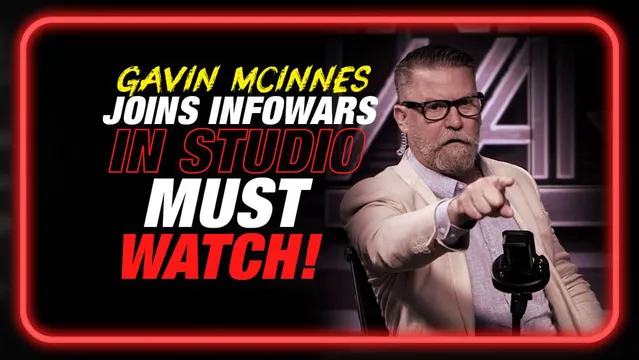
Gavin McInnes In-Studio with Alex Jones, MUST WATCH!
1:24:18 - 1:26:34

Gavin McInnes In-Studio with Alex Jones, MUST WATCH!

Confrontations in Public and the Best Defense

The host recounts a verbal altercation in Hawaii where a stranger accused him of being a "Russian agent." He describes his cutting response and the subsequent debate with his wife about whether he should have been more polite. Gavin McInnes argues that the best defense is a "good offense" and that public confrontations with "stray dogs" should be met with strength.