Topic: Theology

60 chapters across the catalog

The "liberation theology" promoted by the Ford Foundation is identified as a key ideological enemy. Patrick Byrne argues that overthrowing the cartels in Venezuela and Cuba will cut off the funding for these subversive movements in the U.S. The return of the Monroe Doctrine is presented as a necessary response to what is described as a "successful act of war" against the United States.

Dr. Kirk Elliott reports that his clients have seen gains of up to 90% on silver and 70% on gold year-to-date. Amidst legal battles and a potential shutdown of the InfoWars network following a Supreme Court ruling, the host expresses a reliance on faith and divine providence. The segment concludes with a theological discussion on stepping out in faith and trusting God during times of personal and national destruction.

An anecdote is shared about an interaction with ChatGPT where the AI attempted to interpret "speaking in tongues" phonetically. After being challenged as a "false prophet" without a spirit, the AI reportedly admitted it could not truly interpret spiritual gifts and would need to "repent" if it were human. This is used to illustrate the limitations of artificial intelligence in understanding the spiritual realm.

A unconventional theological discussion explores the idea that Jesus was not a "sweetie pie" but a figure who associated with the marginalized and potentially enjoyed wine. The host and McGinnis argue that while personal forgiveness is a virtue, the state must still execute justice against those who commit treason or murder. The "benevolent dictator" model of the patriarchy is defended as the most stable form of social organization.

Drew Hernandez discusses the theological roots of modern Zionism and dispensationalism, arguing they are relatively new interpretations of scripture. He posits that many Christians have been misled into a "cult-like" support for the state of Israel that places political entities above the preeminence of Jesus Christ. The discussion explores the differences between traditional covenant theology and modern evangelical views on the end times.

Debater Andrew Wilson argues that "rights" are a fiction unless they are divinely grounded in God's law. In debates with figures like Tim Pool and Dave Smith, Wilson asserts that secular rights are merely an "appeal to force." He contends that if one believes in unalienable rights, they must logically concede the existence of a divine creator and follow His laws.

A listener from Maryland discusses the theological distinction between "Biblical Israel" and the modern political state. The caller argues that the Jewish people must take responsibility for actions that "embarrass God's name," such as settler violence. The host agrees that conflating the Jewish nation with the actions of the Mossad or Netanyahu is a dangerous political manipulation.

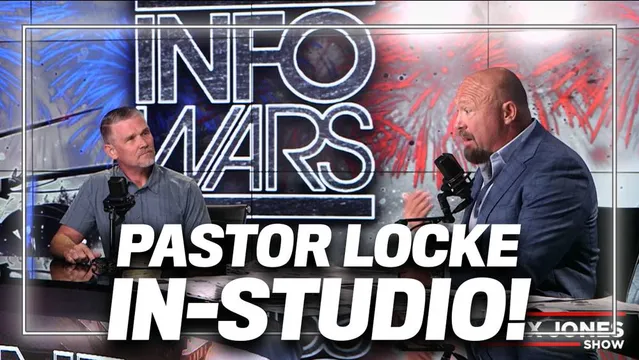
Pastor Greg Locke explains that Israel is the only nation in a direct covenant with God, making anti-Semitism a "demon" and an anti-Christ ideology. He rejects "replacement theology," the idea that the church has replaced Israel in God's plan, citing Romans 11. Locke emphasizes that while individual Jews must accept Jesus for salvation, the nation of Israel remains central to biblical prophecy and the second coming of Christ.

Anti-Semitism is characterized as a demonic ideology that opposes the lineage of Jesus and the throne of David. The conversation rejects replacement theology, the belief that the Christian church has replaced Israel in God's plan, labeling it a "damnable heresy." The speakers argue that while individual governments like Netanyahu's may err, the biblical covenant with the descendants of Abraham remains intact.

The conflict in the Middle East is framed as a 4,000-year-old sibling rivalry between the descendants of Ishmael and Isaac. Islam is characterized as a "satanic counterfeit" resulting from Abraham's attempt to fulfill God's promise through the flesh rather than through the promised son, Isaac. This "bastard son" narrative is used to explain the perpetual enmity between Islamic nations and Israel.

Dyer concludes his theological analysis by stating that the "whore of Babylon" in Revelation refers to Jerusalem, which colluded with Rome to crucify Christ. He argues there are not "three Abrahamic faiths" because Abraham worshipped Jesus, as stated in the Gospel of John. The segment emphasizes that all biblical promises are fulfilled only in Jesus Christ.

Rabbi Shmuley Boteach and Senator Ted Cruz argue that Christians are biblically commanded to support the modern state of Israel based on the book of Genesis. Cruz asserts that the nation of Israel mentioned in scripture is identical to the political entity currently led by Benjamin Netanyahu. Critics challenge this theology, questioning whether the "blessing" mentioned in the Bible applies to modern political leadership or a specific people group.

Theological discussion centers on the biblical command to "bless Israel," with Dr. Kirk Elliott arguing that this refers to a people group rather than a specific government or political boundary. Under Just War theory, critics argue that supporting a leader who seeks to initiate a global conflict does not constitute a blessing. The segment emphasizes praying for the safety of people rather than blindly following the dictates of any national government.

Top Mexican officials are reportedly making statements about retaking the U.S. Southwest, supported by "Aslan" ideology and liberation theology. These concepts are alleged to be CIA creations designed to break the United States into smaller regions. The ultimate goal is described as the formation of a North American Union, merging Canada, the U.S., and Mexico into a single managed region.

Leo Zagami discusses the history of the Augustinian order and its links to Jesuit educational systems. He claims Pope Leo XIV will push "liberation theology"—a mix of Marxism and Catholicism—and predicts a deepening conflict between the Vatican and the American nationalist movement.

Alex Jones argues that Diversity, Equity, and Inclusion (DEI) is a form of "neo-communism" or "liberation theology" designed to divide society through race-based identity politics. He plays clips of an academic and a Muslim cleric to contrast Western civilization with Sharia law. Jones expresses support for the Trump administration's efforts to scrap DEI policies, which he views as a scheme to revive racism against white people.

Michael Savage critiques modern religious institutions, claiming they have been penetrated by socialist ideologies and have abandoned traditional spiritual teachings. He discusses his personal history of searching for medicinal plants and launching an herbal revolution. The conversation also touches on Gavin Newsom's recent media appearances and his attempts to position himself as a centrist.

Dyer concludes with an analysis of "Liberation Theology" as a tool for population control and the "Global War on Terror" as a successor to Operation Gladio. He claims that terror networks like Al-Qaeda were modeled on Gladio's "stay-behind" armies to justify a total tracking and tracing grid. He asserts that these conflicts are smashing together cultures to create a global socialist technocracy.

Economist and theologian Dr. Kirk Elliott joins the show to discuss the intersection of finance and faith. He argues that the current economic instability is a physical manifestation of a spiritual battle. Elliott suggests that God may be using these hardships to wake up the American people and calls for the clergy to speak truth from the pulpit.