Topic: Security

1129 chapters across the catalog

Former CIA officer Larry Johnson analyzes the security failures during the Trump hotel shooting, noting that JD Vance was escorted off stage before Donald Trump, which violates standard protocol. Johnson cites a former head of Ronald Reagan's security detail to argue that the Secret Service is no longer following established training standards. The failure to establish a proper outer security perimeter at the hotel is highlighted as a major red flag.
Joe Kent, a former National Counterterrorism Center official, describes the internal surprise within the administration when Donald Trump launched a decapitation strike against Iran's Supreme Leader. Kent notes that the decision-making circle was unusually small, bypassing traditional National Security Council debates. He expresses concern that members of Congress and the Cabinet may be more loyal to Israeli interests than to the American president's agenda.

Representative Tim Burchett discusses the lack of transparency regarding government spending on UFO research. Burchett argues that if the phenomena were Russian or Chinese technology, they would have already dominated global conflicts. The host posits that these "aliens" are actually interdimensional demonic spirits and suggests that the suppression of Christianity is linked to the return of these entities.

Benjamin Netanyahu announced that Israel will not withdraw to the international border and intends to maintain a 10-kilometer-thick security zone in southern Lebanon. He rejected Hezbollah's conditions for a ceasefire, stating that Israel's demands include the total disarmament of the group. Analysts suggest the U.S. and Israel are attempting to turn the Lebanese government into a security subcontractor.

Harrison Smith analyzes Donald Trump's social media post ordering Israel to stop bombing Lebanon as a humiliating moment for the "Israel First" lobby. He suggests Trump has finally reached his limit with Benjamin Netanyahu's attempts to drag the U.S. deeper into Middle Eastern conflicts. The segment calls for a shift in focus toward American national security and the protection of military personnel.

Harrison Smith uses the analogy of King Theoden from Lord of the Rings to describe his current view of Donald Trump, suggesting the president has been led astray by advisors. He clarifies that while he still supports Trump's stated goals like border security, he is critical of recent actions regarding the Iran war and H-1B visas. Smith maintains that his criticism stems from a desire to see Trump return to his original promises.

The host discusses the accuracy of past geopolitical predictions, citing documents like the 2010 Rockefeller Foundation "Operation Lockstep" and Rand Corporation reports on Iran. A 2006 Homeland Security battle plan is mentioned as the source for predicting social distancing and mask mandates. The segment emphasizes that current warnings about the Iran quagmire are based on established military wargames rather than mere opinion.

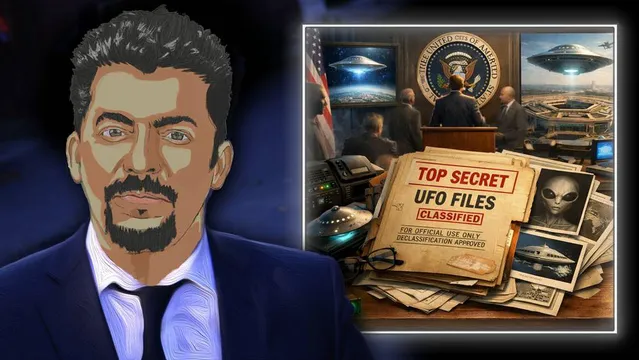
Donald Trump is reportedly attempting to bring the UFO file back under executive control, a move previously attempted by John F. Kennedy. Daniel Liss discusses recent drone swarms over US military bases as a potential "blackmail" tactic by the breakaway corporate-state group that holds advanced technology. This situation is linked to the proposed "Americom" defense grid, which would merge Northcom and Southcom into a unified surveillance and UFO defense system.

Vice Presidential candidate JD Vance has reportedly described UFOs as "demons," a framing that aligns the phenomena with interdimensional spiritual threats. This narrative is seen as a calculated move to bring the Christian demographic into the national security conversation regarding unidentified aerial phenomena. Analysts suggest this "demon" label is part of a war-gamed strategy to justify a military "war office" dedicated to fighting non-human entities.

Kyle Serafin explains the nuances of federal polygraph examinations, which include "lifestyle" and "counterintelligence" (CI) components. He describes how examiners use physiological props to gauge a subject's truthfulness and look for contradictory statements during follow-up interviews. The fact that the investigation into the J6 pipe bomber was discontinued after a failed polygraph is highlighted as a major investigative anomaly.

Caroline Leavitt blames Congressional Democrats for failing to fund the Department of Homeland Security, leading to 500 TSA resignations and widespread sick-outs. President Trump signed a memorandum to ensure TSA employees receive compensation despite the shutdown. The host criticizes the TSA as a "humiliation ritual" and suggests that airport security should be privatized to improve efficiency.

General McCasland's work for a company called "Blue Halo" is linked to the "Golden Dome" project, a $300 billion defense grid designed to track both missiles and "anomalies" (UFOs). The host argues that high-level generals are typically equipped with tracking devices, making McCasland's month-long disappearance highly suspicious. The vacuuming up of these experts is seen as a move to prevent technology leaks.

War correspondent Michael Yon joins Mike Adams to discuss the "engineered" nature of the current global food and energy crisis. Yon, speaking from Japan, notes that the country is extremely vulnerable to famine due to its reliance on imported food and energy. He references historical warnings from Commodore Perry and Ulysses S. Grant regarding the strategic importance of Okinawa and the potential for debt traps in Asia.