Topic: Irs Audit

27 chapters across the catalog

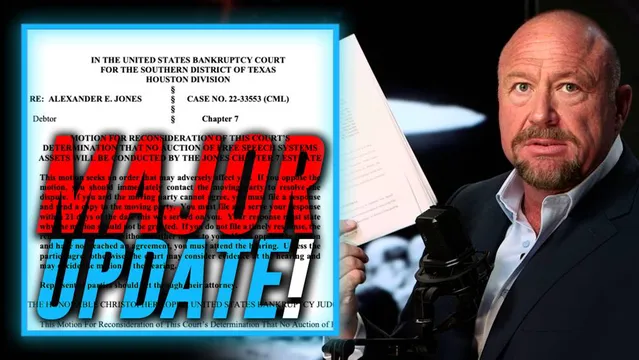
Recent federal investigations and five separate IRS audits into InfoWars' finances have contradicted mainstream media reports regarding hidden assets. The audits revealed that the organization actually overpaid the IRS by $4.3 million over the last five years, rather than hiding hundreds of millions in offshore accounts. These forensic findings are being used in ongoing bankruptcy court proceedings to challenge claims made by opposing legal teams.

InfoWars has undergone multiple federal audits by the IRS and court-appointed officials, which reportedly found no hidden assets. Criticism is directed at mainline conservatives for failing to file amicus briefs in a case that could set a precedent for the destruction of the First Amendment. The legal battle is described as an attempt by the Left to steal the host's identity and misrepresent his platform.

The law firm Paul Weiss reportedly paid $40 million in restitution for engaging in "lawfare" against Donald Trump. The host discusses his own bankruptcy proceedings, noting that a year-long IRS audit resulted in a $4.3 million refund rather than uncovering hidden assets. He accuses the bankruptcy trustee of wasting estate funds on legal fees to continue a political vendetta.

Kevin O'Leary has raised alarms about a provision in a new bill that would allow the IRS to audit small businesses regarding the Employee Retention Credit (ERC) for up to nine years. This is described as an "unprecedented" war on small business, as most companies are not required to keep records for that long. Critics argue this is a "witch hunt" designed to claw back money from the middle class.

Jones reports that $370 billion was allegedly stolen by John Podesta through "fake green funds." He also reveals that forensic auditors spent $12 million over two years investigating his own bankruptcy, only to find that he had actually overpaid the IRS by $4.3 million. Jones characterizes his legal opponents as "gremlins" and "soulless mercenaries" who are failing to find any actual corruption.

A chronicle of the three-year Chapter 11 reorganization process for Free Speech Systems details the transition into liquidation and the failure of forensic accountants to find hidden assets. Over $3 million was reportedly spent on four different accounting firms, while an IRS audit resulted in a $4.3 million tax refund for overpayment. The narrative asserts that the plaintiffs' refusal to settle for high eight-figure sums proves their goal was total censorship rather than debt collection.

A long-time listener from California describes the current era as a "political renaissance," citing the release of JFK files and the potential auditing of the Federal Reserve and IRS. The host encourages supporters to "press the attack" and "stick the landing" to ensure the movement's success. An artist caller offers to design t-shirts to support the cause.

Chase Geiser shares a personal story of being audited by the IRS for $150,000, claiming the agency taxed the same income twice as a form of harassment. He links this to the Obama-era weaponization of the IRS against conservative groups under Eric Holder and mentions that fellow host Owen Shroyer has faced similar targeting.

The host recounts personal experiences with intense IRS and forensic audits, which ultimately found he had overpaid millions in taxes. He argues that the globalist "New World Order" is destroying the "golden goose" of a free society by stealing wealth and collapsing the infrastructure needed for a functioning economy. The segment warns that the elite's plan for a nuclear survival scenario is a "jackass" strategy that will leave them with worthless money.

Fitz criticizes the bipartisan adoption of FASB 56, a policy that allows federal agencies to keep their financial books "dark" for national security reasons. She notes that over $21 trillion is missing from the DOD and HUD, yet the current DOGE initiative is focusing on auditing the IRS rather than recovering these untraceable funds. She expresses concern that AI software from companies like Palantir will be used to extract more money from citizens while ignoring high-level financial fraud.

Alex Jones returns for his final minute on air from the Austin studios where he has broadcast for 16 years. He mentions a $4.3 million tax return from a recent IRS audit as proof that he was not hiding assets. Jones directs the audience to his new digital homes at alexjones.network and realalexjones.com before the power is officially cut.

Alex Jones recounts a series of legal battles, including a massive IRS audit that resulted in a $4.3 million refund and aggressive depositions by the Justice Department. He cites a Bloomberg article and court filings alleging that legal opponents argued the 13th Amendment does not apply to him. Jones contrasts his treatment with the lack of prosecution for government officials like Alejandro Mayorkas regarding missing children at the border.

Jennings reveals that after a series of aggressive audits by the IRS and bankruptcy accountants, he actually received a $4.3 million tax return. He explains that his CPAs advised him to overpay taxes for years to avoid any allegations of fraud while he was a political target. The host uses this to debunk media claims that he has "hundreds of millions of dollars" hidden in offshore accounts.

Alex Jones reveals that a two-year investigation by the Justice Department and an IRS audit found no criminal activity or hidden assets. Instead, the audit resulted in a $4.3 million tax return that was absorbed by the bankruptcy court. Jones claims this proves he is a "straight shooter" and that the legal attacks against him are purely political.

The host addresses a New York Times article describing his assets as "meager," contrasting it with previous media claims that he had hundreds of millions of dollars hidden offshore. He reveals the results of a recent IRS audit that resulted in a $4.3 million refund, which he uses to argue that he has been transparent about his finances. He expresses intent to sue the New York Times for defamation regarding their financial reporting.

Despite promises that an $80 billion IRS expansion would only target the wealthy, new data shows that 63% of audits now target taxpayers earning less than $200,000. Critics argue the agency lied to the public to secure funding for 80,000 new agents who are now focusing on middle-class and blue-collar workers. This is framed as a systemic effort to harass the general public while the ultra-rich avoid similar scrutiny.

Attorney Robert Barnes discusses how he correctly predicted the host had overpaid millions in taxes years before a formal IRS audit confirmed it. Barnes explains his background in tax law and shares a story of a client who received a $450,000 refund after the California Franchise Tax Board initially demanded $1.2 million.

An aggressive year-long IRS audit reportedly concluded that the host overpaid his taxes by $4.2 million over five years due to accounting errors where business expenses were mislabeled as personal profit. However, these funds are currently locked in bankruptcy court and cannot be used to pay current legal debts. The host compares his character to the "Sheriff of Mayberry" to counter media portrayals of him as an evil mastermind.

Chase Geiser and Alex Jones discuss what they describe as "bureaucratic harassment," including arbitrary IRS audits and legal targeting. Jones claims he recently received a $500,000 tax notice for a tax ID that does not belong to him. They argue that the system uses red tape to exhaust political opponents and that the only solution is to elect leaders like Donald Trump who are hated by the establishment.

The IRS is reportedly focusing its new enforcement capabilities on individuals making $40,000 a year or less, despite claims of targeting the ultra-wealthy. TIGTA audits reveal that the lower and middle classes are five times more likely to be audited than the upper class. This strategy is described as a "smash and grab" against small business owners, using a new tranche of 87,000 agents to close the "tax gap" through aggressive audits.