Topic: Iran Strike

18 chapters across the catalog

Analysis of recent missile strikes in the Middle East highlights a discrepancy between Fox News reporting and Donald Trump's public statements regarding military success. The conversation posits that Trump has betrayed his base by covering up Epstein files and prioritizing Israeli interests over American ones. Loyalty to truth is presented as superior to loyalty to any individual political figure.

The Pentagon and White House are framing current military actions against Iran as preemptive defensive measures to prevent an imminent attack on the United States or Israel. Alex Jones disputes the narrative that Iran was behind the assassination attempts on Donald Trump in Butler and Mar-a-Lago, suggesting these claims are being used as a pretext for war. He compares the current intelligence environment to the lead-up to the Iraq War, where false claims of assassination plots against George H.W. Bush were used to justify invasion.

The Iranian Security Council announced that the country could conduct a nuclear test within one week and assemble a bomb in one hour. In response, a massive military operation involving over 1,000 munitions has targeted Iranian leadership, government buildings, and military bases. Reports indicate that assassination squads and car bombs are active on the ground following a speech by Donald Trump regarding regime change.

The hysteria surrounding Pete Hegseth is framed as an attempt to prevent a military strike on Venezuela. Byrne notes that Iran has built drone factories in Venezuela capable of reaching the U.S. mainland. He argues that Donald Trump must execute the strike soon, as "time is his enemy" and the opposition is using every delay to organize resistance.

The MAGA coalition is described as splitting following the Iran strikes, which served as a turning point for internal administration stability. Analysis suggests the administration's difficulties began with the failure to address the deep state during Trump's first term and the subsequent intimidation of Matt Gaetz. The segment links current ICE raids on California pot farms to broader concerns about child slavery and the failure to release the Jeffrey Epstein client list.

Mark Mitchell of Rasmussen Reports releases new polling data showing Donald Trump's approval ratings approaching all-time lows for his second administration. The decline is attributed to a series of controversial events, including the Iran strikes, the fallout with Elon Musk, and the perceived cover-up of the Epstein list during a recent cabinet meeting. Schroer notes that these issues are fracturing the core MAGA coalition.

The Trump administration faces internal criticism for a series of policy decisions that have reportedly broken the MAGA coalition. Specific grievances include the June 21st Iran strikes, the alienation of Elon Musk, and the "Big Beautiful Bill" which increased the federal budget. Schroer argues that running cover for these unpopular moves has led to a foreign and domestic policy disaster that threatens Republican success in the upcoming midterms.

Ben Shapiro is criticized for claiming the Epstein case is not a priority for American voters. Schroer counters that the Epstein list is a top-five issue for the MAGA base, unlike the Iran strikes favored by neoconservatives. Tensions are reportedly rising among House Republicans, with figures like Eric Burleson pushing for hearings that could force Kash Patel and Pam Bondi to testify under oath.

Alex Jones evaluates the first 157 days of the Trump administration, giving the president an "A plus" despite concerns over Middle East escalation. He discusses the power of the Israel lobby and AIPAC, claiming they hold more influence over Congress than the American grassroots. Jones also references Steve Bannon's analysis of Israeli strikes on Iranian nuclear facilities and predicts Prime Minister Netanyahu will seek to extend his emergency powers.

Secretary of Defense Pete Hegseth is shown confronting the Pentagon press corps, accusing them of "cheering against Trump" and undermining the success of U.S. military strikes. Hegseth defends his use of the phrase "our boys" and praises the technical proficiency of B-2 and F-35 pilots. He argues that the media's hatred of the administration leads them to peddle classified leaks to make the president look bad.

The conflict between Iran and Israel is escalating, with Trump giving the Iranian regime a one-month deadline to reach a deal before potential military action. The host reviews the history of CIA involvement in Iran, including Operation Ajax in 1953 and the eventual rise of the Ayatollahs. There is concern that Iran may use proxy forces, including cartels in the US, to carry out retaliatory strikes if their nuclear facilities are targeted.

Donald Trump reiterated that war with Iran may be imminent if a peace deal is not reached quickly, noting that Iran became wealthy again under the Biden administration's relaxed sanctions. There are concerns that a conflict could trigger Iranian sleeper cells within the U.S. and Europe. Trump emphasized that he would have secured a deal shortly after the 2020 election had he remained in office.

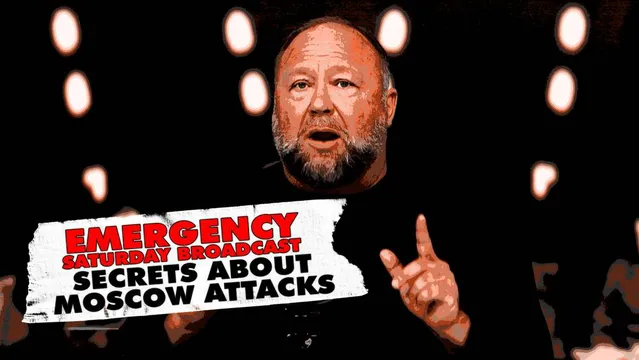
Saturday Emergency Broadcast: Alex Jones & Vladimir Soloviev Reveal Secrets of The Moscow Terror Attacks
1:41:31 - 1:45:55

Saturday Emergency Broadcast: Alex Jones & Vladimir Soloviev Reveal Secrets of The Moscow Terror Attacks

Nuclear Doctrine, Preemptive Strikes, and Middle East Tensions

Solovyov clarifies that Russian military doctrine prohibits the first use of nuclear weapons, unlike U.S. policy which allows for preemptive strikes. He expresses concern that the Biden administration might use tactical nuclear weapons against Iran to regain "respect" in the Arab world. The discussion touches on Israel’s inability to win its current conflicts and the potential for a broader Middle Eastern war.

Iran has reportedly fired missiles at targets in Pakistan, escalating tensions in a region involving multiple nuclear-armed powers. The conflict between Pakistan, India, and Iran is identified as a potential flashpoint for a global hot war in 2024. The instability in the Kashmir region and the involvement of China further complicate the security landscape of the subcontinent.