Topic: Gaza War

55 chapters across the catalog

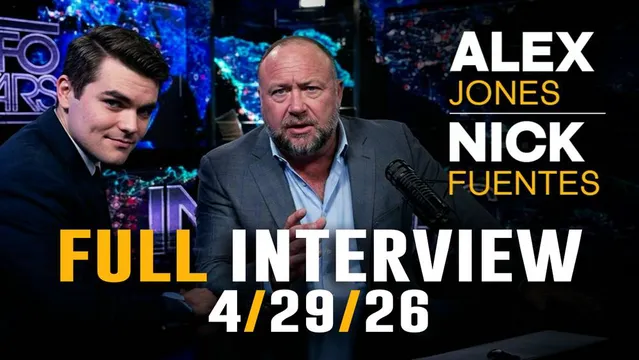
FULL NEW ALEX JONES INTERVIEW WITH NICK FUENTES — 4/29/26
19:34 - 23:40

FULL NEW ALEX JONES INTERVIEW WITH NICK FUENTES — 4/29/26

Trump Approval Ratings, Technical Audio Failure

Donald Trump's approval ratings have reportedly plunged to 32% as he distances himself from his original grassroots base. During the discussion of Trump's handling of the wars in Iran and Gaza, the broadcast experiences a major technical failure, requiring a reboot of the soundboard. Nick Fuentes continues to argue that Trump has betrayed the movement that initially brought him to power.
Footage from the "Peace 2025" summit in Egypt shows President Trump meeting with world leaders to certify a Middle East peace agreement. Trump asserts that the deal prevents the start of World War III in the region. The segment concludes that the most likely outcome of the current diplomatic push is the establishment of a full-fledged Palestinian state.

The New York Times is cited regarding missed opportunities for earlier hostage deals, suggesting the prolonged war served Netanyahu's personal political interests. With the ceasefire in effect, Netanyahu faces the resumption of corruption trials and investigations into the "stand down" on October 7th. The segment predicts that evidence of Israeli war crimes in Gaza will soon emerge as journalists regain access to the region.

Harrison Smith promotes a new "Come and Take It" Faraday backpack for protecting electronics. He then plays footage of President Trump asserting that World War III will not start in the Middle East. Trump outlines a plan for the demilitarization of Gaza and the creation of a new civilian police force to replace Hamas-led governance.

Syrian Girl describes the horrific scenes discovered at Al-Shifa Hospital, including doctors found with their hands tied and rotted infant corpses. She calls for a museum to commemorate the victims of Gaza, comparing the scale of the tragedy to the Holocaust. The segment concludes with the claim that the American government is effectively "occupied" by foreign interests through organizations like AIPAC.

Michael Savage characterizes the Israeli military response in Gaza as an "overreaction" that risks turning the world against the Jewish people. While acknowledging the atrocities of October 7, he argues that the displacement of 1.2 million civilians is a disaster. He distinguishes between the actions of the Netanyahu government and the Israeli people.

An investigation by The Guardian identifies an Israeli sniper from a Chicago suburb who admitted to killing unarmed Palestinians in Gaza. The sniper, Daniel Rabb, reportedly described shooting a 19-year-old and his father as they tried to retrieve a body. Harrison Smith expresses horror that "serial killers" with allegiance to a foreign nation are allowed to live as American citizens in places like Naperville, Illinois.

EU President Ursula von der Leyen is criticized for a speech calling for a new world order and total war, which is described as "Hitlerian." The segment links her rhetoric to a new "global health resilience initiative" and mentions her past controversies involving Pfizer. The discussion warns that the EU is using the Gaza conflict as a "cause célèbre" to distract from its aggressive stance toward Russia.

The EU leadership is compared to a "degenerate gambler" who blames Vladimir Putin for the consequences of their own policies, such as high energy prices and agricultural shutdowns. The host claims that the "New World Order" demands nuclear war to prevent its own collapse. He also mentions the suppression of the AFD party in Germany as a sign that the "gloves are off" in European politics.

Prime Minister Benjamin Netanyahu's announcement that Israel intends to take full control of Gaza is criticized as a move that will further destabilize the Middle East. The segment argues that the $10 trillion spent on wars in Afghanistan and Iraq is the primary driver of US inflation. Critics suggest that Netanyahu's actions are alienating global goodwill and potentially drawing Russia into a larger conflict.

Donald Trump recently referred to Benjamin Netanyahu as a "war hero" and applied the label to himself, despite neither having served in the military. This rhetoric is criticized alongside the Israeli Security Council's decision to move forward with a full invasion of Gaza. Concerns are raised regarding the influence of the Israeli lobby on the Trump administration's policies and free speech protections.

The current escalation in Israel is linked to a 140-year-old prediction by Albert Pike regarding a third world war starting in the Middle East. The "Samson Option," referring to Israel's potential use of nuclear weapons if facing total destruction, is discussed as a major global threat. The host emphasizes that Netanyahu's funding of Hamas has lit a fuse that could lead to a nuclear conflict involving Russia and NATO.

Major Israeli human rights groups, including B'Tselem, have accused the Israeli military of committing genocide in Gaza. The host criticizes the behavior of Israeli troops for posting videos of their actions online, which has led to Israel becoming one of the most unpopular countries in the world. Donald Trump has reportedly warned Netanyahu that Israel must make a decision on Gaza as international sentiment shifts.

The Lavon Affair and the USS Liberty are cited as historical examples of Israeli "false flag" operations against Western interests. New reports from Israeli media claim that Israel is currently training and arming an ISIS-linked militia in Gaza to fight Hamas. The deployment of a third U.S. aircraft carrier, the USS Gerald R. Ford, to the Mediterranean is seen as a final preparation for World War III.

A Republican representative from Florida sparked controversy by suggesting that the United States should consider using nuclear weapons on Gaza to achieve an unconditional surrender, citing the precedent of Japan in World War II. This proposal is criticized for its potential for extreme peripheral damage and unintended global consequences.

Current geopolitical discourse is criticized for obsessing over the conflict in Gaza while ignoring the millions dead in the Russia-Ukraine war. The potential for nuclear escalation between Russia and Europe is presented as an infinitely more important threat to global survival than regional Middle Eastern conflicts. There is a call to recognize that both sides in various international disputes can be problematic.

The host addresses criticism regarding his coverage of the Gaza conflict, using an "elephant gun" analogy to explain his focus on larger threats like World War III and the "poison shots." He expresses disgust with all sides of the Middle Eastern conflict, viewing it as a distraction from the primary goal of saving Western civilization. He prioritizes stopping the "genetic Armageddon" over sectarian tribal wars.

Royce White critiques the post-World War II "democratic liberal order" as a business model for global corporate interests. He points to the planned rebuilding of Ukraine and Gaza by major corporations as evidence of economic imperialism that profits from war and destruction. This system is framed as a betrayal of American founding principles in favor of a globalist "death and debt cult."

Jason Jones and Alex Jones discuss the humanitarian crisis in Gaza, comparing the devastation to Iraq after ISIS. They review reports of IDF soldiers allegedly mistreating civilians and the accidental killing of Israeli hostages. The segment critiques the "most moral military" narrative, arguing that the current conduct of the war is destroying Israel's international standing and harming long-term security.

Gerald Celente criticizes the media for focusing on the death of a tech tycoon on a luxury yacht while ignoring the ongoing slaughter in Gaza. He references Smedley Butler's "War is a Racket," arguing that US foreign entanglements always serve corporate interests. Celente calls out the hypocrisy of "billionaires for peace" who refuse to spend a penny to stop global conflicts.