Topic: Forensic Ballistics

8 chapters across the catalog

Dr. Chris Martinson presents a detailed forensic analysis of the Charlie Kirk shooting, arguing that a .30-06 round fired from the Losey building roof could not have produced the observed wound. He demonstrates that the 10-degree downslope angle is inconsistent with the spinal damage reported and the massive cavitation seen in video frames. Martinson concludes that the physical evidence suggests a shot from a much steeper angle, likely from a different building.
Dr. Martinson discusses the difficulty of finding original source videos on TikTok due to the platform's data-handling practices. He uses high-speed footage of watermelons being shot to illustrate the destructive power and straight trajectory of a .30-06 round. Martinson maintains that the laws of physics preclude the official narrative of the bullet's behavior in the Charlie Kirk case.

Joel Skousen, a former Marine pilot, argues that a 30-06 bullet would have caused devastating exit wounds that are absent in the Kirk case. The lack of a formal medical examiner's report in Utah and the immediate transport of the body to Arizona are cited as major red flags. Skousen suggests the forensics do not support the official narrative of a single shooter from the roof.

Alex Jones provides a detailed breakdown of the ballistics involved in Charlie Kirk's death based on conversations with Turning Point USA spokespeople and surgeons. He explains how a bullet entering at a downward angle can ricochet off bone and fragment, causing internal damage without an exit wound. Jones compares these mechanics to his personal experience hunting wild hogs.

Jones presents a detailed ballistics analysis of the Kirk shooting, questioning the official "lone gunman" narrative. He points to video evidence showing what appears to be a muzzle flash from a stairwell 70 yards away and a bullet trajectory entering the back of Kirk's neck. He suggests a professional shooter may have been involved, coordinating with the primary suspect on the roof.

The host disputes claims by FBI Director Christopher Wray that Donald Trump might have been hit by shrapnel rather than a bullet. Using HD video analysis, the host argues that a 5.56mm round grazed Trump's ear, explaining that cartilage does not "blow off" unless a direct hit occurs on bone. A comparison is made to shooting at prickly pear cacti, where a grazing shot leaves a clean nick similar to the wound seen on Trump's ear.

A caller from New York asks why forensic tests for gunpowder residue haven't been conducted on the water tower or inside the AGR building. Jones explains that the FBI has total control over the site and has even excluded members of Congress like Josh Hawley from the investigation. He characterizes the lack of transparency as a clear cover-up.

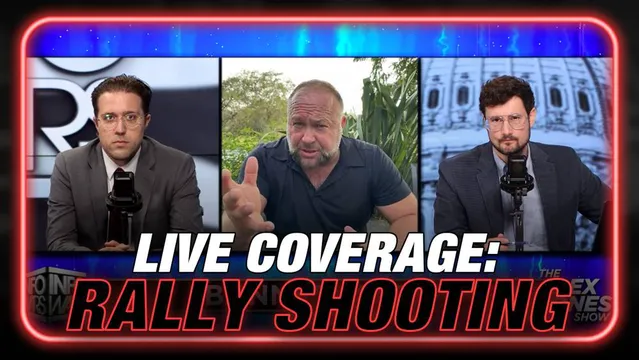
WATCH: Live Roundtable Analysis On Failed Assassination Attempt Of Donald Trump
1:25:54 - 1:33:36

WATCH: Live Roundtable Analysis On Failed Assassination Attempt Of Donald Trump

Mike Adams Forensic Audio Analysis of the Shooting

Mike Adams, the Health Ranger, presented a forensic audio analysis of the gunfire to debunk claims that the shooting was a hoax. By measuring the 0.22-second delay between the hypersonic bullet impact and the audible rifle report, Adams calculated the shooter's distance at approximately 450 feet. He concluded that the data is consistent with a shooter positioned on the identified rooftop.