Topic: Electricity

167 chapters across the catalog

Israel has reportedly begun bombing Iranian power plants and electrical switching centers, ignoring requests from President Trump to avoid targeting the energy sector. These attacks are expected to provoke asymmetrical retaliation from Iran, potentially targeting the United States' own vulnerable electrical grid. Concerns are raised about the lack of replacement transformers and the presence of sleeper cells within the U.S.
The International Energy Agency (IEA) has published a ten-point plan for the energy crisis, recommending reduced highway speed limits, car-free Sundays, and restricted air travel. This aligns with the C40 Cities agenda, which aims to limit individual consumption of clothing and food by 2030 through carbon credit systems. The transition to electric vehicles is described as a tool for centralized movement control, mirroring China's social credit system.

Anthony Cumia discusses New York's push to eliminate natural gas in favor of an all-electric infrastructure. He argues that consolidating energy sources under the electric grid makes it easier for the government to control the population by "flipping a switch." Cumia shares anecdotes about the breakdown of civility during power outages to illustrate how dependency on government-controlled utilities can be weaponized.

AI is expected to eliminate many white-collar jobs in marketing and graphics, making blue-collar trades like plumbing and electrical engineering the new "rockstars" of the economy. Jason Hollis notes that his 19-year-old daughter and other Gen Z students are now seeking "AI-proof" careers. The segment suggests that anything requiring manual labor will see a significant increase in value.

The Department of Homeland Security and FBI are on high alert for potential cyber attacks targeting US water supplies and the electric grid. Brianna Morello reports that thousands of potential sleeper cells were allowed into the country during the Biden administration. There are concerns that the death of the Ayatollah could trigger immediate kinetic retaliation from these domestic proxies.

US Energy Secretary Chris Wright criticizes the "Net Zero" movement as the greatest malinvestment in human history. He points to Germany's energy crisis as a warning, noting that massive investments in renewables have led to higher prices and lower production. Wright advocates for continued use of oil and natural gas.

Donald Trump’s "Art of the Deal" style involves making outrageous opening offers to wobble opponents, though critics argue this tactic requires more nuance in international diplomacy. In Canada, Mark Carney is accused of allowing 50,000 Chinese-made electric vehicles into the country, which are described as roaming spyware nodes for the Chinese government. These vehicles allegedly provide the Chinese Communist Party with access to massive amounts of domestic data through their integrated servers.

FULL VIDEO: President Trump Presents 365 Wins In 365 Days To The American People At Historic Press Conference!
58:40 - 1:01:28

FULL VIDEO: President Trump Presents 365 Wins In 365 Days To The American People At Historic Press Conference!

DEI Abolition, Electric Vehicle Mandates, Paris Accord

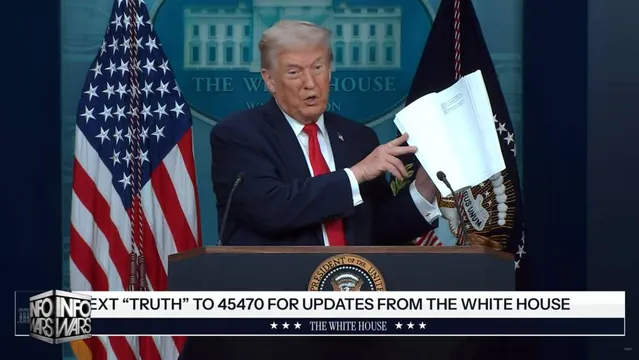
Donald Trump announces the abolition of all Diversity, Equity, and Inclusion (DEI) policies within the federal government. He terminates the "Green New Scam" and ends mandates for electric vehicles, though he clarifies he still likes Elon Musk and Tesla. Trump also discusses his withdrawal from the Paris Climate Accord, calling it a "ripoff of America."

FULL VIDEO: President Trump Presents 365 Wins In 365 Days To The American People At Historic Press Conference!
1:10:49 - 1:13:31

FULL VIDEO: President Trump Presents 365 Wins In 365 Days To The American People At Historic Press Conference!

AI Dominance, California Water Rights, Mark Zuckerberg

Donald Trump discusses an executive order to ensure U.S. dominance in Artificial Intelligence, noting that tech leaders like Mark Zuckerberg and Jeff Bezos need massive amounts of electricity. He criticizes California officials for routing water into the ocean to protect fish instead of fighting fires. Trump credits Lee Zeldin for fast-tracking federal permits for housing and power plants.

Economist Dr. Kirk Elliott reports that silver has reached $95 an ounce, outperforming gold by a factor of four in early 2026. Unlike previous speculative bubbles, the current price surge is driven by fundamental supply shortages and massive industrial demand for AI chips, electric vehicles, and solar technology. Analyst Eric Sprott has projected that silver could reach $300 an ounce as global mining supply fails to meet the needs of emerging technologies.

A caller suggests a mass movement of civil disobedience where citizens refuse to pay their electric bills to protest BlackRock's takeover of the grid. Jones acknowledges the "radical action" but warns that such a move could inadvertently bring down the grid and leave the country in the dark, noting that nuclear reactors cannot be easily powered down.

Alex Jones reports on a major power outage in San Francisco following the winter solstice, noting that a lack of backup power has left electric vehicles stalled on the roads. The broadcast also covers the U.S. Coast Guard's pursuit and seizure of oil tankers off the coast of Venezuela, which the Venezuelan government has condemned as active piracy.

Adams notes that China is winning the AI war due to its superior industrial output and 500% more STEM graduates than the US. He highlights a trend where electricity rates for American citizens are being raised to subsidize the massive power needs of AI data centers. He warns that the government may soon ask citizens to "sacrifice" their electricity to help win the AI race against China.

The commentary critiques electric vehicles and solar panels as having high toxic footprints while dismissing the dangers of carbon dioxide. It argues that CO2 is a "life-giving gas" that increases plant yields and that the Earth is currently at historically low levels of oxygen and carbon. The United Nations is accused of ignoring the Sun's 99.9% impact on climate to push regulatory agendas.

Donald Trump has escalated his rhetoric against Elon Musk, suggesting that the Department of Government Efficiency (DOGE) should investigate Musk's own government contracts. Trump criticized Musk's reliance on federal subsidies and his opposition to terminating electric vehicle mandates. The tension between the two figures has raised concerns about a potential split in the Republican base ahead of future elections.

Massachusetts State Senator Cynthia Cream has introduced legislation to track and limit the number of miles citizens can drive, arguing that electric vehicles are insufficient to meet climate goals. This bill is viewed as a precursor to the "15-minute city" model promoted by the World Economic Forum, which seeks to eliminate private car ownership. Critics warn that GPS tracking and mileage vouchers are the next steps in a global technocratic prison system.

Klaus Schwab and the World Economic Forum are accused of planning to eliminate individual car ownership in favor of expensive robo-taxis. The segment argues that high electricity costs will be used to force people out of personal vehicles. While not against the technology of electric cars, the host opposes the forced acceleration of human obsolescence in transit.

The U.S. currently faces a dangerous dependency on China for rare earth minerals essential for electric motors and military technology. Beyond economic concerns, China is criticized for its "mothership" fishing fleets that allegedly eradicate life in the oceans and its role as the primary source of plastic pollution in the Pacific. The segment argues that globalists have empowered China at the expense of both the American worker and the global environment.