Topic: Courage

63 chapters across the catalog

Rhodes and Jones discuss the lack of moral courage among figures like Dan Bongino when facing internal "deep state" enemies. Rhodes contrasts his own refusal to take a plea deal with other veterans who "rolled over" under pressure. They suggest that Bongino and others may be overwhelmed or compromised, failing to uphold their oath to the Constitution.

The discussion returns to the Latin Kings' threats against ICE agents, with Jones predicting the deep state will use this violence to distract from J6 revelations. Joe Biggs notes the disparity in justice, where a man who threw a sandwich at an agent faced no consequences while J6ers received decades in prison. They emphasize the need for "men of courage" to run into the metaphorical fire to save the country.

Dallas Alexander reflects on the need for spiritual guidance and moral courage during times of extreme political violence. Alex Jones references historical films like *The Patriot* and *Spartacus* to illustrate the point that good people are often forced into battle when their families are threatened. They discuss the "joy of battle" not as a desire for violence, but as the fulfillment of a duty to defend the innocent.

A reflection on leadership and patriotism cites Mark Twain's observation that a patriot is initially a "scarce man, hated, feared, and scorned." The narrative suggests that true leadership requires going against the tide of a degenerate establishment until the cause succeeds and the "timid" eventually join. This commitment to truth is framed as a spiritual duty forged by God to protect human freedom.

A philosophical distinction is made between "having" courage and "being" courage, with a childhood anecdote about the movie The Thing causing a fear of dogs. Trump is reportedly angry at the broadcaster, calling him a "dumb shit," to which the broadcaster adopts the title "Darth Dumb Shit." The segment concludes that true friendship involves telling the President the truth, even when he is "retarded" or self-destructive.

Pastor Locke criticizes "cowardly pastors" who refuse to speak on controversial issues like abortion, transgenderism, or the border for fear of losing their tax-exempt status or popularity. He compares modern truth-tellers to John the Baptist, who was executed for speaking out against King Herod. Locke argues that history only remembers those with the courage to stand for truth, while those who try to silence them are forgotten.

The essence of leadership is defined as the willingness to go against the tide of a degenerate establishment, as exemplified by the naval hero John Paul Jones. Citing Mark Twain, the discussion notes that a patriot is often "hated, feared, and scorned" until their cause succeeds and the "timid join him." This moral courage is presented as a divine requirement for those seeking to preserve human freedom.

A discussion on the essence of leadership emphasizes going against the tide of a degenerate establishment to set a moral example. Referencing Mark Twain, the narrative describes the patriot as a scarce and scorned individual who is eventually joined by the timid once the cause succeeds. The commitment to freedom is framed as a spiritual strength forged by God.

A theological discussion posits that the current global conflict is a manifestation of spiritual warfare between the "Antichrist system" and humanity. The host criticizes churches that welcome societal decline as a sign of the end times, arguing that "faith without works is dead." He asserts that God hates cowards and calls on believers to "occupy the earth" and fight evil rather than submitting to a self-fulfilling prophecy of destruction.

Jones discusses the necessity of "alpha" men acting as sheepdogs to protect society from predatory "wolves." He rejects the idea of submitting to political correctness or groveling to evil, arguing that a man of courage only tastes death once. He defines true alpha status as building civilization and standing against tyranny rather than dominating others for no reason.

Joe Pags encourages listeners to maintain their courage and not be intimidated by the pressure from the left. He and Alex Jones frame the current political struggle as the "Second American Revolution." Pags emphasizes that patriots must stay true to their beliefs and not be "scared into a hole" as they were during the Obama and Biden administrations.

Donald Trump's ability to endure 91 criminal charges and multiple assassination attempts is described as superhuman. Unlike other politicians who would have quit, Trump has used a "rope-a-dope" strategy to navigate gag orders and legal challenges. His motivation is attributed to a genuine belief that he is the only person capable of fixing the country's deep-seated issues.

The discussion concludes with a call for moral courage among government employees and citizens to expose corruption. James O'Keefe and the host agree that the country has reached a tipping point, with scandals involving figures like P. Diddy and Jeffrey Epstein revealing a system built on blackmail and leverage. They argue that the "Great Awakening" is underway as more individuals choose to prioritize their conscience over professional security.

Nikki Haley's endorsement of Donald Trump at the RNC is described as a move for "unity," though Geiser remains skeptical of her "swamp" ties. Tucker Carlson is featured, explaining that Trump "won" the election the moment he displayed physical courage under fire. Carlson argues that leadership requires the ability to stand up and say "fight" when others would run away.

The guests discuss the "uncancellable" nature of figures like Jordan Peterson, Dave Chappelle, and Joe Rogan, attributing their success to a refusal to acquiesce to intimidation. They argue that the fear of losing approval is a form of control, and that true love and respect are only found when one is willing to be authentic. The act of speaking one's truth is described as a necessary step to becoming an "unstoppable force."

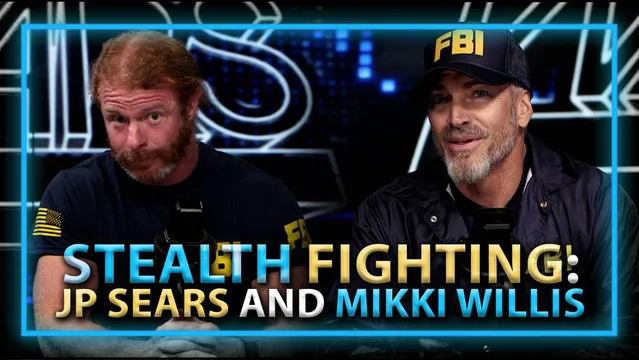
POWERFUL: Stealth Fighting With JP Sears And Mikki Willis
1:09:35 - 1:13:23

POWERFUL: Stealth Fighting With JP Sears And Mikki Willis

Johnny Twilight’s Coming Out, The Courage to Speak Truth

Mickey Willis acknowledges musician Johnny Twilight for his courage in appearing on a "banned" network, noting the fear of being disconnected from his social "tribe." Johnny describes the experience of following the truth as a way to put oneself in resonance with God and nature. The host compares the feeling of telling the truth to a "psychedelic" experience that leads to spiritual synchronicity.

Colonel Burton reflects on the nature of courage, distinguishing between the physical bravery required to land on an aircraft carrier and the "moral courage" needed to speak the truth. He credits his Christian faith and the concept of grace for his ability to challenge the national security establishment. Alex Jones agrees, noting that moral courage is increasingly rare among national leaders.