Topic: Building 7

167 chapters across the catalog

Tucker Carlson's personal evolution is detailed, including his time living with the Contras as a teenager and his eventual rejection of neoconservative war policies. Carlson reportedly had a change of heart after learning about Building Seven and apologized for his previous support of foreign interventions. The host mentions that Carlson and Charlie Kirk were among the few voices Trump listened to before recent shifts in policy.

An unearthed email from 2003 shows investigative journalist Edward Epstein inviting Ghislaine Maxwell to join a proposed "shadow commission" on 9/11. This revelation highlights the deep connections between the Epstein network and high-level political inquiries. The segment reviews the controversies of the official 9/11 report, including the collapse of World Trade Center Building 7, eyewitness accounts of explosions by Barry Jennings, and Larry Silverstein's "pull it" comment.

Kati reveals that her stepfather is William Rodriguez, the 9/11 janitor who famously claimed bombs went off in the North Tower basement before the planes hit. She mentions an unreleased documentary featuring Rodriguez and former FBI head Ted Gunderson. The discussion touches on the suspicious death of Barry Jennings and the "art students" present in the towers.

Archival audio features William Rodriguez describing the basement explosion and the "impact" of bodies hitting the lobby floor on 9/11. The segment details the suspicious death of Barry Jennings, the Deputy Director of Emergency Services, who claimed to have stepped over bodies in Building 7 before its collapse. The host notes that the BBC reported the building's collapse 25 minutes before it occurred.

The discussion focuses on the "controlled demolition" of Building 7 and the use of Red Cross communication channels by the deep state. References are made to celebrities like Charlie and Martin Sheen who questioned the official 9/11 narrative. Fletcher Prouty, the former head of black ops, is cited regarding the mechanics of state-sponsored assassinations.

A personal anecdote describes Tucker Carlson receiving threatening phone calls from Benjamin Netanyahu during a dinner in Florida eight months ago regarding his stance on Iran. The narrative traces the friendship between the host and Carlson back 14 years to when Carlson apologized for previous neocon-aligned criticisms. Carlson is described as a consistent anti-war voice who has been unfairly labeled as a foreign agent by various political factions.

The segment revisits the collapse of WTC Building 7, with Dr. Martinson and Alex Jones arguing it was a professional controlled demolition. They cite the free-fall speed of the collapse, the testimony of Barry Jennings, and the presence of fused concrete and steel in the debris. The discussion highlights the loss of critical FBI, CIA, and SEC records that were housed in the building at the time of its destruction.

Alex Jones reflects on the deaths of numerous 9/11 first responders and witnesses due to toxic dust and related cancers. He emphasizes the importance of preserving their interviews and testimonies as evidence of the events in New York. The segment transitions back to the Charlie Kirk case, with Jones warning against being distracted by unproven theories that flood the information space.

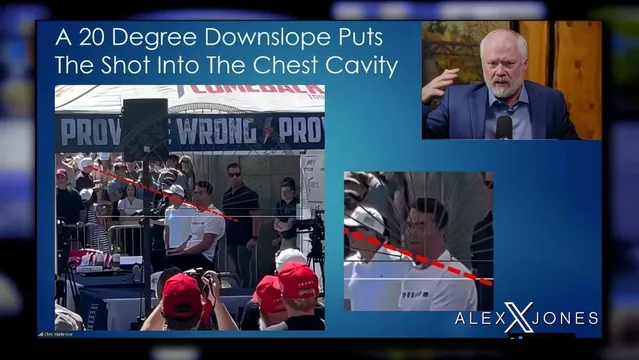
Ballistics analysis of the Charlie Kirk shooting suggests that the official narrative regarding the shooter's position is physically impossible. Evidence from the UVU courtyard and the Losey building indicates a 10-degree downslope that would not result in the reported spinal injuries. A .30-06 rifle round fired from the alleged roof position would have passed through soft tissue rather than ricocheting into the body as claimed by official reports.

Dr. Chris Martinson reviews data from the Donald Trump shooting in Butler, Pennsylvania, using sonograms to identify "snick-boom" signatures of supersonic rounds. Analysis of audio from seven high-quality sources, including Trump's microphone, reveals distinct echo geometries that indicate the presence of two separate shooters. Martinson notes that the FBI has shown zero interest in this acoustic data, which contradicts the lone-wolf narrative.

The conversation shifts to the collapse of World Trade Center Building 7 on September 11, 2001, citing it as a primary example of the government violating the laws of physics. The hosts discuss reports of a countdown over Red Cross radios and Larry Silverstein's "pull it" comment as evidence of a professional demolition. They note that the building housed critical records for the FBI, CIA, and SEC that were destroyed in the collapse.

In a segment featuring Tucker Carlson and Charlie Sheen, Sheen discusses his long-standing relationship with Alex Jones and his skepticism regarding the official 9/11 narrative. Sheen highlights anomalies such as the collapse of Building 7 and the lack of surveillance footage from the Pentagon. The host suggests that the public "destruction" of Sheen was a tactic to prevent other celebrities from questioning government accounts.

Protesters identified as Antifa surrounded a federal building in Eugene, Oregon, to block employees from exiting in a demonstration against ICE. Federal agents made several arrests after protesters used umbrellas and bear spray against law enforcement. The segment criticizes the lack of immediate repercussions for leftist agitators in blue cities.

New claims emerge regarding the Oklahoma City bombing, suggesting the FBI seized surveillance tapes that showed Timothy McVeigh with "John Doe Number Two." Witnesses from HUD and local law enforcement reportedly saw federal agents planting explosives in the Murrah building days before the blast. Despite the official narrative of a single truck bomb, experts like General Benton and Sam Cohen argued that the building's collapse was consistent with internal demolition.

A caller recalls news retractions on 9-11 regarding a plane allegedly shot down near the Capitol. The segment transitions into a fictionalized "InfoWars in Outer Space" narrative to promote methylene blue. The story depicts Captain Alex Jones traveling to Planet X2 to retrieve the purest methylene blue to save humanity.

The discussion revisits the collapse of World Trade Center Building 7, highlighting Larry Silverstein's televised comments about the decision to "pull" the building. Critics point to Silverstein's acquisition of a double insurance policy shortly before the 9/11 attacks as a significant red flag. The segment argues that public attention should remain on documented evidence of controlled demolition rather than unproven theories about other financial figures.