Topic: Brian Krassenstein

15 chapters across the catalog

Alex Jones prepares for a debate with Democratic activist Brian Krassenstein while critiquing Minneapolis Mayor Jacob Frey's refusal to cooperate with federal immigration enforcement. Jones argues that the refusal to assist ICE, even in cases involving violent criminals, represents a breakdown of the rule of law. He characterizes the Democratic strategy as using "shiny objects" and emotional diversions to distract from systemic issues.
Alex Jones introduces Brian Krassenstein for a debate, jokingly comparing him to the Star Wars character Salacious Crumb. Despite the insults, Jones acknowledges Krassenstein as one of the few liberals willing to appear on the show. The segment includes a montage of InfoWars' history and its mission to provide "tomorrow's news today" while navigating intense deplatforming and legal challenges.

Brian Krassenstein and Alex Jones discuss the recent fatal shooting of Alex Pretty by federal agents in Minneapolis. Jones admits that initial reports of Pretty pulling a gun were inaccurate based on high-definition footage, while Krassenstein argues the incident has caused a significant drop in Trump's popularity regarding immigration. They debate whether the shooting was a tragic accident or a result of overly aggressive federal policies.

The debate continues regarding Philadelphia DA Larry Krasner's comparison of ICE agents to Nazis. Krassenstein defends the right of states to prosecute federal agents who break the law, while Jones argues that such rhetoric incites violence against law enforcement. They examine the legal definitions of "justified" shootings and the high-pressure environment faced by agents during urban enforcement operations.

Jones and Krassenstein clash over the refusal of sanctuary cities like Minneapolis to cooperate with ICE. Krassenstein asserts that cities are reporting undocumented immigrants released from prison as required by law, but Jones contends that many blue cities actively obstruct federal agents from taking custody of violent offenders. They discuss the efficiency of using local police resources for federal immigration tasks.

The discussion shifts to the potential for a government shutdown over a $10 billion funding increase for ICE. Krassenstein argues the money is unnecessary, while Jones views it as essential for border security. They also debate Trump's comments regarding the Second Amendment in the context of the Alex Pretty shooting, with Krassenstein highlighting the irony of a pro-gun administration criticizing a citizen for carrying a firearm.

Alex Jones plays a clip of Joe Biden during a 2019 debate calling for a "surge to the border" of asylum seekers. Jones argues this was a direct invitation that created the current border crisis, while Krassenstein interprets the comment as a call to surge Border Patrol resources to process applicants. They debate the role of NGOs and the UN in facilitating mass migration into the United States.

Alex Jones defends his long-term warnings about a police state, clarifying that his concerns are specifically about unconstitutional martial law and national gun confiscation. Krassenstein questions why Jones is not more critical of federal agents killing an armed citizen like Alex Pretty. Jones maintains that enforcing existing immigration laws against foreign nationals is fundamentally different from a military takeover of the domestic population.

Using the film "True Grit" as an analogy, Alex Jones describes the type of individuals recruited for high-risk federal law enforcement roles. He argues that protesters who insert themselves into active federal raids are inviting disaster. Krassenstein counters that citizens have a right to film the government to ensure compliance with the law, leading to a debate over the boundaries of safe protest.

Alex Jones outlines the "Cloward-Piven" strategy of overwhelming the system through mass migration to force a socialist transition. He also touches on controversial "leftist" policies such as gender-affirming care for minors and state-sponsored euthanasia in Canada. Krassenstein dismisses these as embellishments, while Jones argues they are part of a broader "anti-human" globalist agenda.

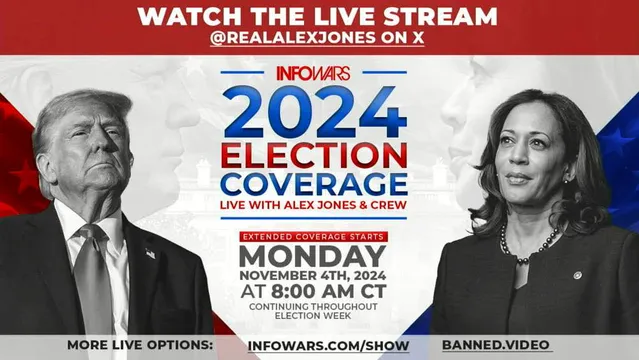
Reports emerge that Kamala Harris has canceled her election night speech at Howard University and her supporters are leaving. Democrat operative Brian Krassenstein reportedly credits Elon Musk for Trump's victory. Jones warns that the "76 days of hell" between the election and inauguration will be a period of extreme danger for Trump.

World Exclusive Coverage & Revelations of the Celestial Event Globalists Want Kept Hidden! — FULL SHOW 4/8/24
38:34 - 43:22

World Exclusive Coverage & Revelations of the Celestial Event Globalists Want Kept Hidden! — FULL SHOW 4/8/24

Brian Krassenstein FSD Video, Tesla Autopilot Skepticism

Brian Krassenstein shares a video of his "relaxing" drive across Florida using Tesla's Full Self-Driving (FSD) version 12.3.3. The host expresses deep skepticism toward autonomous vehicles, arguing that relying on AI for transportation requires a dangerous level of blind faith. The segment highlights Krassenstein's admission that he had to intervene during a right-hand turn.

Brian Krassenstein joins the discussion, agreeing that the probability of living in a simulation is high given the trajectory of rendering technology. The Fermi Paradox is addressed, with the suggestion that "aliens" are not seen because they exist outside the visible light spectrum or have moved "inward" into virtual environments. David Icke notes that the speed of light may represent the processing limit of our current simulation.