Topic: Vehicle

113 chapters across the catalog

The International Energy Agency (IEA) has published a ten-point plan for the energy crisis, recommending reduced highway speed limits, car-free Sundays, and restricted air travel. This aligns with the C40 Cities agenda, which aims to limit individual consumption of clothing and food by 2030 through carbon credit systems. The transition to electric vehicles is described as a tool for centralized movement control, mirroring China's social credit system.
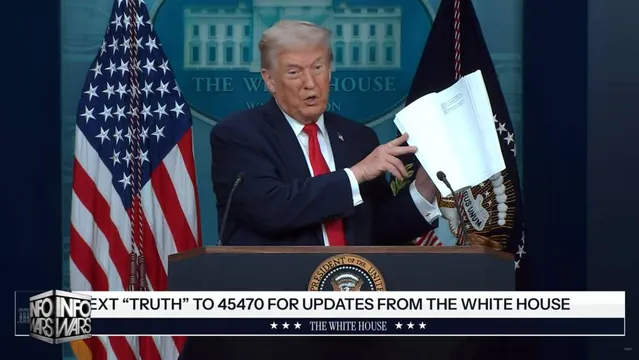
Donald Trump’s "Art of the Deal" style involves making outrageous opening offers to wobble opponents, though critics argue this tactic requires more nuance in international diplomacy. In Canada, Mark Carney is accused of allowing 50,000 Chinese-made electric vehicles into the country, which are described as roaming spyware nodes for the Chinese government. These vehicles allegedly provide the Chinese Communist Party with access to massive amounts of domestic data through their integrated servers.

FULL VIDEO: President Trump Presents 365 Wins In 365 Days To The American People At Historic Press Conference!
58:40 - 1:01:28

FULL VIDEO: President Trump Presents 365 Wins In 365 Days To The American People At Historic Press Conference!

DEI Abolition, Electric Vehicle Mandates, Paris Accord

Donald Trump announces the abolition of all Diversity, Equity, and Inclusion (DEI) policies within the federal government. He terminates the "Green New Scam" and ends mandates for electric vehicles, though he clarifies he still likes Elon Musk and Tesla. Trump also discusses his withdrawal from the Paris Climate Accord, calling it a "ripoff of America."

Economist Dr. Kirk Elliott reports that silver has reached $95 an ounce, outperforming gold by a factor of four in early 2026. Unlike previous speculative bubbles, the current price surge is driven by fundamental supply shortages and massive industrial demand for AI chips, electric vehicles, and solar technology. Analyst Eric Sprott has projected that silver could reach $300 an ounce as global mining supply fails to meet the needs of emerging technologies.

Dashcam and cell phone footage are analyzed to support the claim that ICE agent Jonathan Ross acted in self-defense when he fired at Renee Good. The footage reportedly shows Ross being struck by the vehicle and bouncing off the hood before discharging his weapon. The narrative presented by corporate media, which depicted Good as an innocent mother who took a wrong turn, is challenged by evidence of her participation in a coordinated blockade of federal agents.

The ICE agent in Minneapolis is praised for his restraint and for acting to protect other officers behind him during the vehicle assault. The tactic of swarming federal agents with vehicles is described as a "deadly force situation" that justifies a lethal response. The segment concludes that Renee Good's death was the result of "playing stupid games" and that her radicalization led her to believe she could attack agents without consequence.

A second camera angle of the Minneapolis shooting confirms that the driver made a deliberate left turn to target an ICE officer. The officer is seen jumping back while firing, and the vehicle only swerves away after the driver is hit. This evidence contradicts media claims that the woman was simply trying to flee the scene. The analysis concludes that the driver weaponized the SUV in an attempt to murder the federal agent.

Five men, including an Egyptian imam, were arrested in Bavaria, Germany, for allegedly planning a vehicle-ramming attack on a Christmas market. Prosecutors claim the group intended to kill as many people as possible because they view Christian symbols as illegal. The speaker argues that such incidents are frequently downplayed as "vehicle malfunctions" by the mainstream media.

Waymo makes its debut in New York City, while Tesla expands its autonomous taxi program in Austin, Texas. Schroer expresses personal skepticism and "control freak" anxiety regarding riding in driverless vehicles. Despite these concerns, the segment acknowledges that autonomous ride services are becoming a permanent fixture in major metropolitan areas like Austin and Phoenix.

Donald Trump has escalated his rhetoric against Elon Musk, suggesting that the Department of Government Efficiency (DOGE) should investigate Musk's own government contracts. Trump criticized Musk's reliance on federal subsidies and his opposition to terminating electric vehicle mandates. The tension between the two figures has raised concerns about a potential split in the Republican base ahead of future elections.

Massachusetts State Senator Cynthia Cream has introduced legislation to track and limit the number of miles citizens can drive, arguing that electric vehicles are insufficient to meet climate goals. This bill is viewed as a precursor to the "15-minute city" model promoted by the World Economic Forum, which seeks to eliminate private car ownership. Critics warn that GPS tracking and mileage vouchers are the next steps in a global technocratic prison system.

The integration of AI into streetlights, electricity, and banking is viewed as a significant risk for centralized control. Technologies like Neuralink are described as double-edged swords that could cure paralysis but also allow for subliminal marketing or government "voices" to be injected into the brain. The potential for AI to create "autonomous NPCs" controlled by a central grid is highlighted.

Since the late 1950s, the U.S. has allegedly utilized "Alien Reproduction Vehicles" to stage fake abductions for psychological warfare purposes. A 1985 CIA document reportedly detailed these operations in Argentina and Brazil to test public reaction. Dr. Greer cites these staged events as evidence that the "alien threat" narrative is a human-led fabrication designed for social control.

A forensic diagnostic of an investigator's vehicle revealed a hacking attempt targeting the steering, brakes, and acceleration systems. This "Info Vault 7" style cyber-attack is attributed to specialized intelligence units attempting to stop the investigation. Furthermore, geofencing data analyzed by the Heritage Foundation reportedly shows a device from Thomas Crooks' home appearing at the FBI headquarters in Washington D.C. prior to the shooting.

Industrial demand for silver is surging, with Samsung developing a solid-state battery that can fully charge an electric vehicle in nine minutes. China is projected to consume 12,000 tons of silver in 2025 solely for EV and solar applications, nearly 60% of the total global supply from the previous year. Dr. Kirk Elliott warns of a massive supply chain disruption as 70% of silver is mined only as a byproduct of other metals.

Silver is identified as a critical industrial component for military missiles, electric vehicles, and solar panels. Despite high demand, the price has been historically suppressed by the military-industrial complex and big banks to keep acquisition costs low. Analysts predict that as physical supplies dwindle, the market will break free from manipulation, potentially driving silver prices to $50 or $100 per ounce.

Dane Wigington of GeoengineeringWatch.org is cited for providing satellite footage of hurricane ionization. A caller from New Jersey reports witnessing the Motor Vehicle Commission registering non-citizens to vote without checking for citizenship, claiming clerks are "not allowed to ask" for proof.

Kamala Harris describes climate change as an existential threat and touts the administration's investment in a clean energy economy. Donald Trump argues that green energy policies are killing the American auto industry and benefiting China. He vows to protect the United Auto Workers by placing tariffs on cars manufactured in Mexico by Chinese companies.

Pre-Trump/Harris LIVE Debate Coverage Plus All The Other Insane News To Be Covered Today! — FULL SHOW 9/10/24
2:45:00 - 2:50:39

Pre-Trump/Harris LIVE Debate Coverage Plus All The Other Insane News To Be Covered Today! — FULL SHOW 9/10/24

Electric Vehicle Mandates, Remote Kill Switches

The push for electric vehicles is characterized as a global effort to implement "smart" technology that allows governments to remotely disable transportation. The discussion links EV mandates to the transition toward a central bank digital currency (CBDC), suggesting that both are tools for total state control over individual movement and spending.