Matt Bracken introduces his interview with Victor Bout, recently released from U.S. custody. Bracken, a former Navy SEAL, discusses his fascination with "international mavericks" and historical figures like Gerald Bull and Mad Mike Hoare.
113 chapters across the catalog
Matt Bracken introduces his interview with Victor Bout, recently released from U.S. custody. Bracken, a former Navy SEAL, discusses his fascination with "international mavericks" and historical figures like Gerald Bull and Mad Mike Hoare.
Former Navy SEAL Matt Bracken analyzes the tactical difficulty of invading Iran, noting it is six times the size of Colorado and significantly more mountainous. Bracken criticizes the "Usrael" alliance and Pete Hegseth's rhetoric of "negotiating with bombs." He argues that destroying Iranian bridges and power plants will isolate 92 million people and lead to a multi-generational humanitarian catastrophe that the U.S. cannot contain.
JP Sears invokes the Serenity Prayer to emphasize focusing on controllable factors in life. Jones admits he feels "fooled" by Trump's previous promises regarding Epstein justice and rooting out the Deep State. He vows to stop obsessing over Trump's "betrayal" and refocus his energy on exposing globalist agendas and digital IDs.
Navy SEAL Training Mindset, Serenity Prayer, Globalist Focus
Drawing on advice from Navy SEAL trainees, the host emphasizes focusing only on variables within one's control. The "Serenity Prayer" is cited as a guide for personal responsibility. The host announces a shift in focus toward exposing globalist agendas, such as internet IDs, rather than obsessing over Donald Trump's perceived betrayals.
Active duty military members and veterans, including Navy SEALs and Delta Force operators, are reportedly expressing deep concern over Trump's Iran strategy. While some high-ranking specialists believe a mission to secure nuclear material is possible, many view it as a suicide mission with a high probability of failure. Figures like Joe Kent are being demonized by the administration for warning against the conflict, despite support from former Israeli intelligence chiefs.
Logistics of a Ground Invasion and the Desert Storm Fiasco
A ground invasion of Iran is described as a logistical nightmare, with sortie rates for jets cut in half due to maintenance and refueling needs. Comparisons are made to the 1979 "Desert Storm" fiasco (Operation Eagle Claw), where a complex mission ended in a black eye for U.S. special operations. Critics argue that modern plans to "snatch uranium" from Iranian mountains are "fantasy land" scenarios promoted by media outlets like Fox News.
Delta Force, SEAL Team 6 and Uranium Extraction Mission
Special operations units, including Delta Force and SEAL Team 6, are reportedly training for raids on armored mountain fortresses to extract 1,000 pounds of enriched uranium. Critics label this a "suicide mission," arguing that Iranian forces have likely moved the material to hidden locations like goat farms or residential backyards. The mission is characterized as a wild goose chase designed to trap U.S. forces.
Joe Kent's extensive combat record is defended against media attacks, while figures like Eric Prince and Congresswoman Nancy Mace warn against sending "boots on the ground" to Iran. Classified briefings reportedly indicate the U.S. is losing the conflict, despite Trump's public claims of victory. The Pentagon's internal assessments are said to be far more pessimistic than the public narrative.
Bunker Buster Bombs, Iranian Nuclear Proliferation
The feasibility of seizing nuclear materials using Delta Force or Seal Team Six is questioned given the depth of Iranian bunkers. Even if 20,000-pound bombs are used, extracting enriched uranium would require extensive engineering efforts rather than quick raids. There is a growing concern that the Iranian leadership can now produce a functional nuclear weapon within one week.
Erik Prince, founder of Blackwater, has reportedly warned that the current conflict will lead to "boots on the ground" in Iran with casualty rates comparable to the Vietnam War. Critics also point to administration figures like Howard Lutnick, alleging they profit from policy shifts while the President takes the blame. The economic "bear trap" of combined tariffs and high oil prices is highlighted.
A caller from Nevada suggests that Donald Trump is emulating General Patton and likely has Navy SEALs prepared to clear the Strait of Hormuz using explosives. The plan would involve breaking up sunken ships into manageable pieces to restore oil flow quickly, similar to the rapid response seen with the Francis Scott Key Bridge. The host remains skeptical but hopes for a swift resolution.
The "Seal of Solomon" is described as an archetype used to control demons through the will of God, a concept found in ancient Judaic texts. The "occult" is defined as hidden knowledge, with Lucifer framed as a "light bearer" who turned against God's perfection. The discussion explores the metaphysical nature of dark matter and the "power of the air" as dimensions where spiritual wickedness operates against the Holy Spirit.
Matt Bracken, Iranian Hostage Rescue, Quagmire Risks
Former Navy SEAL Matt Bracken joins the show to discuss the risks of a long-term quagmire in Venezuela. He compares the current situation to the 1980 Iranian hostage rescue attempt and warns that a "snatch" operation is much easier than securing a country's infrastructure. Bracken expresses concern that the U.S. is unprepared for a Vietnam-style insurgency in the Venezuelan jungle.
Former Navy SEAL Matt Bracken warns that 2026 will be the "catapult energy release" of global conflict. He argues that Iran is five times larger than Iraq and that the U.S. Navy is now vulnerable to low-cost drone and missile attacks, as proven by the Houthis. Bracken cites a "demonstration strike" by Iran on a U.S. radar site in Qatar as proof of their advanced missile accuracy.

Sean Johnson on Trump's Administration and Canada's Tyranny
Navy SEAL veteran Sean Johnson joins Alex Jones to discuss his confusion regarding the direction of the Trump administration in 2025. They discuss the influence of Susie Wiles and Todd Blanche, expressing concern that Trump is being steered away from his core base. Johnson also highlights the rapid descent of Canada into a "police state" under globalist influence, warning that similar tyranny is at America's doorstep.
The sabotage of the Nord Stream pipeline is attributed to US Navy SEAL Team 10, a claim reportedly known within the SEAL community. Additionally, declassified documents from the Bush era show Vladimir Putin expressing early concerns about nuclear proliferation in Pakistan and Iran.
The distinction between lawful and "manifestly unlawful" orders is explored using the My Lai Massacre and Abu Ghraib as historical examples. Rhodes defends Pete Hegseth's authorization of strikes on drug boats, noting that sinking a ship has been a standard part of naval warfare since the Civil War. He dismisses the war crime allegations as a "red herring" designed to cause dissension in the military ranks.
Air Force Security, OSI, CIA Special Activities Division
A former Air Force Security Force member discusses the "SAD" (Special Activities Division) of the CIA, which he describes as a personal paramilitary force for the agency. He advises President Trump to bypass the CIA and rely on military intelligence branches like the OSI (Office of Special Investigations) and ONI (Office of Naval Intelligence). Jones agrees, warning that any special ops mission in Venezuela involving the CIA is likely a setup.
CIA-Trained Afghan Strike Forces and Domestic Attacks
A former SEAL Team 6 member discusses how Afghan "Zero Units" trained by the CIA were abandoned during the U.S. withdrawal and are now being utilized for domestic attacks. The shooter in D.C. and the alleged bomber in Fort Worth are linked to these CIA-trained hit teams. The narrative suggests these individuals are "soldiers of the left" being paid to incite violence against the National Guard.
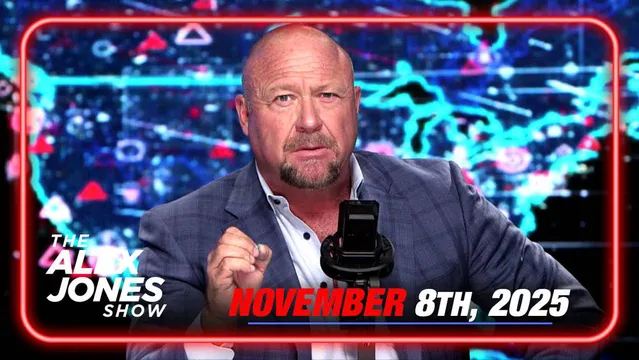
Elvis Comparisons, 500 Push-ups, and the Sean Johnson Workout
The host recounts Russell Brand's visit to Austin, comparing Brand's fan reception to that of Elvis Presley. He details his own physical transformation, credited to a rigorous workout regimen from trainer Sean Johnson. The story culminates in a description of the push-up contest where Brand allegedly jumped on the host's back during the set.