Topic: Glyphosate

78 chapters across the catalog

Comedian and author JP Sears joins the program to discuss a perceived radical shift in Donald Trump's political trajectory. Concerns are raised regarding Trump's recent support for the glyphosate lobby, his alignment with neocon figures like Mark Levin, and his stance on military intervention. The dialogue suggests that Trump has moved away from his revolutionary roots toward a more establishment-aligned platform.
The segment explores the decline in American food quality compared to Europe, claiming that US food is "poisoned" with GMOs and glyphosate. A specific viral claim is discussed regarding Hershey bars now containing wax and having a rubbery texture. The speakers lament the change in taste and quality of major American food brands like McDonald's and Domino's over the last 20 years.

The host suggests that Donald Trump's administration uses regulatory threats to "shake down" corporations for political or financial gain. While praising Trump's actions on the border and carbon taxes, the speakers reiterate their strong opposition to the Iran war. The segment concludes with the theory that Trump has "cashed out" and made a deal with globalist forces.

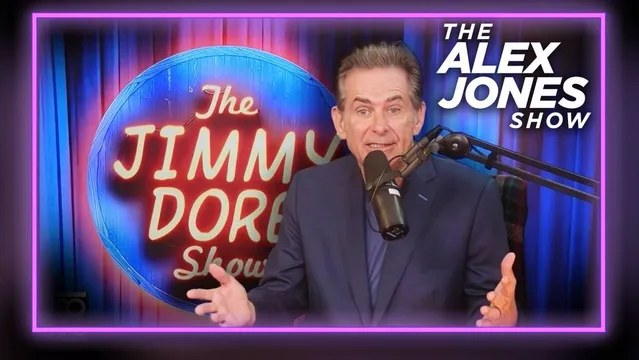
MUST-SEE: Alex Jones Interviews Jimmy Dore In EXPLOSIVE Must-Watch End Of The World Interview!
3:25 - 6:44

MUST-SEE: Alex Jones Interviews Jimmy Dore In EXPLOSIVE Must-Watch End Of The World Interview!

Trump Campaign Promises and Alleged Policy Reversals

The Donald Trump presidential campaign is characterized as a significant electoral fraud due to reversals on peace and anti-establishment stances. Despite campaigning on ending Middle East wars and challenging Big Pharma and Big Agra, the administration is accused of funding Ozempic manufacturers and protecting glyphosate producers. RFK Jr. and Tulsi Gabbard are mentioned as figures whose anti-establishment platforms are being sidelined.

Concerns are rising regarding Donald Trump's recent policy shifts, including granting liability protection to glyphosate manufacturers. This move is described as a departure from the anti-globalist trajectory seen earlier in the administration. Despite these concerns, the disruption of the previous globalist order is viewed as a historical process that remains superior to Democratic alternatives.

Donald Trump is reportedly under extreme stress due to ongoing indictments and a heavy workload, leading to a more "maniacal" and "grumpy" demeanor behind the scenes. Alex Jones claims Trump has made deals to suppress the Epstein files and has gone "sideways" on issues like liability protection for Roundup (glyphosate). Jones mentions reports of Trump screaming at advisors, including Pete Hegseth, as the administration grapples with the quagmire of the Iran conflict.

Robert F. Kennedy Jr. defended President Donald Trump's executive order regarding glyphosate, arguing that the policy aims to bring industrial production back to the United States before a gradual phase-out. Critics express concern over the order providing liability protection to Bayer, the parent company of Monsanto, despite evidence linking Roundup to cancer and neurological damage. Kennedy maintains that the compromise is necessary to avoid immediate industrial disruption while educating the public on wheat intolerance.

President Trump signed an executive order declaring glyphosate production a national security issue, effectively granting liability protection to companies like Bayer and Monsanto. While the administration argues the chemical is a necessary precursor for weapons manufacturing, critics like Robert F. Kennedy Jr. warn of its extreme toxicity and link to cancer. The order is viewed by some supporters as a betrayal of the "MAHA" (Make America Healthy Again) agenda.

On the same day President Trump signed an executive order promoting glyphosate production, the company that owns Roundup proposed a $7.25 billion settlement for cancer-related lawsuits. This policy contradiction has caused friction within the "MAHA" movement, as supporters of RFK Jr. view the promotion of the chemical as a threat to public health. The host expresses confusion over the administration's decision to back a known carcinogen.

President Trump utilized the Defense Production Act to promote the domestic production of glyphosate, citing its importance to the national defense supply chain and military readiness. This move has sparked intense debate among supporters who follow RFK Jr.'s warnings about the chemical's link to chronic disease. The host struggles to reconcile the administration's "MAHA" goals with the promotion of a controversial pesticide.

RFK Jr. discusses emerging "laser weeding" technology as a potential off-ramp for farmers currently dependent on glyphosate. While an outright ban on the chemical would bankrupt 80% of US farmers, laser robots can kill 100,000 weeds per hour without pesticides. The "MAHA" agenda aims to support the agricultural community in transitioning away from chemicals and ultra-processed foods to combat the chronic disease crisis in children.

The Trump administration's decision to grant liability protection to glyphosate manufacturers is explained as a maneuver to protect the supply chain for weapons manufacturing. However, Alex Jones vows to "put Trump's feet to the fire" over the health implications for the American public. He argues that the executive order should be narrowed to exclude agricultural use, preventing companies like Bayer from avoiding lawsuits related to cancer.

The speaker praises RFK Jr. for his efforts to dismantle what he calls the "kill grid," including initiatives to ban geoengineering, fluoride, and glyphosate. Claims are made that these efforts are inspiring states like Texas and Florida to take legislative action against mercury in vaccines and mRNA technology. The segment frames these developments as a major victory for the populist movement.

A detailed discussion on the use of glyphosate (Roundup) as a desiccant on wheat crops shortly before harvest. The speaker argues that modern "gluten intolerance" is actually a reaction to weed killer residue in the food supply. He cites Mel Gibson's observations on the healthiness of European wheat compared to American GMO crops and the link between glyphosate and various cancers.

Florida Surgeon General Dr. Joseph Ladapo discusses the dangers of glyphosate, explaining how the chemical weakens the blood-brain barrier and allows toxins to enter the central operating system. The segment includes a clip of Mel Gibson praising the unpasteurized milk and non-GMO food supply in Italy as a defense against environmental assaults.