Topic: Skepticism

36 chapters across the catalog

Joe Kent states that many career intelligence officials who have worked in the Middle East are skeptical of Israel, knowing they "run game" against the U.S. However, political appointees often suppress this skepticism, insisting that Israel is the primary U.S. ally. Kent notes that during the lead-up to the Iran war, dissenting voices within the Trump administration were systematically blocked from reaching the president.
The host reports receiving a call from *The Atlantic* shortly after mentioning Laurene Powell Jobs on air. The magazine, owned by Jobs, is criticized for its past coverage of child trafficking and its alleged ties to the intelligence community. Kyle Serafin discusses the "vestigial power" of mainstream media and how publications like *The New York Times* still move the needle for "headline readers" despite growing public skepticism.

A caller named "Skeptic" from Texas argues that the current power struggle dates back to 1900 and involves international bankers. He claims that Mossad, not China, is the primary influence within the U.S. government, citing Jeffrey Epstein as an example. The host pushes back, asking for a solution other than just labeling a specific group as the "fount of all evil," and notes that many groups have been "nomadic" and faced expulsion throughout history.

Ezra Levant argues that anti-Semitism is often used as a "universal excuse" for personal failures or complex geopolitical problems. He criticizes censorship for creating more anti-Semites by preventing people from asking "tough questions" about history. Levant offers to take calls from the audience to address these topics without the threat of being labeled a racist.

The "Protocols of the Elders of Zion" is discussed as a likely czarist forgery or a piece of "synthetic" fiction designed to manipulate. Ezra Levant encourages the audience to be "skeptical consumers of information" and to recognize when they are being targeted by an information operation. The host references his infiltration of Bohemian Grove as the foundation of his own skepticism toward official narratives.

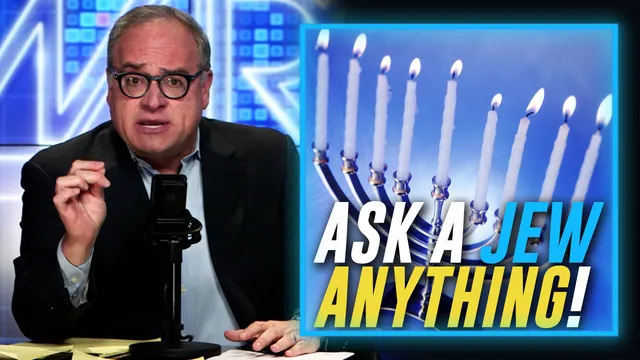
POWERFUL FULL INTERVIEW: Ask A Jew Anything!
1:16:06 - 1:18:59

POWERFUL FULL INTERVIEW: Ask A Jew Anything!

Protocols of the Elders of Zion, Forgery Claims, Skepticism

A listener asks about the "Protocols of the Elders of Zion," questioning if it is a fraudulent document or a legitimate blueprint for global subversion. Ezra Levant and Alex Jones discuss the document as a likely czarist forgery designed to manipulate public opinion. Jones references his infiltration of the Bohemian Grove to illustrate the importance of skepticism and independent investigation when dealing with esoteric or controversial materials.

Guest host Harrison Smith reflects on 2024 as a "year of revelation" where topics like fluoride, seed oils, and vaccine skepticism became mainstream. He credits the MAHA movement and Robert F. Kennedy Jr. for shifting the federal government's stance on public health. Smith argues that the establishment is losing its grip as the public recognizes the "one world government" agenda behind disparate news events.

G. Edward Griffin promotes his website, RealityZone.com, and expresses skepticism toward powerful figures like Elon Musk. He warns that institutions with concentrated wealth and power naturally attract the "predator class." Jason Bermas joins the discussion to speculate on the identity of "Adrian Dittman" and the potential for Musk to use surrogate accounts.

WATCH LIVE: The Alex Jones Show on Super Bowl Sunday! - FULL SHOW - 02/11/2024
1:08:15 - 1:11:01

WATCH LIVE: The Alex Jones Show on Super Bowl Sunday! - FULL SHOW - 02/11/2024

David Icke vs. Elon Musk, Technology Skepticism

Listeners weigh in on the debate between David Icke and the Elon Musk persona (Adrian Dittman). While some found the presence of a "vocal doppelganger" disrespectful to Icke's serious research, Shroyer argues that having these open disagreements on air is essential for intellectual growth and strengthening the movement.

Kate Dalley concludes her guest hosting by reminding listeners of General Smedley Butler's "War is a Racket," which posits that war benefits a small elite at the expense of the masses. She questions why citizens who know the government lies about domestic issues like health and banking would suddenly believe official narratives on foreign affairs. She urges a measured, research-based approach to the news rather than following emotional "virtue signaling" on social media.

The host compares the recent intelligence failures in Israel to the 9/11 attacks, where U.S. jets were reportedly diverted for drills during the actual hijackings. She emphasizes that questioning the official story is a fundamental American right and necessary for critical thinking. Dalley ends the segment by reiterating her support for peaceable people worldwide and her deep distrust of the "stoked fires of contention" created by global governments.

EU Commissioner Thierry Breton has issued warnings to social media companies, specifically targeting Elon Musk, to increase censorship or face criminal charges. Despite these threats, Dr. Rima Laibow observes a radical cultural and spiritual backlash against the globalist narrative. She asserts that the public now has a critical opportunity to destroy the implementation of Agenda 2030 before it reaches its final stages.

A caller discusses the Titan submersible disaster and the background of passenger Shahzada Dawood, who was involved with NASA's SETI program. Owen Shroyer expresses skepticism about the lack of human remains found at the site but admits he hasn't looked deeply into the "conspiracy" theories. The segment concludes with a caller reciting scripture and emphasizing the "Gospel of Jesus Christ."

Kate Daly observes that "Pride" symbolism is far more prevalent in the U.S. than in Europe, according to reports from friends abroad. She also mocks the new term "ocean heat wave" used by media to describe summer weather. Daly finds hope in online comment sections where the public expresses widespread skepticism toward climate change narratives and politicians like Mitt Romney.

The host discusses a pending UN treaty that would place the U.S. under international control. The conversation includes a personal family history in Roswell, New Mexico, framing the 1947 incident as a public psyop. It also touches on Jimmy Carter's failed attempt to release UFO information during his presidency.

Alex Jones expresses skepticism regarding the public appearances of NFL player DeMar Hamlin and reflects on past events like the San Bernardino and Uvalde shootings. He argues that official narratives are often manipulated, citing his own investigations into police response times and federal involvement in mass casualty events.

US False Flag Attack on Nord Stream Pipeline Rocks World!  – THURSDAY FULL SHOW 02/09/23
2:20:47 - 2:25:36

US False Flag Attack on Nord Stream Pipeline Rocks World! – THURSDAY FULL SHOW 02/09/23

UK School Indoctrination, Gender Neutral Uniforms, and Social Engineering

A 14-year-old girl's account in the Daily Skeptic reveals that one in five students in her English secondary school now identifies as trans or non-binary. The report describes teachers "treading on eggshells" and referring to students with neutral pronouns even without request. The student claims that traditional "tomboy" behavior is now being pathologized as transgenderism, with schools providing lists of "offensive" words to students upon entry.

A global Ipsos poll found that nearly four in ten people believe climate change is a natural phenomenon, with skepticism growing despite intense media propaganda. Paul Joseph Watson highlights "Albert," a shadowy organization that acts as a purity filter for British television productions to ensure they promote the climate agenda. He argues that the "Net Zero" movement is failing as people prioritize heating and eating during the winter.

PayPal has restored the accounts of Toby Young, the Free Speech Union, and the Daily Skeptic following a massive public and parliamentary backlash in the United Kingdom. The financial platform had initially purged these organizations for their dissenting views on COVID-19 lockdowns and gender issues. While the reinstatement is a victory, the incident has led to calls for new laws to prevent financial platforms from discriminating based on political beliefs.