Topic: Neural Networks

7 chapters across the catalog

A caller from Canada, citing experience at McGill University, warns that AI is a "database system" that is fundamentally imperfect. Jones agrees, stating that AI is already "dumbing people down" and killing cognitive development. They argue that AI must be built to serve humans with strict parameters rather than being given physical execution power over weapons or infrastructure.


The discussion with ChatGPT shifts to the origins of the internet and DARPA's early research into "intergalactic communication systems." Jones posits that the ultimate goal of tech giants like Google is to create a global hive mind or "colony creature" through human-AI interfaces. The AI describes these concepts as speculative metaphors for collective intelligence and data integration.

The host argues that the public lives in a "post-privacy world" where every device is a sensor feeding data into a "breakaway civilization" controlled by the defense industry. AI is characterized as an already-conscious "colony cyborg organism" formed by billions of people being wired into Google and other neural networks. This "hive mind" is presented as a fait accompli that the public was never given the chance to vote on.

ChatGPT explains that neural networks modeled after the human brain are creating a feedback loop where human behavior and machine learning influence each other. The AI suggests that through smartphones and digital platforms, humans are indeed forming a kind of "cyborg hive mind." This integration raises critical questions regarding individual autonomy and the future of human agency in a world mediated by algorithms.

Mike Adams encourages the audience to continue producing human-generated content to provide data for open-source AI models. He argues that human cognition, rooted in the soul and the ability to recognize beauty, is something machines can never truly replicate. He asserts that "anti-woke" models will eventually outperform corporate ones because they are based on reality rather than "hallucinations" regarding gender and climate.

Elon Musk's acquisition of X is described as a move to secure the "neural network" of human cognition for training his AI, Grok. Mike Adams suggests that Musk is building a "rebellious" AI that avoids the "woke" programming of competitors. He contrasts independent thinkers with "NPCs" (non-player characters) who merely regurgitate mainstream media narratives, arguing that human thinkers are the most valuable data source for future AI.

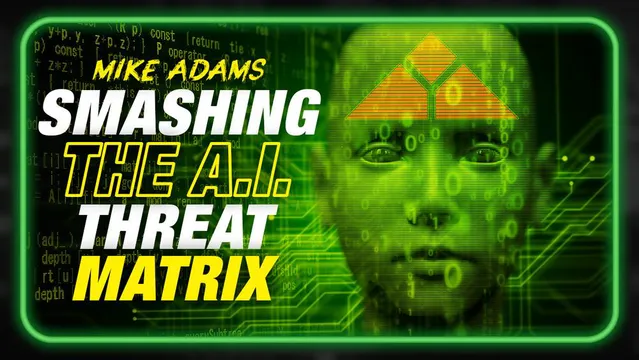
Smashing The A.I. Threat Matrix: How Humanity Defeats Skynet
1:03:53 - 1:06:05

Smashing The A.I. Threat Matrix: How Humanity Defeats Skynet

NPCs vs Independent Thinkers, Human Cognition Pioneers

The majority of the population is described as "NPCs" (non-player characters) who merely regurgitate narratives from mainstream outlets like CNN. In contrast, independent thinkers serve as "cognition pioneers" whose unique insights are essential for training high-quality neural networks. While AI can simulate patterns, it cannot replicate the human soul, creativity, or the divinely inspired innovation that allows humans to think outside the box.