Topic: Military Leadership

7 chapters across the catalog

Peter Tickton recounts his time at the New York Military Academy in 1963, where he served as a platoon sergeant under Donald Trump. Tickton describes Trump as a leader who used "soft power" and was respected by his fellow cadets, noting that Trump never lashed out or used physical force despite the rough environment of the academy. He argues that Trump's primary leadership trait was making people not want to disappoint him.
A former military trainee shares his story of being dismissed from BUDS (Navy SEAL) training due to the COVID-19 vaccine mandate. He expresses admiration for Trump's leadership and the emotional impact of the assassination attempt. Jones encourages the caller to stay strong and maintain a small, self-sufficient community as the system "crumbles."

A caller suggests that Donald Trump needs a strong military figure as his Vice President, such as General Michael Flynn or Colonel Douglas McGregor. The host agrees, noting that Trump's primary weakness in his first term was a lack of reliable military and intelligence leadership. The discussion emphasizes the need to "purge" the Pentagon and the Justice Department.

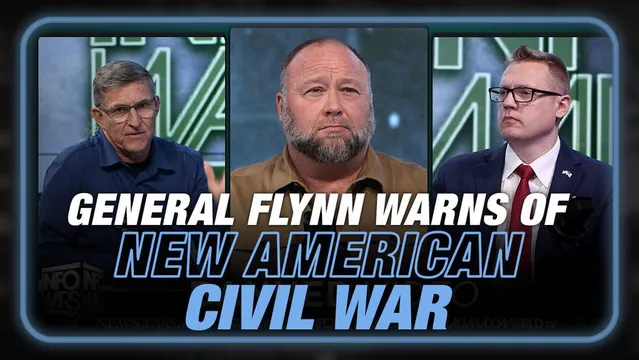
General Flynn expresses concern over "corporate woke" leadership in the U.S. military and calls for officers to stand their ground against unconstitutional orders. He encourages Speaker Mike Johnson to shut down the government to force action on border security. The segment emphasizes maintaining the "moral high ground" through local community engagement and speaking out against the globalist takeover.

General Flynn highlights the specific use of the word "Confederate" by media and politicians to label Trump supporters and the "MAGA cult." He argues this is a precise linguistic tool intended to further divide the country and justify aggressive action. Flynn expresses concern over the direction of uniformed military leadership and calls for local leaders and churches to prepare for a historically consequential year.

The discussion shifts to the current state of the U.S. military, contrasting the physical courage of leaders like General Kurilla with a perceived lack of moral courage to stand against the Biden administration's policies. Michael Yon argues that while Kurilla is a "stud" on the battlefield, his compliance with the open-border agenda and the withdrawal from Afghanistan represents a tragic turn. There is a call for more generals to follow the example of Michael Flynn and speak out against the destruction of the Republic.

Alex Jones and David Parton discuss the General's insistence on understanding the "communist program" to defeat globalism. The General predicted that communists would use open borders, gun confiscation, and the release of prisoners to destabilize society. David emphasizes that his grandfather viewed the fight for the Republic as a serious military engagement and worked to educate the public on these threats.