Topic: Martin Luther King Jr

72 chapters across the catalog

Nick Fuentes argues that the US must use its leverage to restrain Israel, as Israel is the primary obstacle to peace between Washington and Tehran. The host claims to have sources confirming a "firestorm" within the White House as Trump realizes he is being viewed as an "errand boy" for Israel. They discuss the "schizophrenic" messaging coming from the administration as it attempts to manage the fallout of the Iranian strikes.
Despite acknowledging criticisms of Martin Luther King Jr.'s political affiliations, the host praises the "I Have a Dream" speech for its focus on the character of deeds rather than skin color. He argues that modern propaganda weaponizes racial groups to create a clash that prevents the realization of this vision.

In a lengthy philosophical monologue, Jones describes his legal and personal tribulations as a spiritual test and a divine mission. He compares his situation to Obi-Wan Kenobi, suggesting that if he is "struck down" by the system, he will become more powerful. Jones asserts that he is an instrument of God and that his goal is to build a timeless civilization rather than seek mindless pleasure or corporate approval.

A discussion on racial demographics and crime claims that the Biden DOJ has manipulated statistics by misclassifying the race of offenders. The host references the murder of Jamie White in March, asserting that his prediction regarding the suspects' ethnicity was later confirmed in the indictment. The mainstream media is accused of ignoring a crime wave in blue cities by failing to report accurate data.

The death of Charlie Kirk is compared to the martyrdom of Martin Luther King Jr. and Bobby Sands, suggesting it will have a permanent impact on the American psyche. The discussion rejects the "culture of forgiveness" pushed by federal agencies, arguing that anger is a necessary and healthy response to the destruction of civilization. True Christianity is framed as defending one's family and values against those who wish them dead.

A priest provides historical context, claiming Charlie Kirk's death is the first major political assassination in the United States since the 1968 murders of Martin Luther King Jr. and Robert F. Kennedy. The discussion contrasts American stability with the frequent political violence seen in countries like Mexico. Additionally, the segment reports on members of a political party allegedly booing a request for a moment of silent prayer on the House floor.

Glenn Beck argues that Charlie Kirk should be recognized as a civil rights leader rather than just a political activist, comparing his fight for free speech to the work of Martin Luther King Jr. Beck calls for the creation of a "Charlie Kirk Boulevard" in Phoenix to honor his legacy. Harrison Smith supports this framing, urging conservatives to assert moral superiority over those justifying the murder.

A personal story about a daughter attending St. Edward's University highlights the perceived "brainwashing" in modern higher education regarding white guilt. The segment advocates for a return to Martin Luther King Jr.'s vision of judging individuals by the character of their deeds rather than their race. Examples of choosing doctors, personal trainers, and restaurants based on quality and reviews rather than the owner's ethnicity are provided to support a colorblind meritocratic worldview.

A historical review of crime in Washington, D.C. traces the city's decline from the 1968 riots to the crack epidemic of the 1990s. The segment highlights the 2002 sniper attacks and the recent surge in carjackings and homicides following the 2020 police funding cuts. Current residents express fear for their safety, contrasting the city's past with the current "District of Criminals" atmosphere.

A montage of historical speeches features figures such as Winston Churchill, Dwight Eisenhower, and Martin Luther King Jr. discussing the dangers of the technological elite and the defense of freedom. The segment includes a quote suggesting that if fascism comes to America, it will be in the name of liberalism. The host emphasizes the media's power to manipulate public perception of guilt and innocence.

Director of National Intelligence Tulsi Gabbard announces evidence that electronic voting machines are vulnerable to hacking, supporting a mandate for paper ballots. She also reports that over 100 people are working to scan and release long-hidden documents related to the assassinations of Robert F. Kennedy and Martin Luther King Jr. RFK Jr. expresses his gratitude for the release of these documents, which have been in storage for decades.

A historical reflection on FBI abuses mentions COINTELPRO and the harassment of Martin Luther King Jr. The discussion shifts into a tangent regarding public health, where claims are made that sanitation, rather than vaccines, led to the decline of infectious diseases like measles. Personal anecdotes regarding Lyme disease and polio are used to express deep-seated distrust in government-mandated medical interventions.

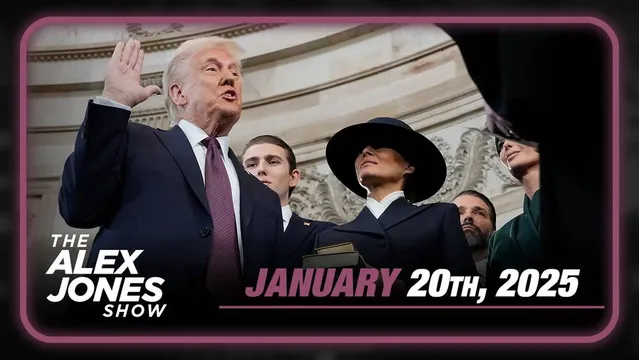
Donald Trump reflected on the assassination attempt in Butler, Pennsylvania, stating he was saved by God to lead the nation. He highlighted his victory in all seven swing states and his success with the popular vote as a mandate for unity. Trump also noted the significance of the inauguration falling on Martin Luther King Day, pledging to make King's dream a reality.

Religious leaders including Rabbi Ari Berman, Pastor Lorenzo Sewell, and Reverend Frank Mund provided the benediction for the inauguration. The prayers invoked biblical values, the prophet Jeremiah, and the legacy of Martin Luther King Jr. to call for national healing. The segment concluded with a recitation of "Free at Last" and a celebration of religious expression in the public square.

The Trump administration pledges to release all remaining records related to the assassinations of John F. Kennedy, Robert Kennedy, and Martin Luther King Jr. Additionally, an executive order will be signed to remove "wokeness" from the military and ban biological men from women's sports. A satirical reference is made to Saturday Night Live's portrayal of Rachel Maddow.

A philosophical discussion contrasts Western culture's focus on individualism with the collectivist ideologies of the political left. The "woke mind virus" is described as a movement that encourages people to abandon their individual identities in favor of groupthink based on race, gender, or sexuality. The values of Western civilization, rooted in thinkers like John Locke and Adam Smith, are presented as universal principles accessible to all people regardless of race.

The failure of Kamala Harris to pledge the release of the JFK assassination files is contrasted with Donald Trump's commitment to do so. White argues that this reveals Harris's allegiances to the intelligence community. He calls on the "silent majority" to become a "loud majority," stating that a visible public presence is necessary to prevent the establishment from rigging the consensus and the election.

Bennett suggests that Donald Trump should deliver a speech similar to Martin Luther King Jr.'s "Mountaintop" address, giving the American people marching orders in case he is killed. He encourages citizens to "own their county" by taking over school boards, mayor's offices, and sheriff's departments. The goal is to create a decentralized resistance that can survive the loss of any single leader.

The broadcast concludes with a call for Donald Trump to adopt a "Christ-like" or "Gandhi-like" stance of forgiveness toward his enemies to win over independent voters. Bennett compares the current movement to the disciplined Spartans rather than a "rebel screaming army." They reiterate that the "dark side" is losing and that the American people must be ready to "pick up the flag" if their leaders fall.

Total Solar Eclipse Special Report: Deep State Using Event to Test Federal Communications Takeover for Martial Law
1:22:16 - 1:27:38

Total Solar Eclipse Special Report: Deep State Using Event to Test Federal Communications Takeover for Martial Law

Human Supremacy Manifesto and the Resistance to Technocracy

Alex Jones delivers a monologue defining "Human Supremacy" as a resistance against the anti-human agendas of Yuval Noah Harari and Klaus Schwab. He calls for unity across all races and backgrounds to oppose a "Satanic" technocracy that views humans as obsolete. Jones envisions a future where humanity colonizes the stars and unlocks the secrets of the universe through divine will.