Topic: Article 3 Court

13 chapters across the catalog

The current Department of Justice has reportedly indicted more mid-level and high-level Democratic officials than any previous Republican administration. There is a concurrent debate regarding the authority of Article 3 administrative courts versus the Supreme Court and the President's constitutional power to enforce border security. The executive branch maintains that the power to arrest and deport illegal immigrants is vested solely in the President as the chief law enforcement officer.
Obama-appointed Article 3 judges are accused of lawless behavior for unilaterally striking down executive actions and ordering the continued funding of Planned Parenthood. These district judges lack the constitutional authority to apportion spending, which is a power reserved for Congress. This judicial overreach is framed as a parasitic attempt by Democrat lawyers to override the will of the voters.

JD Vance and Donald Trump are challenging the European Union and United Kingdom over censorship laws that officials fear could extend to the United States. Trump is utilizing tariff threats to force European concessions on free speech. Additionally, critics are highlighting "judicial activism" by Obama-appointed district judges who are allegedly blocking legally passed Congressional funding cuts, such as those directed at Planned Parenthood.

Jones and Brown discuss the declining poll numbers of the Democratic Party and the recent Supreme Court rulings against "administrative" Article III courts. Brown observes a change in the body language of Democratic leaders like Hakeem Jeffries, noting they appear less arrogant than in previous years.

The Trump administration is moving to federalize the National Guard in red states to conduct immediate deportation hearings, bypassing slow-moving Article III courts. This strategy allows military JAG officers to act as immigration judges under joint federal and state command. Trump suggested that if blue-state governors like Gavin Newsom refuse to cooperate, the federal government may intervene to ensure enforcement.

The Supreme Court issued a 6-3 ruling stating that nationwide injunctions exceed the power of individual federal court judges. This decision is framed as a victory for the executive branch, potentially clearing the way for the Trump administration to end birthright citizenship and remove illegal aliens from census apportionment. The ruling limits lower Article III courts from blocking federal policies across the entire country, a practice described as judicial tyranny.

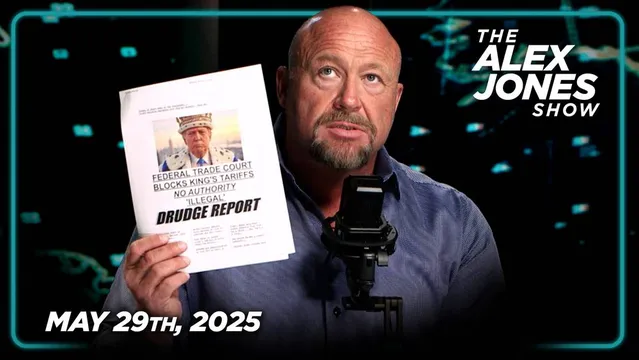
Benjamin Netanyahu accepted a 60-day ceasefire in Gaza following pressure from the Trump administration. Simultaneously, a federal Article 3 court blocked President Trump's tariffs, a move Jones characterizes as an unconstitutional overreach by judicial enemies. The segment also highlights attempts by Moody's and international regulatory groups to destabilize the U.S. stock and bond markets.

Roger Stone characterizes the recent ruling by a New York-based international trade court against Trump's tariffs as an act of judicial tyranny. He argues that the court lacks the authority to block executive trade policy and expects the Supreme Court to overturn the decision. Stone praises Trump's negotiators, including Scott Bessent and Steve Whitkoff, for their success in bringing in $255 billion in new revenue.

Newt Gingrich testifies before Congress regarding the historical precedent of the Judiciary Act of 1802, where Thomas Jefferson abolished federal courts to stop a "judicial coup." The testimony highlights that 92% of nationwide injunctions against Trump were issued by Democrat-appointed judges. Gingrich argues that the legislative and executive branches have the constitutional power to reshape or defund lower courts that overstep their authority.

Federal district judges are accused of executing a judicial coup by issuing hundreds of nationwide injunctions against executive actions, a power not granted by Article 3 of the Constitution. These magistrates are blocking the President's authority to fire CIA staffers or secure the border, despite having no statutory basis for such universal orders. Historically, only 22 such injunctions were issued in 240 years, whereas hundreds have been used against the Trump administration.

Rhodes describes how the DOJ attempted to coerce J6 defendants into turning on Trump by offering to drop charges in exchange for false testimony. He discusses the "constitutional crisis" created by the 2020 election and the Supreme Court's refusal to hear the Texas lawsuit. Rhodes calls for a total overhaul of the Bureau of Prisons (BOP) and the end of coercive plea bargaining.

Donald Trump faces what is described as an administrative coup orchestrated through federal bureaucracies and the judiciary. Three Democratic judges issued orders claiming the President lacks authority over federal agencies, specifically blocking control over Senate-confirmed cabinet positions. These actions are characterized as violations of Article 1 and Article 2 of the Constitution, prompting calls for the impeachment of the involved judges.

The segment discusses potential scenarios where the left might attempt to incite racial conflict as a pretext for a federal crackdown. Patrick Byrne suggests a constitutional solution via Article 4, Section 4, which guarantees a Republican form of government, potentially involving the Supreme Court. References are made to REX 84, a 1980s federal readiness exercise designed to handle civil unrest.