

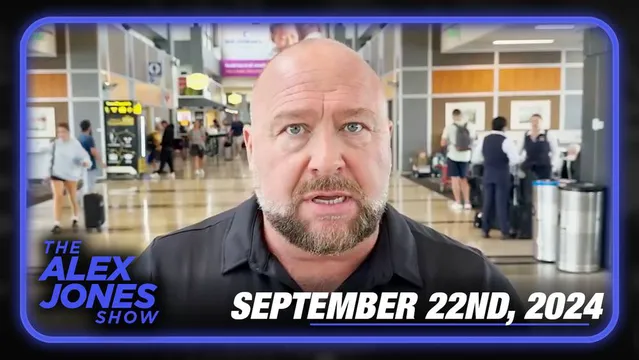
Sunday, 22 September 2024

Sunday Live: DHS Confirms MULTIPLE KILL SQUADS Now Hunting Down President Trump After Second Failed Assassination Attempt - FULL ALEX JONES SHOW - 09.22.2024

From airport confrontations with NIH officials to the weaponization of low Earth orbit, this broadcast dissects the intersection of medical mandates, lawfare, and the transhumanist space agenda.

By The Alex Jones Show | 1h 45m listen | 40 chapters
Sunday Live: DHS Confirms MULTIPLE KILL SQUADS Now Hunting Down President Trump After Second Failed Assassination Attempt - FULL ALEX JONES SHOW - 09.22.2024 cover

About this episode

Alex Jones confronts former NIH Director Francis Collins at an airport, accusing the official of crimes against humanity and mass murder regarding the COVID-19 vaccine rollout. Jones claims over 20 million deaths are linked to the shots and calls for a second Nuremberg trial for Collins, Anthony Fauci, and Bill Gates. The confrontation highlights Jones' ongoing legal battle with the Department of Justice, which he asserts is attempting to seize Free Speech Systems assets to silence him before the November election.

Guest host Royce White broadcasts from Minneapolis to detail his campaign efforts at U.S. Bank Stadium, where he challenges the Minnesota Vikings' fan base to reject political distractions. White criticizes Governor Tim Walz for withholding an $18 billion state surplus and labels the current tax policy as a form of communism. The discussion expands to include NBA referee Kenny Maurer’s resistance to league mandates, the historical data on polio mortality, and the rise of a military-medical-media industrial complex that threatens parental rights and informed consent.

Jason Bermas joins the broadcast to challenge the feasibility of Mars colonization, labeling Elon Musk’s Starship plans and NASA’s humanoid robot strategies as a transhumanist distraction. Bermas cites the physical toll of space on Scott Kelly and the current stranding of Butch Wilmore and Suni Williams on the ISS as evidence of institutional failure. The hour concludes with an analysis of Martine Rothblatt’s influence on directed evolution and the integration of Starlink into DARPA’s global surveillance skin.


CHAPTER 01 / 40 Discussion

Alex Jones Confronts Francis Collins, COVID-19 Vaccine Allegations

Alex Jones confronts former NIH head Francis Collins at an airport, accusing him of crimes against humanity and mass murder related to COVID-19 vaccines. Jones claims over 20 million people died from the shots and suggests a "Nuremberg 2" trial is imminent for officials like Collins, Anthony Fauci, and Bill Gates. The footage shows Jones questioning Collins on his role in the Wuhan operation and the subsequent vaccine rollout.

alex jones· francis collins· anthony fauci· covid-19· nuremberg 2

00:10 We're good. 20 plus million people dead from those shots. We just confronted the former head of the NIH, Francis Collins. He's one of the villains with Fauci and the entire Wuhan operation and the cover up, the origin, and then the poison shot. Now he's since backpedaled some, but that doesn't matter ladies and gentlemen. He needs to be held responsible. So Fauci and Bill Gates are the very worst. He's down here. Part of the way he started to come public and admit that this was wrong, but they did. The lockdowns, the poison shots, all of it. And when I said to him, you're about to see it, 20 plus million dead, he nodded his head. So maybe he has a soul, maybe he's gonna go public. Good, redeem yourself, turn state's evidence, like Redfield and others have started to do, and come all the way out because

01:01 The globalist operation for depopulation and what these shots do turning off the immune system is all public. It's not going away. And it's destroying faith in the system and in the medical system, and it's gonna bring the system down. So those of you in the system need to join with the people. And you need to come out for Nuremberg too, and be witnesses against those that will be held responsible. And you know the punishment for crimes against humanity. You know what that is for Nuremberg with the Nazis. All right, here is this confrontation. How you doing? I'm all right. How are you? We're good. 20-plus million people dead from those shots. A lot of truth's coming out about you and Fauci. How does it feel to kill more people than Hitler? You writing some folk songs about it? You'll never get away with what you did, your bioweapon. You're in a lot of trouble. Nuremberg 2 is coming. Get this face. All right. That's good. We'll be exposing that guy. All of them are going to prison, Nuremberg 2. They can run, but they can't hide. The truth will get them. Mass murderers.

CHAPTER 02 / 40 Discussion

Royce White Guest Hosting, Minnesota Vikings Campaigning

Royce White introduces himself as the guest host for the Alex Jones Show, broadcasting from Minneapolis, Minnesota. White discusses his recent campaign activities outside U.S. Bank Stadium during a Minnesota Vikings game, emphasizing the importance of "retail politics." He frames his presence at sporting events as a way to reach people from all walks of life under the campaign theme "The People are Coming."

royce white· minneapolis· minnesota vikings· u.s. bank stadium· retail politics

02:19 Good luck New York. I love you brother. Before we're heading to the NIH, we're going to get some poison shots and everything right there. Sure. Welcome to the Alex Jones show I'm your guest host for the hour. Royce White here in the belly of the beast, Minneapolis, Minnesota.

03:15 And I got my Minnesota Vikings Bregalia on today. I'm honored again to be able to host the Alice Jones Show. What an incredible clip there, him getting right up in the face of Dr. Collins about these vaccines. We're going to talk a little bit about my opinion on these vaccines over the course of the hour. We're going to talk about a lot of things, some culture, some policy. But strap in, you know, we listen to the alex jones show you're watching the alex jones show I'm your host royce white here in the belly of the beast Minnesota vikings got a big win today And I was out there doing some some some of your some of that uh in-your-face Retail politics myself had some volunteers out there helping me spread the word about the campaign in front of the u.s bank stadium

04:02 Sporting events always bring out people from both sides of the aisle, from all walks of life really. So we want to be everywhere where the people are. That's why the theme of the campaign is the people are coming. We're glad you're here this afternoon. We'll be right back on the other side of a short break. The Alex Jones Show. Royce White, strap in. Smash Mouth populism here on Sunday afternoon. Welcome back to the Alex Jones show here on Sunday afternoon. I'm your host Royce White here in the belly of the beast, Minneapolis, Minnesota. And as I was just saying before the break,

CHAPTER 03 / 40 Discussion

Vaccine Industry Corruption, NBA Mandates and Polio History

Royce White argues that the entire vaccine industry is fundamentally corrupt, citing reports of myocarditis linked to COVID-19 shots. He references a World Health Freedom Summit in Alexandria, Minnesota, where he met NBA referee Kenny Maurer, who resisted league vaccine mandates. White also claims that polio deaths had already decreased by 90% before the vaccine was introduced, characterizing the official history of the vaccine's success as propaganda.

vaccine industry· myocarditis· kenny maurer· nba· polio

04:39 I love seeing Alex Jones get right up in the face of the establishment and their shills, their running dogs. Dr. Collins, responsible for a lot of injury and death in our country and around the world through the vaccines. And it's just my opinion on the vaccine. It's not an opinion, it's a fact. The entire vaccine industry is corrupt. We don't have to, you know, You know, the COVID vaccines for sure. Yeah, we see the issues with that. Now Dr. Fauci says, hey, myocarditis, there's a myocarditis out there. How much? Who knows? It's kind of open-ended. We know there's a problem. We can tell from their reactions. We can tell from the way that they handled the pandemic and the COVID-19 vaccines, there was an issue. But there's an issue with the entire vaccine industry.

05:25 I mean, there's a fundamental problem with the entire vaccine industry. And all you got to do is go back and look at the history. Alex Jones has done a great job of exposing some of that history. But I was just at an incredible health summit, World Health Freedom Summit here in Alexandria, Minnesota. Not last weekend, but the weekend before, I believe. It all runs together when you're on the campaign trail. But I was at this summit and they had a bunch of great presentations. I saw my good friend Kenny Maurer, who is a Hall of Fame referee or will be, should be a Hall of Fame NBA referee, who said, hey, I don't want to take the vaccine. I don't want to take the vaccine. And the NBA tried to mandate it. Never forget.

06:09 I'm saying this all as a precursor to what I'm going to talk about today in terms of culture and sports and entertainment and where we've kind of lost some ground and where we need to pick back up some ground. But this summer was incredible and they laid out a sequence of events where polio, for example, you know, polio, you know, It hit the scene, it devastated people. A lot of lives were lost due to the polio disease. But those numbers were already on their way down. They had already decreased 90 some percent before the vaccine was introduced. And then they used the vaccine to suggest or say that that decrease, that sharp decrease in deaths are due to the vaccine. That's not true at all. There's no evidence to show things like this. This is complete propaganda.

06:56 propaganda, you have three industrial complexes, you have the military industrial complex, you have the medical industrial complex, and you have the media industrial complex. All three of them, they work together. On any given day, you can see a politician go on mainstream media to promote some part of that medical industrial complex, or promote another war, or vice versa. If you really get down to the nitty gritty, you find out that a lot of your media propaganda and a lot of your medical research, advanced research is done in the military industrial complex wing of our government and society. So it's all connected, inextricably linked. So none of my kids have been vaccinated. Not one of them, not under my authority. And they'll be held to pay if I find out that one of my children was vaccinated without my consent.

CHAPTER 05 / 40 Discussion

Sports as Bread and Circuses, Institutional Pushback

Royce White, a former NBA draftee, discusses the dual nature of sports as both a valuable community builder and a tool for "bread and circuses" distraction. He warns against "throwing the baby out with the bathwater" by abandoning institutions captured by Marxist or Communist ideologies. White calls for a fundamental fight-back at the institutional level to break the mainstream monopoly on information.

nba· bread and circuses· marxism· info wars· institutional capture

08:55 at places like the Minnesota Vikings football game, that they can tell you it's a conspiracy or a conspiracy theory. That's really what the conspiracy is. The conspiracy is to distract the American people and the people all across the world with bread and circuses so it's much easier to lie. We all know what the scam is. The problem still, the entertainment is good. I mean, I'm a sportsman myself. I'm a lifelong athlete and a pretty good one at that. I mean only 5,000 people in the history of human civilization were drafted to the NBA. It's a very, very rare feat. You know, I've played sports my whole life and there are a lot, there is a lot that sports offer society. There's no doubt about it. A lot that sports offers us. It's, you know,

09:52 Sports are great. I mean, let's not we don't want to throw the baby out with the bathwater That's part of the problem as well. And that's what I really want to talk about today We we have this tendency when these Marxist and communists Infiltrate take over and they start to spread their dogmatic beliefs We we have the tendency to to reject and resign from whatever they've touched throw the baby out with the bathwater This is a mistake This is a mistake, partly because you got to, you know, when you're in a war, you're in a fight, you got to acknowledge and accept how effective your enemy is with their strategy. And this strategy is effective. When you take the media institutions, when you take the academic institutions, when you run the entertainment industry, you have

10:41 a monopoly on information. That's why the show is called Info Wars, right? There is a mainstream establishment monopoly on information itself. We have to acknowledge that and we have to start to push back. We have to start to fight back fundamentally at an institutional level, at a freedom of movement, freedom of speech, freedom of assembly level. And we're starting to do that. That's what Alex Jones is showing you right there. He's walking through the airport. He's going right up to Dr. Collins. He's getting right up in his face, getting right up in his grill and speaking the truth. But we have to do it, all of us. We have to do it.

11:18 When you know, think about it. I was just down at US Bank Stadium downtown Minneapolis. I know people talk about how dangerous Minneapolis is and there's no doubt about it. There's problems. There's crime. I don't believe for a second that crime is at an all-time low. I think there's a lot of crime happening that isn't being reported or reported properly. I think there are a lot of, you know, dead leads out there that aren't getting reported properly. So I'm not saying that crime isn't an issue. What I am going to say is Crime is still, let's say, a small possibility en masse. En masse, the chances that you become a victim of a violent crime are not high. They're still low.

CHAPTER 06 / 40 Discussion

Minneapolis Crime Rates, Second Amendment Solutions

Royce White addresses the perception of crime in Minneapolis, suggesting that official statistics may underreport the reality of violence. While acknowledging the dangers of carjackings and burglaries, he asserts that the solution is not gun control but a cultural shift. He encourages citizens to remain vigilant and active in metropolitan areas rather than hiding in fear.

minneapolis· crime rates· gun rights· second amendment· cultural fix

10:41 a monopoly on information. That's why the show is called Info Wars, right? There is a mainstream establishment monopoly on information itself. We have to acknowledge that and we have to start to push back. We have to start to fight back fundamentally at an institutional level, at a freedom of movement, freedom of speech, freedom of assembly level. And we're starting to do that. That's what Alex Jones is showing you right there. He's walking through the airport. He's going right up to Dr. Collins. He's getting right up in his face, getting right up in his grill and speaking the truth. But we have to do it, all of us. We have to do it.

11:18 When you know, think about it. I was just down at US Bank Stadium downtown Minneapolis. I know people talk about how dangerous Minneapolis is and there's no doubt about it. There's problems. There's crime. I don't believe for a second that crime is at an all-time low. I think there's a lot of crime happening that isn't being reported or reported properly. I think there are a lot of, you know, dead leads out there that aren't getting reported properly. So I'm not saying that crime isn't an issue. What I am going to say is Crime is still, let's say, a small possibility en masse. En masse, the chances that you become a victim of a violent crime are not high. They're still low.

12:01 It's an issue that we have to solve, and for those who become victims to violent crime, to home invasions or carjackings or burglaries and maybe gun violence and all of that, yes, we have to work on those. We have to keep watching that. We have to be mindful and vigilant, and we have to diagnose the problem and try and come up with a solution. The solution is never gonna be you taking our guns. That ain't happening. That's not a solution. The solution can be that we start to fix the culture and we give people something better to live for and better to live by. But don't let them fool you into hiding in your little corner of the world.

CHAPTER 07 / 40 Discussion

Minnesota Tax Policy, Governor Tim Walz Criticism

Royce White criticizes Minnesota Governor Tim Walz for failing to return an $18 billion state surplus to taxpayers, labeling the state's income tax policy as a form of communism. He warns "snowbirds" who move to Florida or Texas that they cannot outrun these policies, as local governors like Walz are being elevated to national positions like the Vice Presidency. White urges supporters to "hold the line" where they currently live.

tim walz· minnesota· income tax· florida· socialism

12:42 See, because when you do that, I use this example all the time and I was telling some people down at US Bank Stadium today who live in Minnesota or from Minnesota, but they spend time down in Florida. In Minnesota, we call those snowbirds. There's a lot of retirees here from the state of Minnesota or that have two residencies. They live here part of the year and they live down in Florida part of the year. Part of it's because of weather. Part of it's because of income taxes, and we tip our hat to the great state of Florida for having a much better income tax policy than Minnesota. In fact, if there's a hallmark of Minnesota's communism, it would be the state income tax, where we had an $18 billion surplus here in the state of Minnesota, and commie Governor Walz didn't give a single penny back to the working citizens. That, my friends, is what's on the horizon. We know that.

13:34 It's also worthwhile to mention when you think that you're running from the front line, when you think that you're tucking tail and running to a better place somewhere else in the country. It's funny how quickly your commie governor becomes the pick, let's say, get the vice presidency. Yeah, I mean, yeah, you think you're leaving Minnesota to go move to, I don't know, South and North Dakota, Maybe it's Iowa, maybe it's Florida, maybe it's Texas. You think you're running from the communism and the socialism and the Marxism where you were, and all of a sudden the governor from that state shoots up the ladder and he's going to be the vice president of the whole country. I mean, you see, the point I'm making there is don't run.

14:30 Don't run. You got to hold the line where you are. And part of holding the line where you are is not getting so caught up in fear, fearful of the possibility and potential for crime and violence out there in the metropolitan areas that you don't go out and stand firm for what you believe in. And even more importantly, preach and minister the gospel and the value of American citizenship. We have to do this. I saw something today that was so inspirational. I'm there outside the Vikings stadium, US Bank Stadium, which was paid for by the tax dollars, by the way, here in Minnesota. Beautiful stadium, you know, must hold about 80,000 people. It's just a modern marvel.

CHAPTER 08 / 40 Discussion

Community Value of Sports, Campaigning at Stadiums

Royce White reflects on the massive crowds drawn to American football, describing the visual of thousands of fans as a "modern marvel." He notes that sports provide a rare space where people of different faiths and politics gather for fair competition. White details his experience walking through the crowds with campaign volunteers, including Mason Madden, to engage directly with voters.

u.s. bank stadium· minnesota vikings· community· campaign volunteers· mason madden

15:12 and even more of a modern marvel is to see how many people an American football game just draws. I mean, when you really see, when you visually see it, when you're there and you're not there just to get out of your car and kind of, you know, walk up to the arena or the stadium and walk in and get to your seat or get your snacks from the cassette stand. When you actually just sit back and watch it from an observational standpoint, it is breathtaking how, just how many people There at one time. It's it's it's really mind-blowing at least for me. It was today. So I'm there and I see the thousands and thousands of Minnesota Vikings jerseys now what's great about it is I'll talk about what's inspirational in a moment, but what's great about it is American football and American professional sports does bring out a mixed crowd of people who are

16:08 are engaged in their fandom because of a much broader sense of community outside of their politics, right? I mean, people's politics are their politics. People's faith are their faith. But sports has a way to bring all of the people from a given community together under the auspice of genuine, fair, and elite competition. That's what American and that's what all professional sports does. Hell, that's what sports does down at your high school level, you know, down to the Peewee level. As a matter of fact, there's all kinds of tournaments all across the country. You could go off to on a given weekend and you'll find people there who are the parents of young children, kids, teens that believe in many different things, but they're there together in one place under the auspice of genuine and fair competition.

16:58 So that's a beautiful thing. And that's why we went down there as a campaign. And I had about 10, 10, 11 campaign volunteers. One of my young, young up and coming Republicans, his name is Mason Madden, and he's holding the Royce White sign up and we can, we're walking against the grain of traffic. and being polite, just smiling and waving. Hello, how you doing? How you doing today? And good to see you. Good to meet you. You know, people come up and they say, Royce, Royce, good to see you. We're voting for you. Thank you. We support you. And some people give you a little, you know, side eye. Some people make a little snarky remarks under their breath. And that's all good. That's all part of it. But we want to be where the people are. And we want to show

17:42 who we are and we don't want to allow the Marxists and the Communists and the Socialists to brand us. So, sporting events are great, but I saw something inspirational and in front of the stadium, right in front of the stadium, right where you walk up to walk in and get your tickets or punch your tickets or whatever the case may be. there was a man out there and he was hooked up to his microphone and had a speaker and he had a sign, you know, he had one of those body harnesses that was connected to a sign over his head and he was he was preaching the gospel. He was preaching the gospel and it dawned on me how when I was coming up

CHAPTER 09 / 40 Discussion

Street Preaching Encounter, Silos in American Society

Royce White recounts an encounter with a street preacher outside the Vikings stadium who was warning fans about damnation. White describes the tension between the "religious" fervor of sports fans and the preacher's message, which many viewed as a nuisance. After the preacher singled him out, White confronted the man to discuss his faith, eventually earning the preacher's support while highlighting how society has siloed politics, religion, and entertainment.

jesus christ· gospel· street preaching· religious fanaticism· social silos

18:24 When I was coming up, I would have regarded that as a nuisance. I would have regarded him as something that's an irritant. And you can almost see as people encounter what he's saying out there in front of the stadium that many of them think of it as a nuisance, even if they vote Republican, even if they may support Donald Trump, they find it that the football game is not really a place where they should have to come and encounter a man preaching the gospel of Jesus Christ, but I thought it was so courageous. I mean, you just know nobody wants to hear what he has to say. You can feel it when you're out there. When I saw him, I could feel that nobody really wanted to hear what he had to say. You know, and it's a strange

19:08 It's a strange kind of catch-22 right there in front of a football game, because at the same time where I say sports is valuable, it has value that it adds to society, it has become almost religious. So religious, in fact, that people reject the gospel of Jesus Christ right there in front of the stadium as it's an inconvenience. And there's something to be said for that, as to why our society has gone the way that it's gone. So I'm sitting there and I'm listening to him and he's saying Jesus Christ is the way, the truth, and the light. and don't be damned to hell, don't let your soul be damned to hell. Nobody can save that. And he starts talking politics. He says, Democrats, Republicans, Jesus Christ is the only way and he must have saw me. And he starts, he yells out, even Royce White, Royce White isn't in Christ. And if he isn't in Christ, then he can't help you. So I stopped and I'm six foot eight, 270 pounds. So people can see me. I stop, I turn.

20:12 And I walk up to him and I say, now, wait a second. I say, I like what you're doing out here. I think it's courageous. I really do. God bless you. Praise be to God. But what makes you say that I'm not in Christ? He said, oh, I said, if you're not in Christ, I said, no, you said I'm not. They said, oh, well, I meant to say, if you're not, I said, okay, well, fair play to you. God bless you. And he said, yeah, you got my vote. But my point in saying and pointing that out is this. I'm gonna keep talking about this this cultural thing that the crisis of culture and sports and entertainment that we have in the next segment as well But the point the reason I point that out is this sports has a way of bringing people together but we've we've we've siloed sports from politics and politics from education and education from and And it's just all these silos. There's all these little these these little you know

21:09 I don't even, there are all these separations in our society, in our culture. You're not supposed to talk about this thing here. You're not supposed to talk about that thing there. And it's all just nonsense. It's all us just buying into a norm, a status quo where we can't even talk to each other. And that's really what started to happen. When you really think about the result of that culture is we just don't really talk to each other. I mean, we just, people, are starting to become accustomed to not even speaking to one another. And so that's part of something that we have to look at. That is what we have to look at. We have to think to ourselves, we love football, we love technology, we love the internet, we love being able to go to mass online at our mega church, and that's all well and good, but convenience will be the death of freedom and liberty.

CHAPTER 10 / 40 Discussion

Convenience vs. Liberty, School Board Participation

Royce White argues that the pursuit of convenience, such as remote church services or avoiding city traffic, will lead to the death of liberty. He criticizes conservatives for complaining about Marxist influence in schools while being unwilling to serve on school boards. White emphasizes that citizens must be present in metropolitan areas and local government to prevent the spread of communism.

communism· school boards· civic duty· twin cities· inflation

22:08 And you got to understand that. And I know it's inconvenient to go down there into the Twin Cities, into that metropolitan area, wherever that NFL football stadium is or NBA arena is or MLB stadium is in your respective city. I know it's inconvenient to go down and find a place to park and the city overcharges you to park on the street. Everybody's price gouging each other because, hey, I mean, we're living in inflationary times, right? I know it's inconvenient, but you got to ask yourself what's more inconvenient, going down to those places, smiling and waving and representing yourself as an individual citizen, but also the things that you believe in, representing that or living under communism. And that's what we failed to weigh and measure up until this point.

23:00 You know, we've kind of looked at all of these things as somewhat of an inconvenience. Like, we let the Marxists and the communists take over our schools, and we reject that. We don't like it. But we're not willing to sit on the school boards. You understand what I'm saying? Is that we have a problem with crime. down there in Minneapolis in the belly of the beast here in Minneapolis. I'm in the belly of the beast here in Minneapolis. We got a problem with the crime, but we don't want to go down there and preach the gospel or we don't want to go down there and minister the value of American citizenship or the Republican Party platform or whatever party that you believe in whatever party platform you believe. We don't want to do that though, right? And so I get myself to this place where I'm thinking we have to be down there every single home game.

23:46 We have to be down there just to smile and wave because what you have to first check off of your list is before you throw too much condemnation, on people, you know, who may love sports more than they're involved with the church or they may know the stats of their favorite player more than they know what's going on in terms of the people who represent them in government and which way they vote on certain bills. You can throw condemnation on them, but you have to ask yourselves, why would they think any different? And so even myself, where I have great contempt

CHAPTER 11 / 40 Discussion

Democrat Cultural Dominance, Reaching Black Communities

Royce White discusses the historical and cultural ties between the Black community and the Democrat Party, noting that many people support these institutions by default without understanding the underlying Marxist ideology. He claims the general public is the victim of a massive information scam designed to prevent informed decision-making. White calls for grace and redemption when attempting to reach those who have been "brainwashed" by the establishment.

democrat party· black community· marxism· henry kissinger· propaganda

24:23 And it grows, trust me, on a daily basis. Because I do encounter a lot of people who know exactly what's going on and they're siding with these evil people on purpose anyway. They're making a conscious decision to do what's wrong. So those people deserve our condemnation and contempt. But there are a lot of people, a vast majority of people, who are falling through the cracks by default. Simply by default. There are a lot of people who, take it from me, I grew up in a culturally Democrat community. I grew up in a black Catholic community as well, so you could say there are plenty of traditional conservative values that were just

25:03 baked into the way that we thought. But culturally, politically, black communities all across this country remain culturally Democrat. Now you're seeing a shift and Donald Trump helped to bring about that shift in many ways. But regardless, some of these people, some of these people don't know any better. They have no clue. They don't even know what Marxism really is. I mean, they're just being told some fluffy, fictitious fairy tale about Marxism by some white liberal woman who was brainwashed and educated by a Marxist professor who came from the 60s who thought that Marxism and socialism were the only suitable rejection to capitalism because of the military-industrial complex and what they thought to be unrighteous wars. That's one way you could see it.

25:58 Don't get me wrong, there's some people that even back then, Henry Kissinger, they knew exactly what they were doing. I'm not making any excuses for them, but I'm talking about the people, the general public. The greatest scam and conspiracy ran on the general public is to distract them, to not give them all the information. So they can't make an informed decision. So they don't understand the implications of what their views and beliefs, even casually, may really mean. And we have to, as Christians and as Americans who believe in redemption, we have to carry some level of grace when it comes to thinking about the future of this nation. But also, how do we go back and reach these people?

CHAPTER 12 / 40 Discussion

DOJ Intervention in Alex Jones Bankruptcy

Alex Jones provides an update on his personal and business bankruptcy cases, alleging that the U.S. Justice Department is illegally attempting to shut down his operations. He claims the DOJ is intervening to prevent a trustee sale of Free Speech Systems assets to patriotic buyers. Jones asserts that the government's goal is to remove him from the air before the November election to prevent him from supporting Donald Trump.

alex jones· department of justice· bankruptcy· free speech systems· judge lopez

27:32 Here to talk to you about a good deal of things, good many things, political, cultural, so on and so forth. But before that, we got a message from the great Alex Jones himself. It's an honor to be here with you. We'll be right back. 11 weeks ago, the US Justice Department trustee assigned to my case personal and business bankruptcy. Ordered without a court order or any reason. The doors of this facility shut. They lied and said it would just be for three days, and they admitted the security. It would be for a month or permanently. The judge in Houston, Judge Lopez, had nothing to do with it. Then it hit the news they were going to close us. No judge's order, no nothing, just the Justice Department, who'd been involved in the case harassing me from the beginning for over a year and a half. People were blown away by it. I refused to go along with it. I said I'd call the police on them. They didn't have any orders.

28:31 They backed down. Then they went to court two weeks later and said, we want him removed. The judge listened to him and said, you're all fired. The CRO, who had been appointed by the court, and the Justice Department appointed person that the court had let into it. And they had a Justice Department committee, all this stuff. Now I'm in personal bankruptcy. I agreed to sell the assets of Free Speech Systems, the website, the shopping cart, the equipment, and there was going to be an auction on the 24th of October, then they moved to the 30th. The Democratic Party running all this, the FBI, CIA, it's all come out in the news. Didn't want that. They want me off the air by early November. This is in the court filings. They said, we don't want money, want him shut down. And the judge said, no, it's gonna sell. There's buyers out there that are patriots that I'd work with. They'd have to outbid that. They don't want to do that. So they announced, and I knew this two days ago, it hadn't announced yet, it hit Bloomberg, AP Reuters will put Bloomberg up.

29:24 that the Justice Department is intervening. Alex Jones bankruptcy trustee sale efforts challenged by DOJ. They rarely get involved in bankruptcies, but they got involved in mine. They're unable through just pure vigilantism to shut us down 11, 12 weeks ago. Got egg on their face and now they've come back. They want us shut down and just closed and don't even let them sell the assets. You heard that. So it's a gamble, but we were doing it. Only move we had left. And they obviously got our phones capped and stuff, and no, some better is coming. Okay? They're gonna have an issue on their hands. And they don't want to do that. They've got big billionaire backers they claim. They've even told that in the court. We'll see what happens. Alex Jones bankruptcy trustee, sell Everett's challenge by DOJ.

CHAPTER 13 / 40 Discussion

Lawfare Against Steve Bannon and Alex Jones

Royce White returns to discuss the "lawfare" being waged against Alex Jones and Steve Bannon, whom he describes as his mentors. He argues that the legal attacks are a response to their political success and their ability to resonate with a growing movement against corruption. White asserts that protecting the freedom of speech and assembly for these figures is a civic duty for all Americans.

steve bannon· alex jones· lawfare· freedom of speech· political suppression

32:02 And what Alex Jones just said there in the message couldn't be more true and more important. The great sign of the guys who are telling the truth is when the lawfare breaks out at the level it has against Alex Jones and also my good friend and mentor Steve Bannon. These are two individuals I've been linked to since I've shown signs of political success myself. And that's pretty much the reason why They're going after those two, because what they're saying resonates. What they're saying resonates with people. What they're saying resonates with a growing movement in this country that's ready to change the status quo of corruption. Alex Jones.

32:42 Right in the crosshairs, obviously. I mean, I don't have to explain it to you, but I will reiterate and echo those sentiments that we have to support people like Alex Jones and they can call me a conspiracy theorist or radical or an extremist or whatever they want. We were able to win a Minnesota statewide primary. We love embracing Alex Jones. We love the InfoWars audience. We're not hiding. We're not hiding who we are. I had somebody come up to me today at the Vikings game in front of the stadium and say, hey, I heard you hosting on Alex Jones the other day. So things are starting to change. They can't hide the truth forever, but they will try to suppress it. And we can't let them do that. It's part of our duty, our civic duty as American citizens. Freedom of speech, freedom of assembly, our freedoms are fundamental.

33:28 To our American identity and our citizenship. It has a value. We got to protect that value and fight for that value now what I was talking about before the break is we cannot let the fear of Everything that's happened in this country reach a level where we are afraid we are too afraid to go down into the places that we need to go to change minds and hearts and to win. We just, there's no sense, there's no sense in even talking about politics if you're not willing to go somewhere to meet somebody on the road that disagrees with you and talk to them and try to change their mind.

CHAPTER 14 / 40 Discussion

Propaganda and the Design of Public Ignorance

Royce White explains that the establishment relies on propaganda and "bread and circuses" to control the minds of the masses. He contrasts figures like Dr. Francis Collins, who he claims knows the truth, with the general public who rely on outlets like CNN and the New York Times. White describes his movement as a "patriotic rebel force" dedicated to waking people up to the lies of institutional authorities.

propaganda· mainstream media· msnbc· cnn· misinformation

34:07 There's no reason to talk about politics anymore. Just stop. Just, you know, do whatever you're going to do. But to talk about politics or complain is meaningless because it's not going to change unless we change it. We the people, we have the power to change it. We have the power. Our founding fathers were brilliant and they get the freedom of speech, freedom of assembly, just like I'm saying just a moment ago, is the greatest tool we've been given. No matter what the mainstream media lines up against us, Just like Alex Jones did there in the airport, went right up to Dr. Collins and got in his grill and said, we know that you lied. We have the same power to do that. Only the difference is Dr. Collins does know that he lied. He does know what this establishment's agenda is. He actually is in on the end. He's in on the information. He's in on the agenda. These people that you meet out in the street, for the most part,

35:01 The vast majority of them, they do not know. See, perfect example, look here, Dr. Collins, he's walking there like he's a regular guy. He knows, he's in on the agenda. Those people that are standing back there behind him that are just gonna get on the flight, they have no clue what's really going on in this country. And that is by intentional and brilliant design. They have no clue what's happening in the world around them for the most part. They believe MSNBC, they believe CNN, they believe the New York Times. They believe the Wall Street Journal. They believe what they are told. We are that patriotic rebel force that is trying to help people wake up, wake up and realize all of these institutions have every incentive and motive you could possibly imagine to lie to you.

35:48 Control at this level of this many people has to start with lies. It has to start with misinformation and propaganda. This is not rocket science. This isn't political science. This is basic fundamental math. They have to lie. Propaganda is the only way you can control the minds of this many people. The other way is bread and circuses. Yeah, sports is one of them and I love it. Yeah, I'm been a lifelong Viking fan. I was there I was there right in front of the TV as a small child. Oh, Brian that Gary Anderson made the field call back in in 98. He shanked it to the left and Gary Anderson's Probably a great guy never really met him in person. But but you know, he was a an incredible field goal kicker He made a bunch of a bunch of kicks

CHAPTER 15 / 40 Discussion

Minnesota Vikings Fandom, Dangers of Fanaticism

Royce White shares his history as a lifelong Minnesota Vikings fan, recalling the trauma of Gary Anderson's missed field goal in 1998. While acknowledging the community pride found in sports and alma maters like Iowa State, he warns against letting fandom dominate one's identity. He points out that professional sports draw the largest live audiences, which can be used to distract citizens from the loss of their freedoms.

minnesota vikings· gary anderson· iowa state· fanaticism· live television

36:39 He made over the course of his career when he got right up to the moment to send us the Super Bowl. He shanked one I'm sure wherever he is. He's still kicking himself, you know at night because of it Hopefully he's let it go because at the end of the day, it's just a game. But the point I'm making is You know, I'm a lifelong Vikings fan. You know, I was there today and the Vikings won and I'm happy about that because we all share some sense of community, some pride in our community, some pride in the place that we live. And that's why team sports is so popular. And you go back down, I can't tell you how many people I saw today out front that were from Iowa State.

37:14 that were Iowa State grads, and there are a lot of them out there. I meet them all across the country, and they're spread out all across the country. And we have that sense of pride in Iowa State, in Iowa State's sports, in Iowa State as a school. And that's good. Some of that is good. The question is, do you let that consume you? Do you let that dominate your identity to the point, do you let that dominate your focus to the point where you lose sight of everything else? Most of things that are that are much more important Do you lose sight of those things in the in the in the shadow of your your fanaticism your fandom? That's the real question here. And it's not just about sports sports is one example It's probably the best example because if you don't look at the metrics of what draws the most crowds on live television, for example Professional sports is far out in the head in terms of what draws the biggest live audience on all of of live television Okay

38:13 The presidential debates and things like that would also be high up there, which kind of tells you something about what our political entertainment has become. And a lot of it is entertainment by design. You know, it kind of turtles all the way down. But my point is, There is good there. There is good there. We have to see the good. We have to understand the good. Don't throw the baby out with the bathwater, but we have to be hyper-focused that we don't allow sports, entertainment, music, bread and circuses to distract us from everything else going on, especially at this moment in our nation's history, because we are on the verge of losing our freedoms. And even more dangerous than that, you know, I've been thinking about this and I was thinking about this today. The system is working so well.

CHAPTER 16 / 40 Discussion

Population Control Agenda, Future of Surveillance

Royce White discusses a future where convenience masks the loss of rights, including the implementation of eye scans and facial recognition for daily activities. He suggests that the global establishment, including figures like Dr. Collins, views the human population from a "30,000-foot view" and seeks to manage or reduce it. White references the 75 million deaths in World War II as a reminder of the scale of human loss the establishment is capable of overseeing.

population control· surveillance· eye scan· human energy· world war ii

39:00 you could see a scenario where they would find a way to make sure everything continues to work relatively well. The question is, do we as Americans believe that part of our civic duty and our American citizenship is to ensure that it works at a fundamental level for as many people as humanly possible? And that answer in the future is going to be no. In the future, You may still be able to go and get on the light rail, local transportation train here in town. You may still be able to go get on the light rail. You may still be able to go get in your vehicle, drive downtown Minneapolis Park, tailgate, have a beer, have a bite to eat, go into the game, you know, pay electronically. In the future, they'll do an eye scan. It'll be a fingerprint or, you know, facial recognition, whatever the case may be.

39:56 You may still be able to do those things, but your fellow American citizens will slowly lose their rights and freedoms. And even furthermore, they will slowly start to disappear. And you'll look up eventually and you'll go, wow, wow, well, there used to be 70,000 people here. And now there's only 30,000. And you ask yourself, well, what good would that do this establishment? What good would it do to pull consumers And when you think about consumers, when you think about consumer, don't just think about the profit and the money. Think about consumers as a metric of human energy. Okay? When we talk about energy, when you talk about money and currency, what you're really talking about is the exchange of energy. That's what currency really is. Why would they do that? Well, again, you see the population as stagnant.

40:51 But the people like Dr. Collins, they see the population from a 30,000 foot view and they see it as always increasing. Now, there are people who are starting to point out the fact that we might have a population problem, but it depends on which side of that football you're on. I mean, think, go back to World War II. I mean, you think we lost 75 million people during World War II in six years. I think we're so desensitized to exponential math. I don't know that people fully grasp that level of death. We lost 75 million people, 75 million people in six years. It's unbelievable. It's unfathomable that we lose that many people in six years. But we did, we did. And it begs the question,

41:56 You know, this high end level of the establishment of the agenda. They already talk about population control. They talk about there being too many people on the planet. They talk about the need to go back to a time where the population would be much smaller and thus much more manageable. And that is part of their agenda. And right now you may still be able to go to a football game and enjoy it. And I'm not telling you shouldn't, but you for damn sure better at least be thinking somewhere in your mind how important this political season is and the others that are going to come in the near future to try and stifle and spoil that agenda. That at least has to be on your mind.

CHAPTER 17 / 40 Discussion

Little Platoons of America, AAU Basketball Coaching

Royce White highlights the importance of "little platoons"—families, volunteer coaches, and local school boards—in maintaining American society. He shares his experience coaching his son's AAU basketball team and playing on neighborhood courts. White argues that citizens must be willing to engage in these local communities, even in areas labeled as "dangerous," to prevent the long-term loss of the country.

little platoons· aau basketball· community· neighborhood safety· youth sports

42:39 And then have fun. Have fun. Enjoy your football games. Enjoy your basketball games. Enjoy your college sports. Enjoy all of them. Enjoy your high school sports. I coach my son's AAU team. You know, sports in a way is an example. Professional sports is in a way, it's an example of the microcosm of little platoons that help America go, that help America thrive, that help America be America. The little platoons of the mom and the dad and the family and the, you know, taking the daughter to soccer practice or the son to, and volunteer coaches and peewee football and, you know, going to those school boards, being on that school board.

43:19 So professional sports is kind of a macrocosm of those little platoons. I'm not telling you there's no value in it. There's value in it. There's a lot of value in it. A lot of what shaped me into what I am today was done right there on a concrete or cement or asphalt basketball court at a park in the neighborhood that they tell you is too dangerous for you to go to. But I was able to survive out there playing basketball by myself. Now, could I have been hit by a straight bullet? I want that many instances where I was in danger of being hit by a straight bullet, but it happens. I'm not saying it doesn't happen across the country. The point is you and I, we have to be willing to go down there or I guarantee you long-term we will lose this country. Why am I saying this? There's a story that's broken now in the last 24 hours. If you're on X and you see the trending Janet Jackson story, I want to talk about this Janet Jackson thing for a moment because it's very interesting cultural signal.

CHAPTER 18 / 40 Discussion

Janet Jackson Comments on Kamala Harris Identity

Royce White discusses the controversy surrounding Janet Jackson's recent comments questioning Kamala Harris's racial identity. Jackson reportedly stated she heard Harris's father was white, sparking a backlash from the Democrat Party. White defends the right to discuss ethnicity in politics and mocks the idea that the establishment can "cancel" a music icon as influential as Janet Jackson.

janet jackson· kamala harris· race· ethnicity· cancel culture

44:19 Jenna Jackson supposedly was asked about Kamala Harris She said I heard Kamala Harris is in black and that her father is white or he identifies as white Okay now I gotta say this because first let's get this out of the way all of these people out here who say let's not talk about race cut it out take your little take your kiddie ball and you go back to the kiddie side of the Park, okay race is a part of this country and It's a part of this country's history. It's a part of this country's current. It's a part of the culture today. There's nothing we can do about that. How we talk about it is what we can do about it. How we think about it, how we engage in that conversation is what we can do about it. But there is no good sense of thinking that we can pull race or color out of our cultural conversations or out of our culture today. That is fantasy, okay?

45:17 So it's perfectly reasonable to talk about Kamala Harris's identity and ethnicity, especially since she wants to use it as the springboard to garner the blind faith of all of these black people. And Janet Jackson, and why am I bringing this up? Because it's such an important cultural signal again for the Democrat Party and their platform and how it's starting to crumble, how Marxism always starts to implode on itself. They actually think they can go after Janet Jackson. They think they can cancel Janet Jackson. That's what's hilarious. They're not canceling Janet Jackson. You know, one person, as soon as one person says, you know, I think a little differently than the rest of the Democrat Party.

46:06 all of a sudden, they're immediately cast into the fire and left for dead. And say, you know, we're gonna cancel. Like they try to say Janet Jackson is irrelevant. Let me tell you all something, okay? Let me be very clear with you. If you don't understand how influential mainstream media and some of these popular music icons are, then show up at a concert the same way you do at a football game and you'll see there are very few things left in our society that even get people to come out in person.

CHAPTER 19 / 40 Discussion

Remote Society, Kyrie Irving and Alex Jones

Royce White warns that the shift toward remote work, remote learning, and delivery services is a "Trojan horse" designed to make people voluntarily give up their freedom of movement. He cites NBA player Kyrie Irving as a successful example of resisting this control, noting Irving's refusal of the vaccine and his previous sharing of an Alex Jones clip. White argues that the establishment's attempts to suppress the truth are failing.

remote learning· kyrie irving· alex jones· vaccine mandates· digital control

46:45 You can still order, you can order anything you want from Amazon. You can order anything you want from Uber Eats or Instacart. You can, you know, it started off as food and restaurants. Now just bring me my Kleenex from Target, vis-a-vis my mobile app. Okay, so you can, you really don't have to leave the house that much. And now your work is going to be remote too. And even I was at the, you know, at Listen to some remote learning. Everybody has a digital remote learning day now in their school week Okay, so they're shaping society to where you voluntarily give up your freedom of movement where it's culturally culturally Conceded that we don't really have to leave our homes very easy to control you one of the Trojan horses of technology And we're gonna bring everything to you. Don't worry. You don't got to go anywhere. I

47:29 Okay, okay. Well, go see one of these Taylor Swift concerts. People still coming out in person and I can't stand her. But the point is, as far as Billboard success goes, Janet Jackson is ahead of Taylor Swift. Y'all ain't canceling Janet Jackson out there. Sorry, the Democrat Party is getting sloppy. This liberal mainstream media industrial complex, you're getting sloppy. You're getting sloppy. You're way out over your skis, and I love it. I love it, because you just ran into a brick wall. It happened also with Kyrie Irving. Never forget. Never forget they tried to cancel Kyrie Irving.

48:11 One of the best basketball players of all time, and I'm a pretty good basketball player myself, but when you talk about pure skill and talent, Kyrie Irving is one of the best basketball players of all time. And you all remember when he posted the clip of Alex Jones talking about how this entire information war is being waged and they tried to cancel him. But it didn't start with Alex Jones. It started when they tried to mandate him to take a vaccine and he said no. And now in retrospect, we see Alex Jones is right a lot, but we also see that that vaccine mandate had very little merit to it. But they try to cancel them. They try to cancel them. They call them anti-Semitic and so on and so forth. And then all of a sudden, he pops up on the Dallas Mavericks and they make a deep, deep run. Now he has his own sneaker. He's doing fine is what I'm saying. They couldn't cancel him.

CHAPTER 20 / 40 Discussion

Janet Jackson's Cultural Legacy, Final Campaign Sign-off

Royce White praises Janet Jackson's musical legacy, specifically the album "Velvet Rope," and contrasts her cultural impact with Kamala Harris's political record. He urges the Black community to recognize that the establishment narrative is crumbling. White concludes his hosting hour by reminding listeners that they have 30 to 45 days to save the Republic and encourages them to support InfoWars.

janet jackson· michael jackson· velvet rope· r&b· republic

49:00 They tried to, but they couldn't. Janet Jackson the same way. She's number seven all time on the billboard list ahead of her brother Michael Jackson, who in many eyes is the king of pop, okay? You can't cancel Janet Jackson. You can't cancel—and black people out there, we understand if you were born in the 90s—I'm the first United States Senator in American history to be born in the 1990s first nominated Senator to be born in the 1990s if you were born in the 90s in a black household Janet Jackson is Unimpeachable almost and what she contributed to R&B and I mean she is I'm not saying she can do no wrong What I'm saying is compared to Kamala Harris who is Kamala Harrison in the in the shadow Janet Jackson and

49:50 I challenge anybody listening to this right now to go to your phone or wherever you get your music, you go download Velvet Rope, the album, and you go play Velvet Rope today on this Sunday morning, and you open up some windows and pull those blinds back and get some fresh air, and you tell me that that album doesn't make your day feel a little bit better. What has Kamala Harris ever done for the black community? She wasn't even identifying as black. And I like Janet Jackson saying it. And now they're going to call Janet. She's going to get the call and she's going to apologize and walk the statements back. But her first instinct is the instinct that many black people are having. And I only bring it up to say, don't be scared to go down into the metropolitan areas because they're already starting to think the same thing you think out there. The narrative is crumbling. The race narrative is crumbling. Don't be afraid to give it a push. Kick on it a little bit. Kick on it a little bit and see what it yields.

50:43 We got 30 to 45 days to save this republic. We got to take the kiddie gloves off, deal with things as they are, not as we wish they would be. We're not canceling Janet Jackson. Sports are great, but we can't let it consume us. But we have to acknowledge how effective they are, and we have to go to those places ourselves to start to combat the narrative. This has been another episode of the Alex Jones Show. It's been an honor to host. I'm your host, Royce White. here in the belly of the beast, Minneapolis, Minnesota. Make sure you stop at that InfoWars store and support the great Alex Jones. We love you, brother. I'll be back with you again, I'm sure. Godspeed. The fight continues. And don't forget, the people are coming. We the

CHAPTER 21 / 40 Discussion

Jason Bermas on Mars Exploration Skepticism

Guest host Jason Bermas challenges the narrative of human colonization of Mars, calling it "imagination land." He criticizes Donald Trump's promises to reach Mars during his administration and Elon Musk's Starship plans. Bermas argues that the space program is primarily about weaponization, communication systems, and transhumanism rather than actual human exploration of other planets.

jason bermas· mars· donald trump· elon musk· spacex

51:27 Welcome ladies and gentlemen to the Alex Jones show. I am your host for the hour, Jason Burmess. And today we're going to be talking about a subject again that transcends left and right. is a reality when it comes to what's really going on in space. I've got news for everybody. I know it sounds nice. I know people wanna believe in it, but we're not going to Mars at all. That's imagination land. So the first place I'm gonna start is here, okay? We're seeing these headlines everywhere. Trump is now ludicrously

52:12 saying that we're gonna go to Mars during his administration. He's not even talking about human beings. He's talking about landing a large-scale rocket on Mars on the movement to put human beings there. The reason I'm choosing this as a subject is because we have to realize that the vast majority of our space program is one, about weapons and communication systems. It is weaponizing space on a mass level. Okay? That's numero uno, and we're going to show you that in a moment. Then we have to also understand it's putting us

52:55 into the virtual arena, all right? And when we talk about that virtual arena, we are also talking about transhumanism as well. These are the three main things that our space program, NASA, SpaceX, and beyond are really about. We've got to illustrate that. Now, first of all, we're gonna start here, okay? This is a real plan. The old muskernuts retweeted this. Okay, so this is a real announcement. Within two years, the first uncrewed starships launched to Mars during the next Earth-Mars transfer window to test landing reliability. Now listen,

53:42 Just the rocket stuff we have going on here. What's currently going on in the ISS, we're also going to illustrate that. These astronauts who were supposed to be there for a couple days are now stuck there until about February. They're about 250 miles above the planet in low Earth orbit. That has to be illustrated. We'll get there and in a reason in a moment. Four years, the first crewed flights to Mars. If the uncrewed landing section, it's not real. Guys, let's look at some numbers right now, okay? First of all, before we get there, I want people to understand that space is obviously not a uniform thing, just like we don't always know what's going on around our planet. And I think that NASA has a place that we do need to learn more about our Earth, but that's the thing.

CHAPTER 22 / 40 Discussion

Earth's Electric Field, Van Allen Radiation Belts

Jason Bermas discusses NASA's recent discovery of an "invisible electric field" surrounding Earth, which scientists claim is as important as gravity. He highlights the dangers of the Van Allen radiation belts and expresses skepticism about recent missions like Polaris Dawn. Bermas suggests that there is much about Earth's immediate environment that remains unknown or hidden from the public.

nasa· gravity· van allen belts· polaris dawn· magnetosphere

54:42 science is ever-changing. I mean this isn't an old headline. It's from a couple weeks ago. Okay? NASA discovers an invisible electric field surrounding the Earth. claiming it is as important as gravity. Now, I want people to understand this. There's so much going on around us that is invisible to the eye, that even transcends the technology that we have now developed. Yes, we have created wireless networks of information and beyond. When you look at the magnetosphere, the ionosphere, the stratosphere,

55:21 the discovery of even the Van Allen radiation belts, by the way, that came right before the Apollo missions during Gemini. Okay, so not that long ago. And allegedly, human beings for the first time since the Apollo missions, and for the first time women ever, you'd think that'd be a big story, just went past the Van Allen belts actually. So Just so everybody understands that, this Polaris Dawn, which we're going to get into, that just took place, is essential to understand how far we really may be, maybe,

56:00 in putting humans in space. We got a jam packed hour for you and you're gonna wanna pay attention, tons of clips, so much important stuff going on. Infowarsstore.com is where you get the great supplements, the products, support this broadcast, support Alex Jones. We're gonna be back with more InfoWars after this. We are talking about the reality behind what's going on in space, the Polaris Dawn spacewalk and where we've been historically and where I imagine we are going. Now, first and foremost,

CHAPTER 23 / 40 Discussion

History of Spacewalks, Soviet Union Space Race

Jason Bermas reviews the history of spacewalks, noting that the Soviet Union led the early space race with the first multi-crewed missions and the first woman in space. He compares historical footage of tethered spacewalks to modern "untethered" claims, expressing skepticism about the authenticity of the latter. Bermas references the film "2001: A Space Odyssey" as a template for how the public perceives space travel.

spacewalk· soviet union· russia· apollo· 2001 a space odyssey

56:43 When we talk about these spacewalks, they have a long and storied history. And again, prior to this spacewalk of Polarisdown that was not even a thousand miles above the Earth, but above the Van Allen radiation belts, the only time human beings have been beyond that is Apollo. And by the way, the Russians, they've only been just about under 300 miles officially, even though they were kicking our harness in the space race. First spacewalk, first multi-crewed mission, first woman in space also, uh-oh, breaking gender barriers back in the day, Soviet Union style. Now, I'd encourage people to go read this.

57:27 Because look, I think and here it is. This is that spacewalk we're talking about via Russia. We don't want the audio here. We can do without that. Let's grab that off. Okay. And again, whooping us. Notice he's tethered there. Well, later on, you know, when we're supposedly beating these guys, right, here's some tethered stuff. We supposedly go untethered. Like, don't get me wrong. I'm pretty skeptical of that as well. But if you look at what they pitched to you, say 2001, a space odyssey style, they basically said that these things were going to be reality with these little mini boosters on them. They utilize them in the gravity movie. Here's another one of the booster packs, untethered. Look, if you want to look at what they're telling you is the recorded history of spacewalks, I encourage you to check this article out. Now,

58:21 Now, we're talking about human beings. Let's just get to the moon, okay? Because supposedly last year and this year we were supposed to send humans to the moon again, another promise that never came to fruition, no kidding. They sent Snoopy to the moon. No, I'm not kidding. No, you can't make this up. But supposedly they did an unmanned rocket around the moon, okay? Not landing, but around it. We're going to get to the distance there. this Polaris Dawn spacewalk is just under a thousand miles. The moon, oh sorry, well that's Mars, we'll get there in a second, is almost 250,000, okay? And then you got to come back. So again, just think about the numbers that you have to meet. Forget about the possibility of space debris, asteroid fields, encountering things you didn't know about like that invisible magnetic force.

CHAPTER 24 / 40 Discussion

Distance Disparities in Space Travel, Weaponization

Jason Bermas highlights the massive distance gap between low Earth orbit (250 miles), the Moon (250,000 miles), and Mars (up to 140 million miles). He argues that while the public is fed stories about Mars, the real focus of space agencies is the Strategic Defense Initiative (Star Wars) and the weaponization of space. Bermas asserts that the technical challenges of returning from Mars are rarely addressed by proponents like Elon Musk.

moon· mars· strategic defense initiative· ronald reagan· space debris

57:27 Because look, I think and here it is. This is that spacewalk we're talking about via Russia. We don't want the audio here. We can do without that. Let's grab that off. Okay. And again, whooping us. Notice he's tethered there. Well, later on, you know, when we're supposedly beating these guys, right, here's some tethered stuff. We supposedly go untethered. Like, don't get me wrong. I'm pretty skeptical of that as well. But if you look at what they pitched to you, say 2001, a space odyssey style, they basically said that these things were going to be reality with these little mini boosters on them. They utilize them in the gravity movie. Here's another one of the booster packs, untethered. Look, if you want to look at what they're telling you is the recorded history of spacewalks, I encourage you to check this article out. Now,

58:21 Now, we're talking about human beings. Let's just get to the moon, okay? Because supposedly last year and this year we were supposed to send humans to the moon again, another promise that never came to fruition, no kidding. They sent Snoopy to the moon. No, I'm not kidding. No, you can't make this up. But supposedly they did an unmanned rocket around the moon, okay? Not landing, but around it. We're going to get to the distance there. this Polaris Dawn spacewalk is just under a thousand miles. The moon, oh sorry, well that's Mars, we'll get there in a second, is almost 250,000, okay? And then you got to come back. So again, just think about the numbers that you have to meet. Forget about the possibility of space debris, asteroid fields, encountering things you didn't know about like that invisible magnetic force.

59:20 as important as gravity, you're just figuring out that somewhere else, imagine all that. You're circumventing that 240,000 miles. And I wanna remind people before they landed on the moon on Christmas Eve, they said they did that. They circumvented it, human beings on there. They said a prayer. You can go watch that video as well. We're not even gonna bore you there, okay? So now they're telling you Mars, Some say 140 million. This is 120 million when I say some. You can see it right there. There's 140 million miles. Allegedly, when the movement is just right and the launch is just right, I think you can get within 40 million. They're saying a six-month trip for a human being just to get there. And I want to reiterate, no way of knowing how you would get back. 120 million!

1:00:18 Compared to the spacewalk of under a thousand miles, are you starting to grip that? Are you starting to grasp the reality? All right. So now we're going to have some fun. Okay. We've got NASA administrator after administrator, including their chief scientist, telling you back in 2016, about eight years ago, none of this is real. I know that's inconvenient, but again, I want to remind people We've been weaponizing space since the Reagan administration through the Strategic Defense Initiative program. We've created an information skin around the planet, also talked about at this conference in 2016, which we're going to illustrate. And I talked about transhumanism,

CHAPTER 25 / 40 Discussion

NASA's Robot-First Strategy for Mars

In a 2016 clip, NASA Administrator Charles Bolden explains that the first entities on Mars will be robots, not humans. Bolden describes a "fleet of robots," possibly humanoid, that will use 3D printing to establish subterranean habitats before any humans arrive. Bermas links this to Tesla's development of the Optimus robot and the broader push for automation in space exploration.

charles bolden· nasa· robots· 3d printing· humanoid robots

1:01:06 the metaverse, virtual reality. Now you're gonna see where it comes into play. What's real? What's science fiction? You're gonna hear about nanobots, possible biomimetics, those type of things. That's the reality. So let's cut to this clip right here, okay? And you're gonna find out right now that you've got Charles Bolden, 2016, telling you what the first things on Mars are gonna be, and it's not human beings, okay? You've gotta be thinking 30, 40, 50 years out. And Andy is absolutely right. And I tell people all the time, the very first things on the surface of Mars are going to be robots. You know, think about what we do for American forces today around the world. We don't send soldiers, sailors, airmen and Marines often into a very hot area first

1:01:56 We try to get in and make the environment safe for them using robots or whatever. Usually they like to send missiles in first. But we're actually, I imagine there's going to be a fleet of robots, maybe humanoid. They don't have to look like humans. They're going to establish the habitat. They're going to go in because with 3D printing, We can put a fleet of robots on the surface of Mars. We may find, based on what we know about the radiation environment, that we want to go underground rather than have huts on the surface and get blown away in the wind that doesn't exist. But that was a critical part. I tell my wife, it's a movie. So just so you know, the guy laughing over there that he's talking about, and we're gonna get to the woman in the middle who's from Rocketdyne. That's the guy behind The Martian, which is again, the Holly weird perception of Mars with Matt Damon. And Bolden's pointing out that, you know, we don't even know there's wind or an atmosphere on Mars. We're not sending human beings to Mars, okay? And he, think about the fact that he talked about humanoid type robots first.

1:02:58 How far away from that are we and who's behind that as well? Oh, that's right. Tesla is building the Optimus robot. And that's if we're talking about non-biomimetic robotics, which we'll get to in a moment. Okay. Very, very important part. But it may be that robots dig under, go subterranean and establish the habitat. Anybody ever do, you know, build houses for charitable reasons. You don't go there and there are no two by fours on the lot. There are prefab structures so you get eaves and walls and that's what we're going to do on Mars. But we're going to print it I think. Also going to use 3D print. OK. So now the next clip is going to go even further and tell you that these nanobots that they send not just full fledged robots are going to be the first thing and they're going to survey Mars

CHAPTER 26 / 40 Discussion

Nanobots and Virtual Reality Exploration

Jason Bermas presents a 2016 interview featuring former NASA chief scientist Dennis Bushnell, who discusses using nanobots to survey Mars. Bushnell suggests that instead of sending humans, NASA could use "auto-bioluminescent" nanobots to send back data, allowing the public to explore Mars via virtual reality with full haptic senses. This approach is estimated to be 1,000 times cheaper than manned missions.

ray kurzweil· hans moravec· nanobots· virtual reality· haptic technology

1:03:52 And then once they send back that data, then you can virtually visit Mars at any point. Now, this is again an interview from 2016, separate from this, it's an audio interview. And this person actually brings up Ray Kurzweil first. in a transhumanist perspective. And then he actually gets corrected by Dennis Bushnell, former chief scientist of NASA up until like two years ago, retired a couple years ago. He was there pre Apollo, Gemini days. And he says, no, this is Hans Morvick. And I believe Lights in the Tunnel is one of his books and publications on not just transhumanism, but essentially post-humanism. Okay, so let's play this clip.

1:04:36 and you were talking about robot exploration. And I mentioned Ray Kurzweil to you, and you said that he'd spoken at NASA. And to me, the way that you described robots almost as kind of like the children of mankind really stuck with me. And it put what we're doing on Mars right now. So Kurzweil speaking at NASA, that's, of course, I mean, again, there's a NASA-Google partnership. Okay, they've claimed quantum supremacy together. They work on artificial intelligence together. Okay, but children of man, that's also a Moravik thing. Get a new perspective for me. Well, that quote, robots being the children of mankind is actually from Hans Moravik from Carnegie Mellon. He has various books on this robot is one of them from the early 00s as I remember.

1:05:30 And the idea is that we are currently becoming cyborgs at a very fast rate. The IBM Blue Brain project, which is nanosectioning the neocortex and replicating it, Silicon has made such good progress that they are claiming in 12 to 15 years they will be able to market a biometric human level machine intelligence. So again, This is about 2016-ish, maybe even a little bit earlier, but I believe 2016. So they're talking about that 2030 marker that you hear again and again and again. The nano-functionalization of robots is continuing to pace very rapidly.

1:06:15 So there's no reason why in the 10, 20 year, well 15 to 25 year out, that exploration can't be done very well with robots at a cost which has been estimated at about 1,000 out of sending humans. So, one way to do this exploration of Mars and so forth is three ways, I mean three stages. One is to send the nanorobots and instrument the planet and send back the data. And the Brits demonstrated five senses, virtual reality, haptic taste, touch, smell, sight and sound recently.

CHAPTER 27 / 40 Discussion

World Economic Forum and NASA Partnerships

Jason Bermas highlights the partnership between the World Economic Forum and NASA, focusing on 3D-printed simulators in Houston where people practice living on Mars. He argues that these simulations are part of a broader effort to build a "virtual idea" of Mars to distract from the reality that human space travel at that scale is currently impossible.

world economic forum· nasa· 3d printing· simulation· houston

1:06:58 So everyone could explore Mars anytime they wanted to at 1-1000, the cost of sending people. So there you go. you know, before any human being steps on Mars, the nanobots are going to survey the planet, and they'll give you the virtual Mars arena. Now, let's turn the music down here. I want people to also understand the World Economic Forum also partners with NASA and is a very big part of this agenda. Now, aside from creating technology on NASA Tech, that can like hone in on your heartbeat, because that's as significant an individual as your facial recognition, as your finger and thumbprints, as a surveillance tool. In another video they show you, this is them talking kind of about that virtual Mars. Okay, they're looking for people practice living on Mars. You understand?

1:07:51 So they want to build, you heard about 3D printing on Mars? Well, they want to 3D print a simulator for these people to live in. Okay? I mean, think about that. This is a center out of Houston, Texas. the module smaller than a tennis court. OK. And the circumstances it could face on Mars. Listen they're building this virtual idea of Mars. The reality of sending rockets and human beings to Mars is absolutely utterly ridiculous. And you know we're going to come back to what they're actually doing on space. And I just want to say, look, I am a dork. You know, I mean, I've got every time I pick these things up, I'm not one of those people thinks that space is fake. No, I think there are varying degrees of misinformation, disinformation, and total and complete propaganda that were fed about space and the programs. But what they're doing there is very, very real. And it's a multitude of things under different guises.

1:08:54 that are essentially privatized in many respects. Now, let's start with Scott Kelly here. Now, Scott Kelly, as you're going to see, this is not Scott, this is another individual. We're going to pause this because we want to bring up the volume a little bit. He was on a trip with this gentleman for almost a year, I think they were out there. It devastates your body. You can't even walk off the spacecraft and they're monitoring you forever. Okay, now best case scenario, again, six months on the ship there and then maybe getting back. Physically, human beings in space is a whole separate problem that almost never gets as discussed, especially in long-term. We were both involved in experiments

CHAPTER 28 / 40 Discussion

Physical Toll of Space on Astronauts

Jason Bermas discusses the severe physical toll long-term space travel takes on the human body, citing the experiences of astronauts Scott and Mark Kelly. He notes that after a year in space, astronauts suffer from muscle and bone tissue degradation and often cannot walk immediately upon landing. Bermas uses this to question the feasibility of a six-month journey to Mars followed by a landing and return.

scott kelly· mark kelly· kazakhstan· muscle degradation· bone density

1:07:51 So they want to build, you heard about 3D printing on Mars? Well, they want to 3D print a simulator for these people to live in. Okay? I mean, think about that. This is a center out of Houston, Texas. the module smaller than a tennis court. OK. And the circumstances it could face on Mars. Listen they're building this virtual idea of Mars. The reality of sending rockets and human beings to Mars is absolutely utterly ridiculous. And you know we're going to come back to what they're actually doing on space. And I just want to say, look, I am a dork. You know, I mean, I've got every time I pick these things up, I'm not one of those people thinks that space is fake. No, I think there are varying degrees of misinformation, disinformation, and total and complete propaganda that were fed about space and the programs. But what they're doing there is very, very real. And it's a multitude of things under different guises.

1:08:54 that are essentially privatized in many respects. Now, let's start with Scott Kelly here. Now, Scott Kelly, as you're going to see, this is not Scott, this is another individual. We're going to pause this because we want to bring up the volume a little bit. He was on a trip with this gentleman for almost a year, I think they were out there. It devastates your body. You can't even walk off the spacecraft and they're monitoring you forever. Okay, now best case scenario, again, six months on the ship there and then maybe getting back. Physically, human beings in space is a whole separate problem that almost never gets as discussed, especially in long-term. We were both involved in experiments

1:09:40 to understand better how to keep people alive for longer periods of time. And by the way, Scott Kelly's brother, Mark Kelly, I believe he's Congress, not a senator, but he's a twin and even NASA has done twin programs with him as well. Okay. Those type of experimentations. You start doing this right when you get out of the capsule. You know, the idea is to measure your performance right when you get out of the vehicle. Let's say you landed on Mars. And just so everybody understands, and I just love pumping Mars. This is in Kazakhstan. Okay. So before Musk started launching astronauts back up into the ISS, Kazakhstan in this program with of course Russia, because ISS is international space station. That's where the vast majority of this stuff was being launched out of.

1:10:36 Try to understand what your physical capability is. You walk with your eyes closed, like foot to foot, which is hard even when you haven't been in space for a year, especially on this uneven ground that the cows are standing. You get on an airplane, the airplane flies to Norway and you do it there. And then it gets back to Houston and you do them here again before you even get to go home. You're doing these tests for weeks. When do I do this again? Wednesday. What, like in two days Wednesday? Yes. Eventually. So there you see it again. It takes a while for you to regain your strength, your muscle tissue degrades, your bone tissue, right? Space is a very dangerous place. So

CHAPTER 29 / 40 Discussion

Boeing Starliner Issues, SpaceX Dominance

Jason Bermas reports on the Boeing Starliner mission that left astronauts Butch Wilmore and Suni Williams stranded on the International Space Station. Originally a 10-day mission, the stay has been extended until February due to safety concerns with the Boeing craft. Bermas suggests that Boeing's failures are being used to "pass the torch" to techno-fascistic entities like SpaceX and Blue Origin.

boeing· starliner· spacex· butch wilmore· suni williams

1:11:30 I want to also show you don't just launch rockets whenever you want, if you've got the actual rockets to launch. And by the way, I want to put this out there. I have no idea what's going on in black projects with propulsion systems. We are going to show you some ion propulsion systems, et cetera, some mini jet stuff that doesn't get talked about, but is a reality. Who knows where we've actually been? Okay. Human beings, very far, I'm extremely skeptical of. Propulsion system-wise with just rockets, I'm extremely skeptical of that as well. But I do believe we have other types of technology that, of course, would have to be classified not just because of space exploration, but their weapons potential and use. That, again, just reality.

1:12:21 So let's talk about the ISS and the fact that you now have people stuck up there possibly till February. They've already been stuck up there months, and they keep easing the situation. This is a report from a month ago. Now on day 63 of what was supposed to be a 10 day mission, NASA today said astronauts Butch Wilmore and Sonny Williams may remain in space until February. Butch and Sonny would remain on station and become part of that increment and return home with them on Crew 9. Crew 9 is a SpaceX mission to the station set to launch in late September, returning next year. For months, NASA has insisted Wilmore and Williams are not stuck in space.

1:13:06 Years behind schedule, Boeing's troubled Starliner launched on a test flight in early June. But Starliner has remained docked to the space station with mission managers divided over whether it's safe to bring Wilmore and Williams home. And by the way, that's another thing people have to understand about Boeing. They're a large military industrial complex contractor for this type of work. And SpaceX actually surpassed them. And another part of this agenda, you know, we often talk about that 2030 agenda of restricting your access to travel to geographical areas. Well, they want to revamp the entire flying industry, airports, etc., and automate them further. And I think that they've been using demonized, or I'm sorry, Boeing, to demonize that situation. I'm not saying they're a good company, but look at this as well. They're falling apart, etc. They're passing the torch

CHAPTER 30 / 40 Discussion

Ion Propulsion and 3D Printed Rockets

A representative from Rocketdyne discusses the development of ion and solar electric propulsion systems, which reduce the cost of launching materials into space. The discussion covers the 3D printing of entire small rockets and CubeSat propulsion systems in a single pass. Bermas notes that while small rockets are being printed now, larger rocket technology remains largely classified.

ion propulsion· solar electric propulsion· rocketdyne· cubesats· 3d printing

1:14:01 to other types of really techno-fascistic normalities. And not only SpaceX, but Blue Origin, which is Bezos' outfit. So again, we'll even see if these guys get back in February and what their condition is going to be. They're supposed to be there for 10 days. They've been there for months now. So what are some of the technologies that they are utilizing? Well, let's start with this one. What do we want to start? I want to start with the ion propulsion system and 3D printing rockets, right? We've talked a lot of 3D printing. So let's move on to that right there.

1:14:42 You know, things like solar electric propulsion, another thing I like saying. So kind of blow our hair back. Give us a sense of what you guys are working on, you know, that's really cool and how it fits into all this. You know, we're working on, like you said, we support government, we support commercial, and we do primarily propulsion, which is engines, big engines, motors, those type of things, as well as power. The key things you know neat things are working on today. We're doing ion propulsion which is a form of electric propulsion. It reduces them as you talk about bringing you know bringing the cost down. Everything we throw off the planet now has to go on a rocket that costs quite a bit of money. So the smaller you can make it the cheaper it gets. So we have solar electric propulsion that we'll be putting on these next missions. We're working the technology on NASA contracts and internal.

1:15:29 And by the way, this also works into small cube satellites. This woman is from Rocketdyne. All right. And right here is where she's going to move into those 3D printed rockets and also talk about again, a lot of rocket technology is still classified. And it'll have. or one-tenth the size depending on how we do that. So that's one thing and it looks just like you see the blue glow from the old Star Trek, it looks just like that and it is like that. So we're working on, we're printing rockets now. You know, we're doing 3D printing of whole rockets and a number of people are doing it and the hard thing about that... So does that mean I can illegally download a rocket?

1:16:08 You know you. Well. You know with rocket technology still protected right now. But it gets to that. You get a model and you can do that. The really big ones you can't do yet but you can certainly do the smaller ones. This is eight years ago and they're talking about printing in one piece smaller rockets. And you know what the bigger ones look like. I mean take a look at what is on the bottom of one of these launch vessels via SpaceX. They're massive. We talk about the small sats. We can actually print a whole CubeSat propulsion system in one pass.

CHAPTER 31 / 40 Discussion

3D Printing Human Organs in Space

Jason Bermas explores the use of 3D bioprinters on the International Space Station to create human tissue, such as a knee meniscus. The company Redwire claims that printing in microgravity prevents organs from collapsing during the process. Bermas links this technology to the transhumanist agenda and the use of hydrogels in medical distribution systems.

redwire· 3d bioprinting· hydrogel· transhumanism· microgravity

1:16:49 And those are things that, you know, bring down not just the cost of the product, they're more efficient, they bring down time. And all of this just continues to feel the cycle like as George was saying it. So it's really a transformative time. We're building off the things that we put in place for the last few decades, but now we can actually take them that next step. And they are taking that next step because it's not just these type of 3D printing technologies we're hearing about. You heard about space? Well, how about 3D printing human organs in space? That's another big part of this. This is why we're talking transhumanism. We're going to get into biomimetics and other type of technologies, hydrogels as well. But before we go to break, here you go. Let's 3D print some organs over on the ISS.

1:17:38 Welcome back. A Florida company is making history this weekend launching the first 3D bioprinter into space. Redwire will attempt to 3D print a human knee meniscus. This is all part of creating a way to 3D print replacement organs. So why space? Well, it's because you can print the organs with gravity turned off so the organs do not collapse. Joining us now is Rich Boling. Thank you so much for being here. We really appreciate it. Let's create you with you this morning on the eve of what we hope is a pretty important launch. Oh, absolutely. So this project combines science, medicine and technology. Can you tell us a little more about it so our viewers get a sense of what it is? Everyone is just so happy about this. I'll tell you what it is. It is them doing this. And I had Greg Autry, who authored the book Red Moon Rising with Peter Navarro talking about this technology and also Hydrogel is very excited

1:18:33 When you're printing on Earth because of gravity, everything wants to be stacked, right? It wants to be hard. There is no gravity. So the way our organs often work, it isn't a 3D manner where they're not necessarily on top of each other. And that technology allows this to be a better version, possibly, because we really don't know. And we don't really know if a general public is going to be able to partake in these technologies. I can tell you this, you can partake at infowarestore.com. Go get the great products, the books, the videos and beyond. This is the Alex Jones Show and we'll be back with more after this.

CHAPTER 32 / 40 Discussion

Hydrogel Research and the ISS National Lab

Jason Bermas discusses the development of hydrogel patches by startups like Tempanogen, which are tested on the International Space Station via the ISS National Lab. He compares these university and corporate partnerships to historical programs like MK Ultra, suggesting they serve as avenues for advanced medicine and command-and-control technology.

hydrogel· nanoracks· iss national lab· eardrum repair· virginia

1:19:11 We are back, it is the Alex Jones Show. I am Jason Vermas and we are talking about the realities regarding space travel, experimentation, NASA, SpaceX, et cetera, and beyond because they've really partnered together a long time ago and we're gonna show you some clips of that as well. But I promised you hydro gels, so you are going to get hydro gels. At least in the, I would say, alternative media arena, a lot of people began to question the hydrogel technology during the COVID-1984 nightmare because they began to realize with mRNA and other bio nanotechnologies, there were certain types of distribution systems that they were already looking into. Well, guess what?

1:20:05 very large part of those types of technologies and distribution systems. Meet Elaine, one of the co-founders of Tempanogen, a medical device startup based in Virginia. Her company is developing a gel patch that can serve as a replacement for eardrum repair surgery. That could have huge benefits here on earth, but launch that gel to space and the opportunities for use grow even more. First, we have to back up a few steps. Putting your life's work on top of a rocket may seem like a daunting task, but there's a system in place to help scientists who know nothing about spaceflight get their research into orbit. You see, NASA and its international partners aren't the only source of science aboard the space station. The ISS U.S. National Laboratory creates pathways to space for companies, universities, and even young students. So again, when you talk about the

1:21:01 companies especially and the universities. These are the same systems that you saw in play. And I'm going to make this comparison with things like MK Ultra. OK. Just just different avenues. and methods of medicine command control technology. Just point that out. If you're starting a journey into the unknown, it helps to have an expert at your side to navigate the way. The National Lab connects researchers with implementation partners who provide resources and guidance for taking an experiment from Earth to microgravity.

1:21:37 Elaine and her team are working with NanoRacks. They have the plate reader on the space station that's going to be used for our project and they're coordinating the launch and getting all the materials together for us. We're glad that we're working with them because we're glad that somebody has done this before and can help us along with the process. And I'm just going to say this, you know, again, I watch a lot of the old school stuff. I watch a lot of the new school stuff. In fact, NASA had its own television network. They've, I think, moved it all the way online. When you go there, it tells you to go to this URL. But you notice the young, attractive women. You're seeing that all over in

1:22:12 in NASA. It's a rebranding of everything along with these same SDGs and the climate agenda, which these guys are a huge part of as well. So we're going to get into that in a moment. But I want to talk about this really quickly. And this is them using auto bioluminescent nanotechnology. And again, I just want to throw a little something out there from the COVID 1984 nightmare. Remember that whole thing, Luciferase? where they had this bioluminescence in some of these hate and lies shots, just I know, conspiracy theories. Look into it. It was admitted. And by the way, the amount put in there, a little bit sketchy. But when you're talking about genetically modified organisms and bioluminescence, it's been going on publicly for decades. In fact, on this very network,

CHAPTER 33 / 40 Discussion

Auto-Bioluminescence and Drug Development

Jason Bermas highlights the use of auto-bioluminescent nanotechnology on the ISS to monitor cell health for drug development. He references "Luciferase" and previous experiments with bioluminescent pigs to illustrate the long history of genetically modified organisms. Bermas argues that these technologies allow cells to "talk" to researchers, aiding in the creation of new pharmaceuticals in microgravity.

luciferase· bioluminescence· 490 biotech· genetically modified organisms· drug testing

1:21:37 Elaine and her team are working with NanoRacks. They have the plate reader on the space station that's going to be used for our project and they're coordinating the launch and getting all the materials together for us. We're glad that we're working with them because we're glad that somebody has done this before and can help us along with the process. And I'm just going to say this, you know, again, I watch a lot of the old school stuff. I watch a lot of the new school stuff. In fact, NASA had its own television network. They've, I think, moved it all the way online. When you go there, it tells you to go to this URL. But you notice the young, attractive women. You're seeing that all over in

1:22:12 in NASA. It's a rebranding of everything along with these same SDGs and the climate agenda, which these guys are a huge part of as well. So we're going to get into that in a moment. But I want to talk about this really quickly. And this is them using auto bioluminescent nanotechnology. And again, I just want to throw a little something out there from the COVID 1984 nightmare. Remember that whole thing, Luciferase? where they had this bioluminescence in some of these hate and lies shots, just I know, conspiracy theories. Look into it. It was admitted. And by the way, the amount put in there, a little bit sketchy. But when you're talking about genetically modified organisms and bioluminescence, it's been going on publicly for decades. In fact, on this very network,

1:23:09 2008, 2009, I was talking about the bioluminescent pigs that they had genetically created. They had infused them with a type of jellyfish DNA, and that literally made them glow in the dark and be neon pigs. So here we are again when I talk about these companies. They're in it to win it and they're utilizing that technology on the ISS. Bioluminescence itself has been around for a very, very long time. Our technology, which we call auto bioluminescence, allows cells to basically talk to us and tell us about their level of health. So when they're happy and healthy, they make a ton of light. And when they start to get sick, that light gets dim.

1:23:55 People like drug development companies, academic researchers, scientists across the world spend lots of money and they use lots of crazy different materials in order to encourage cells to grow in three-dimensional structure. The International Space Station allows cells to do this with no external materials required. We want to be able to demonstrate that we can use microgravity to improve drug development. Think about that, 490 biotech. And all this stuff is dated. None of this is brand new. So now I want to talk about satellite networks that they launched. Now, number one, let's start with the balloon satellites, which are under low Earth orbit that nobody really talks about. And in more than

CHAPTER 34 / 40 Discussion

NASA Balloon Satellites and Arctic Communications

Jason Bermas discusses NASA's use of large balloon-borne satellites to provide communications in the Arctic region. He references investigative journalist Seymour Hersh's claims regarding Chinese spy balloons, suggesting that many "UFO" or "spy" sightings are actually part of an international network of high-altitude NASA balloons that occasionally drift out of control.

nasa· balloon satellites· seymour hersh· arctic· surveillance

1:24:44 More than likely, these were NASA satellites, part of an international program to circumvent the Arctic region where communications are much tougher. That's what Seymour Hersh said when Chinese spy satellites. No, I think that they're putting more and more of these things up. And because of that inhuman error, a few of them got out of their control system, where the public arena is not supposed to see them. But right here, we're going to show you, okay, and it's a little bit blocked on that one. Let's see if we can get it there. But these satellite systems

1:25:21 are often put up by balloons. This is NASA launch. They've, it's on their own website. They've got a ton of them. They have to bring them in via a truck. You can't see it there. Here, let's do this. See if we can't do it a little dick a dick a do. Kind of see it on the bottom. You're going to see it in a moment. There you go. There's a nice little shot of it. Okay. There there's human beings and there's the spot, the satellite. And remember the last one was like as large as a bus. Okay. So that, is part of the Weather Balloon Satellite Network. There's a lot more going on than just that. First, we're gonna go back to that 2016 forum and we're gonna talk about partnerships and NASA versus SpaceX. I got news for you. It's a big joke and they're all the same thing. And they're still promoting this Mars thing because they know it's what the public wants to hear.

CHAPTER 36 / 40 Discussion

Small Satellites and the Information Skin

A NASA representative explains the shift toward small satellite constellations, which are creating a permanent "information skin" around Earth for weather, navigation, and remote sensing. Jason Bermas links this technological infrastructure to the "Green Movement" and the climate agenda, arguing it allows for the total micromanagement of the planet's resources and species.

small sats· cubesats· information skin· remote sensing· climate agenda

1:29:03 Here you will have a representative from NASA explaining to you this global information network. Through ISS has been sort of seeding the small sat market. But you can't launch into all the different orbits from ISS. And so what we'll be able to do with our vehicle launcher one is to put These satellites into other orbits, but I think what's interesting is that the u.s. Is now leading a new area which is the small satellite sector and You know, we're gonna see tremendous growth the geostationary The number of geostationary satellites into getting launched into orbit isn't really growing right now But you're gonna see this huge growth in small satellite constellations over the coming years, which we've seen again, this is eight years ago and

1:29:57 All right, and they're constantly launching these things. This is the reality of the space program. Okay? Now, with the weather and the remote sensing stuff, again, because where are we here? Because I actually watched this, okay, and anybody can get their hands on it, Space Race. In the late 70s, early 80s, all of a sudden, NASA is very, very involved in what will become the Green Movement. It still is. It does a ton of surveillance, not just in the United States and the Arctic region, but globally, period. In fact,

1:30:44 With renewables in particular, they talked about the solar propulsion systems, but they were the ones that pioneered using those massive windmills as well. Anybody can look at NASA and their promotion of quote-unquote global warming and climate change, and they were at the apex of that. Now, what do they want to do in response to, oh, humans are bad? They want to regulate everything, everything. And they think that they can literally technologically micromanage all of the species on the earth through a thing that they call directed evolution. Okay, but I'm gonna let him finish up on this information skin on the planet, which we're gonna back it up. Think about this. He says it's a slow pace then and around 2016 it was.

1:31:38 Okay, but more and more over the last five years you've been normalized a string of pearls in the sky the the US is now leading a new area, which is the small satellite sector and You know, we're gonna see tremendous growth the geostationary The number of geostationary satellites into getting launched into orbit isn't really growing right now But you're gonna see this huge growth in small satellite constellations over the coming years that will establish essentially a new information skin for planet Earth that helps us with navigation and communication and weather and remote sensing. And I think it'll be eventually sort of a permanent new skin around the planet. And a lot of that is being catalyzed by the work that was done inside NASA labs and now inside the national lab at ISS.

CHAPTER 37 / 40 Discussion

Microjet Propulsion and Space Debris

The discussion turns to microjet propulsion systems that allow CubeSats to maneuver and comply with reentry laws. Jason Bermas expresses skepticism about the danger of space debris harming people on the ground, noting that such events are rarer than lightning strikes. He also shows footage from the Polaris Dawn mission, questioning the altitude and authenticity of the spacewalk.

microjets· cubesats· space debris· vacuum· propulsion

1:32:31 Here they just briefly discuss different types of micro propulsion systems. Again, if you're thinking that rockets in the state they are, are taking us these exponential levels, exponential levels, I mean take a look at it, just every time I see it, it's ridiculous. The moon. a quarter million. We're going to show you some of Polaris Dawn in a moment and this spacewalk. Almost a quarter million away, and we're talking instead of that 121 million to 140 million is Mars. Does it make any sense? No, no. Instead, what we're talking about is the weaponization of space. Putin's really openly talking about those satellite systems. This should scare

1:33:19 everybody. If you don't think that this is going to be a part of World War III, I don't know what you're watching. So here are the microjet propulsion systems. These hundreds and thousands of small sets or cube sets is their free flyers. They don't have propulsion systems today. Julie and other propulsion companies are working on micro jets. They're micro rockets. So in a CubeSat that has the brains from Andy's telephone and a camera that came out of his telephone, it's going to have a little micro jet from Julie's computer. own and they're going to be able to maneuver around. But most importantly they're going to be able to comply with the law that says when you put a vehicle in space it's got to be able to be controlled for a controlled reentry where it will not harm anybody on the ground. And we're going to be able to do it again. The idea anything any of these things are going to harm you on the ground is also pretty ludicrous. Even them even Musk has pointed out that there are so few people on the planet that we do have things

1:34:18 falling from space all the time, whether it be debris we created or natural debris, I mean, it's much less than being hit by lightning, folks. So let's show some of this. Turn it on down and you know, I'm gonna skip around here. You get to decide for yourself. Some of this is the helmet cam. Now, I have no doubt that these people are in space. Here, let's bring that one back so you can see as he comes out. The question is, How far out there are they? I have no way of telling you that. I don't know if that's a hundred miles above the planet, 200 miles, 400 miles, 500 miles, no clue. They're saying again, the largest one since Apollo, 900 miles, not even a thousand, not even a thousand. Look, they lost some communications.

CHAPTER 38 / 40 Discussion

Polaris Dawn Spacewalk and Civilian Crews

Jason Bermas critiques the media coverage of the Polaris Dawn mission, the first all-civilian spacewalk funded by billionaire Jared Isaacman. He notes that the crew did not fully exit the craft and questions the "feel-good" narrative presented on the Today Show. Bermas highlights that the mission reached 870 miles, which is still a fraction of the distance required for lunar or Martian travel.

polaris dawn· jared isaacman· spacex· civilian crew· today show

1:35:14 Here's the side shot. Now, a lot of people were upset that they didn't get all the way out of the craft. I could care less. Again, when I see the history of spacewalk from the BBC and I see things like this, they're highly questionable to me. And hey, maybe that's real. Untethered in space, I'd be a little bit worried. Allegedly you're moving and grooving out there, even though you don't feel it because you're in a vacuum. But I've watched enough 2001 Space Odyssey when how the AI intelligence controlling the spaceship, and by the way, that's another thing we didn't even really talk about is that

1:36:03 Space travel now, at least in these rockets that they're showing you, I mean, this is a commercial crew. They're not trained by NASA. Apparently, this one guy is funding a ton of it. One of the astronauts you're seeing come out here. He's actually paying for it, okay? And, you know, I'm not sure what, you watch his hands and all this thing. There's plenty of people that believe that none of this is really happening. I have no idea. I think they're in space. It would it should be a big story though again the two women on there that are going to commercialize. And that's the thing. It's about a feel good story. And it's about the Today Show. And it's about not projecting the things that we all just saw here.

1:36:55 and the realities of people internally and what they've said in NASA, but that we can live the dream and we're going to Mars as human beings. We're gonna colonize Mars. Let's watch that Today Show talking about the Polaris crew coming out. And this morning, an exciting new milestone in space travel. Earlier this week, the nation cheered the successful voyage of the Polaris Dawn. It's the first all-civilian team to complete a spacewalk. We are incredibly delighted to have them right here on our couch, right next to us. We're going to talk to them in just a moment, but first, a closer look at their history. And they're all a civilian team. And by the way, the guy with his arms crossed that doesn't seem to be so thrilled to be there, he's the dude.

CHAPTER 39 / 40 Discussion

SpaceX Technology and Kubrick Comparisons

Jason Bermas compares the interior of the SpaceX Dragon capsule to the aesthetics of Stanley Kubrick's "2001: A Space Odyssey." He expresses concern over the use of touchscreens instead of mechanical buttons in a vacuum environment. Bermas argues that the mission's primary value was gathering data for future manned missions, though he remains skeptical of the long-term goals of multi-planetary life.

stanley kubrick· 2001 a space odyssey· touchscreens· dragon capsule· vacuum

1:37:45 He's the guy who's supposedly spending all this money and very much a part. Everybody else got the big smile on him. He's kind of got a lot to, yeah, I don't know. Stream making space odyssey. That's awesome. In the five days between launch and splashdown, the four Polaris crew members made their mark on history, reaching an orbit 870 miles above Earth. And you know, that's the other thing about these rockets is just crazy to me. Listen, there's a time and a place for touchscreens. And again, we've shown you those all the way back to 2001, a space odyssey. And I often make the argument you watch 2001, a space odyssey, which comes out, I believe in 68 before the moon landing. And it really preps not only the United States populace, but the global populace

1:38:36 as to what to believe via space travel and what it's actually like and how it can be portrayed. And to Kubrick's credit, that movie stands up today, but when you really take a look at it, And you take a look at those scenes in the deep, dark bowels of space with no sound and slow movements. Yes, there's an artistic feel, but it also kind of gives you the idea of the lunacy of the idea of that type of travel that is so extensive. pointing that out. SpaceX astronaut Sarah Gillis and Anna Menon flew further in space than any women in history. The Dragon capsule flying higher than anyone since the last Apollo flights to the moon more than 50 years ago. And you know again talking about those flights when I was talking about the touchscreens

1:39:28 they had all these physical buttons. And I don't know how far Apollo actually went with rockets, but I can only tell you that I remain extremely skeptical of the whole scenario. Okay? Please take us closer to fulfilling SpaceX's dream of making life multi-planetary. With Scott Poteet serving as the mission pilot, the crew also conducting some 40 research experiments and testing new spacesuits in the first ever all-civilian spacewalk. And again, those suits look a lot more like something you'd see in 2001, a space odyssey than anything else.

1:40:04 As far as the experimentation, obviously they don't have the ISS labs there, but I have to wonder if some of those are, if they're that much higher up, right? We're talking about way higher up. You're not taking some of those projects that have been worked on on the ISS and sending them up there as well. If again, they're 900 miles in space, which would only be about, I don't know, 237,000 plus miles away from the moon. let alone 120, 140 million miles away from Mars. A high-risk operation that required the crew to open the entire capsule, exposing all four of the members to the vacuum of space.

1:40:48 Billionaire entrepreneur Jared Isaacman and SpaceX engineer Sarah Gillis venturing outside the capsule. We have visual. Affirm, we have visual on the nose cone. The crew says the mission brought back valuable information about the challenges of future manned missions. I mean, take a look at that. Take a look at that. I'm just, again, I get it. We're in the information age. We've had the iPad for a while. I can see the value of touchscreens, but when you look at the mechanical buttons on the bottom, boy, that just seems a little dangerous. But what do I know? I'm not a rocket engineer. I'm just a kooky conspiracy theorist to most. Folks, we got a couple minutes left in the broadcast. I would encourage people to do their own research, to go check everything out, not just believe not only the conspiracy videos, but the mainstream stuff out there.

1:41:41 out there. I didn't really even delve into that. It was the Transformers conference, the vast majority of that that you saw with NASA. Well, the thing is that that Transformers conference also had somebody involved in 3D printing, transhumanism and transgenderism. That would be Martine Rothblatt. And if you're unaware of Martine Rothblatt, When we're talking about transhumanism, space, satellites, that's somebody you should know. Martine Rothblatt, formerly Martin Rothblatt. was the founder of Sirius XM, was very involved in satellite radio and its institution around the world, is very involved in transhumanism and is very involved in the transgender movement that has infiltrated your school systems and our culture on a level most can't imagine.

CHAPTER 40 / 40 Discussion

Martine Rothblatt, Transhumanism, and Final Sign-off

Jason Bermas concludes the hour by discussing Martine Rothblatt, the founder of Sirius XM and a key figure in the transhumanist and transgender movements. He links Rothblatt's work in satellite technology to the broader agenda of "directed evolution." Bermas encourages listeners to do their own research and support InfoWars by purchasing products and entering the truck giveaway at the Alex Jones Store.

martine rothblatt· sirius xm· transhumanism· transgenderism· infowarsstore.com

1:40:48 Billionaire entrepreneur Jared Isaacman and SpaceX engineer Sarah Gillis venturing outside the capsule. We have visual. Affirm, we have visual on the nose cone. The crew says the mission brought back valuable information about the challenges of future manned missions. I mean, take a look at that. Take a look at that. I'm just, again, I get it. We're in the information age. We've had the iPad for a while. I can see the value of touchscreens, but when you look at the mechanical buttons on the bottom, boy, that just seems a little dangerous. But what do I know? I'm not a rocket engineer. I'm just a kooky conspiracy theorist to most. Folks, we got a couple minutes left in the broadcast. I would encourage people to do their own research, to go check everything out, not just believe not only the conspiracy videos, but the mainstream stuff out there.

1:41:41 out there. I didn't really even delve into that. It was the Transformers conference, the vast majority of that that you saw with NASA. Well, the thing is that that Transformers conference also had somebody involved in 3D printing, transhumanism and transgenderism. That would be Martine Rothblatt. And if you're unaware of Martine Rothblatt, When we're talking about transhumanism, space, satellites, that's somebody you should know. Martine Rothblatt, formerly Martin Rothblatt. was the founder of Sirius XM, was very involved in satellite radio and its institution around the world, is very involved in transhumanism and is very involved in the transgender movement that has infiltrated your school systems and our culture on a level most can't imagine.

1:42:38 because it really is about being from transgender to transhuman, aka that book. And Unzipped Genes. Do I have Unzipped Genes right here? Oh, there it is. Look at that. Also wrote Unzipped Genes, Taking Charge of Baby-Making in the New Millennium. I am Jason Burmess. You can check me out at xatj.com. Jason Burmas, that's B-E-R-M-A-S. I'm on every single platform. I'm also live on patriot.tv five days a week, 5 p.m. Eastern with my show, Making Sense of the Madness. I want to let everybody know that it is not about left or right to this guy. It's always about right

1:43:15 and wrong and you can do the right thing right now by going to Infowarsstore.com, supporting this broadcast, supporting Alex Jones, getting the supplements, getting the products, getting the books, getting the videos, but most importantly, not just sitting on your hands, not looking to others, looking in the mirror, deciding to take action today, be your own hero, do your own research, and let Infowars.com help along the way. We'll see you on the flip side. If you want your shot to own this piece of pure Americana, the most powerful, amazing truck in the world today, it's real simple. You go to thealexjonestore.com. Thealexjonestore.com. You can enter for free by putting your email or when you buy great t-shirts or amazing knives and so many other great products that fund the Info War, you get entered five to 10 times for every purchase. Now,

1:44:30 You're getting the colors I like the best. This dark green, this black, the red pinstripe. But what really matters is the shocks, the giant tires, the engine. Folks, I've had a lot of big trucks, but I'm telling you, they don't even compare to this. Be part of this, be part of history, be part of saving the Republic. And believe me, you want this truck. TheAlexJonesStore.com. I'll see you there. And I can't wait to find out who the lucky winner is gonna be. I'm telling you, this is better than sex.