Topic: Nuclear Pakistan

25 chapters across the catalog

Reports and video footage from southern Lebanon show IDF soldiers allegedly destroying ancient churches and decapitating statues of Jesus in Christian areas. Pakistan, a nuclear-armed power, has officially demanded that Israel withdraw from all occupied Lebanese territories to maintain regional sovereignty. The conflict is described as a "Greater Israel" project aimed at territorial expansion across the Levant.

Reports indicate that 85 students were killed when Israel bombed a girls' school in Manab, an event likely to fuel global anti-Israel sentiment. Military experts, including Eric Prince and the Chairman of the Joint Chiefs, have reportedly advised against the escalation due to the risk of a regional quagmire. Pakistan has previously threatened to provide nuclear weapons to Iran, raising the specter of a broader nuclear conflict involving India.

Pakistan remains a major "wildcard" in the conflict, as the country possesses nuclear weapons and has previously threatened to support Iran. While the initial US and Israeli strikes faced no casualties due to the successful suppression of Iranian missile defenses, analysts warn of overconfidence. Politico and other outlets are beginning to report on the possibility of the conflict escalating into World War III involving Russia and China.

The segment analyzes Israel's declining global popularity and the strategic implications of the "Samson Option," a doctrine of mutually assured destruction using nuclear weapons. It is argued that a localized nuclear conflict in the Middle East would inevitably escalate into a global war involving Russia, China, and the West. A metaphor involving a firework factory is used to describe the danger of current geopolitical tensions.

The global push against nuclear power is described as a strategic move to prevent nations like Iran from developing nuclear weaponry and to maintain artificial demand for oil. By suppressing nuclear energy, the global establishment ensures that the U.S. dollar remains propped up by oil trades. Safety concerns regarding Chernobyl and Three Mile Island are characterized as secondary to the goal of maintaining a global energy monopoly.

Alex Jones reports on a whistleblower claim alleging Representative Adam Schiff approved the leaking of classified information to frame Donald Trump. The broadcast also addresses high-level diplomatic pressure on Pakistan and India ahead of a peace summit in Alaska involving Vladimir Putin and Donald Trump. Jones highlights rhetoric from the Pakistani military regarding potential nuclear escalation and global population threats.

A debate on nuclear deterrence contrasted the "self-preservation" goals of nations like Pakistan and North Korea with the "martyrdom" ideology of the Iranian mullahs. Rabbi Shmuley Boteach argued that Iran cannot be deterred by traditional means because the regime values exporting revolution over the survival of its people. The host countered that cornering a nuclear-armed regime increases the likelihood of a desperate launch.

Retired Marine Corps Colonel Gannon Burton joins the program to identify Pakistan as the critical "wildcard" in the Iran conflict. He warns that Pakistan's nuclear capabilities and its ties to China could lead to a kinetic all-out world war. Burton also expresses resentment toward AIPAC's influence over U.S. lawmakers, arguing it prioritizes foreign interests over American citizens.

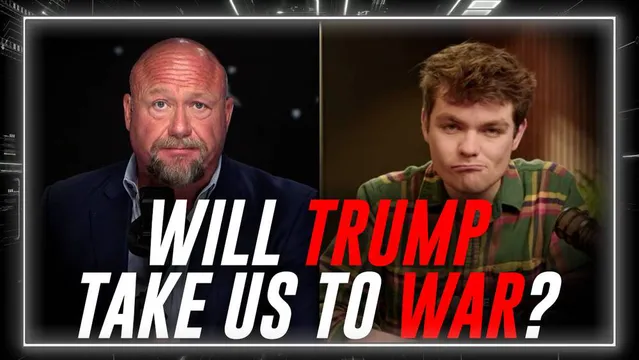
FULL MUST-WATCH INTERVIEW: Nick Fuentes & Alex Jones Debate / Wargame Trump's Plan To Officially Go To War With Iran
1:27:45 - 1:32:34

FULL MUST-WATCH INTERVIEW: Nick Fuentes & Alex Jones Debate / Wargame Trump's Plan To Officially Go To War With Iran

Pakistan Nuclear Wildcard and AIPAC Influence on U.S. Policy

A retired Marine Corps Colonel identifies Pakistan as the critical "wildcard" in the Iran conflict due to its ballistic missiles and nuclear arsenal. The Colonel expresses resentment toward the influence of AIPAC on U.S. lawmakers, arguing that foreign lobbying groups prioritize external interests over American well-being. The segment warns that a kinetic war involving Iran could quickly draw in Pakistan and China, leading to a global catastrophe.

Iran has launched up to 300 missiles daily into Israeli cities including Haifa and Tel Aviv, causing significant damage and casualties. President Donald Trump has called for Iranian capitulation regarding their nuclear program, while Prime Minister Netanyahu advocates for regime change. Military war games suggest a high probability of a nuclear conflict if the Iranian regime faces total collapse, potentially triggering a "Samson Option" involving atomic strikes.

President Trump discusses his recent diplomatic successes in Saudi Arabia, Qatar, and the UAE, claiming the US is now the "hottest country" in the world. He credits his administration with stopping a potential nuclear disaster between India and Pakistan through trade negotiations. Trump also highlights the rapid defeat of ISIS and his "peace through strength" military philosophy.

The Likud party in Israel is accused of attempting to control U.S. foreign policy and pushing for a conflict that could trigger a nuclear exchange between India and Pakistan. European leaders Emmanuel Macron and Keir Starmer are dismissed as "insectoid bureaucrats" and "cokeheads" who are insulated from the consequences of their pro-war policies. A global economic meltdown is predicted if these regional tensions escalate into a full-scale nuclear disaster.

India and Pakistan have officially entered a state of war following a series of military escalations in the disputed Kashmir region. Military analysts identify this conflict as the primary global nuclear trigger, surpassing previous threats in Russia and North Korea. Pakistan continues to fund Islamic proxy networks while China remains militarily aligned with Pakistan against the nationalist government of Prime Minister Narendra Modi.

Analysts identify the India-Pakistan border as a primary flashpoint for nuclear conflict, exacerbated by China's alliance with Pakistan. Prime Minister Modi has reportedly authorized generals to use all necessary force, including nuclear options, in response to threats.

Jones reports on escalating tensions between India and Pakistan, noting that PM Narendra Modi has given the military a "free hand" to choose targets and fire at will. Pakistan claims to have credible intelligence of an imminent Indian attack within 24 to 36 hours. Jones warns that this region is the most likely flashpoint for a nuclear conflict due to historical religious and territorial disputes in Kashmir.

Geopolitical tensions between India and Pakistan have escalated to critical levels following a deadly attack in Kashmir, with both nations issuing public threats of nuclear strikes. Russia has officially confirmed the presence of North Korean troops fighting in Ukraine, a development characterized as a definitive step toward World War III. Meanwhile, domestic political friction in the United States intensifies as members of Congress and governors call for aggressive civil destabilization heading into the summer of 2025.

Secretary of State Antony Blinken and National Security Advisor Jake Sullivan have reportedly briefed President-elect Donald Trump on potential nuclear threats from Iran and Pakistan. Claims are made that the lame-duck Biden administration is stoking fears of a nuclear sneak attack to create a geopolitical disaster for the incoming administration. The segment also notes Trump's increased security measures and "bunkering down" following multiple assassination attempts.